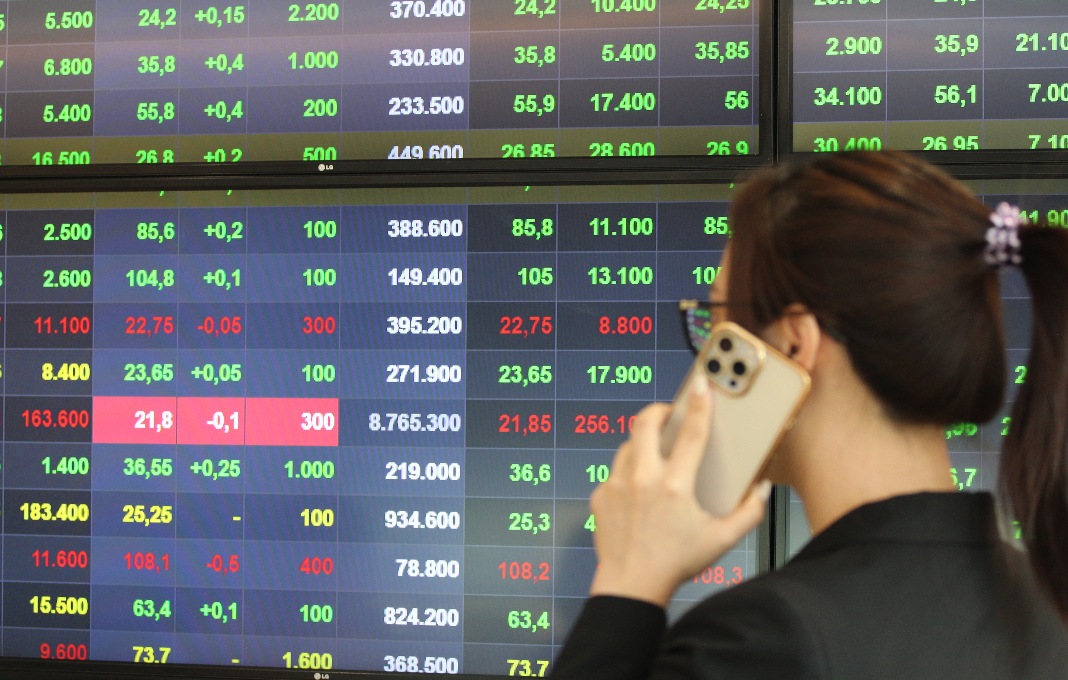
The notable improvement in stock market liquidity brings a positive outlook. Money is flowing back into securities.
Correction pressure
Recent times have seen the stock market under significant correction pressure. Concerns arise from the potential negative impact of soaring exchange rates on monetary policy, coupled with the influence of the Chinese real estate market due to Evergrande Group's bankruptcy protection filing in the U.S. On August 18, the VN-Index plummeted by 55 points during the trading session, with over 1.58 billion shares traded on the HOSE alone. Subsequently, on August 22, the index temporarily lost over 30 points, dropping below the 1,150-point threshold before recovering its balance.
Although the VN-Index returned to the 1,200-point mark during the trading session on August 28, the market is still grappling. As anticipated, the stock market entered a correction phase in the latter part of August, a short-term phenomenon according to analysts, as the medium- and long-term trajectory remains positive.
Dragon Capital predicts an imminent end to the correction phase, indicating that exiting the market at this juncture might lead to re-entry at a higher price, considering the history of similar downturns. The institution notes that the central bank and the Government have conveyed a clear message about monetary policy, emphasizing decreasing interest rates and increasing credit supply. Consequently, minor fluctuations in the exchange rate should have minimal impact on monetary policy trends.
PYN Elite anticipates that savings deposited in banks for 12 months at the end of 2022 will transition into higher-return investment channels, like the stock market, when they mature at the year's end. The Finnish investment fund projects further recovery in Vietnam's stock index this autumn, with 2024 poised for impressive market growth. With the P/S (price-to-sales) ratio falling below 1.2 due to forecasted revenue growth in 2024, the current stock market valuation appears attractive.
Despite the prevailing shortage of information, the increasingly improved market liquidity brings positivity. This trend indicates energetic money circulation, drawing investment back into securities. As deposit rates continue to decrease and savings approach maturity, potential future corrections may provide an opportunity for these available funds.
Outlook for securities firms
Securities firms are poised to reap benefits from the current market landscape, as their business performance in the latter half of the year is projected to show substantial improvements. The surge in average trading volume on the HOSE, surging from 500-600 million shares per session in previous months to 750-850 million shares currently, and even reaching one billion shares in specific sessions, translates to a significant increase in transaction charges for securities firms.
The recent notable decline in interest rates not only encourages cash flows to shift into the stock market, as previously mentioned, but also offers favorable conditions for securities companies to tap into alternative capital sources at a reduced cost. This has bolstered their financial resources, enabling them to lower margin lending rates. Consequently, margin lending at securities companies has become more vibrant, with transactions occurring more frequently.
Projections indicate that total margin lending across the entire market could reach VND155-180 trillion in the second half of 2023, a 10-30% increase compared to the VND140 trillion figure at the close of the second quarter of this year, according to analysis by VNDirect Securities Corporation.
As of the end of the second quarter of 2023, the combined total equity of the 30 securities companies amounted to approximately VND183 trillion. This results in a margin lending-to-equity ratio of 0.85-1 within this sector.
Looking at the medium and long terms, with fiscal and monetary policies set to remain expansionary in support of the economy, the stock market would continue benefiting. An additional crucial catalyst for the securities companies group is the imminent launch of the new KRX trading system, expected to inject vibrancy and strength into transactions.
As per the plans of the contractor KRX, the Vietnamese party will undertake the final acceptance test (FAT) in November, with all preparations expected to conclude by the end of December, paving the way for system deployment. The new system is anticipated to enhance the capacity of Vietnam's stock market, boosting liquidity (up to US$4 billion per session), shortening settlement times from the current T+2.5, thereby enhancing capital turnover rates and fulfilling the criteria for an upgrade to an emerging market.
VNDirect also highlights that investor interest has been relatively subdued in stocks of securities companies, resulting in the sector's valuation resting at a P/B (price-to-book) ratio of 1.6. This is notably lower than the industry average of the past three years.
Consequently, the securities sector stands as a prominent representative of the stock market's resurgence. Brokerage companies, armed with the advantage of retail investors and a high level of digitization, are poised to be the primary beneficiaries of the substantial cash flows entering the stock market. Key players include SSI, VND, and MBS.
Indeed, securities company stocks have swiftly responded in recent trading sessions. Following the significant decline observed on August 18, stocks of securities firms have displayed among the most robust recoveries. Specifically, within five sessions from August 22 to 28, the prices of such stocks recouped 10% of their value.