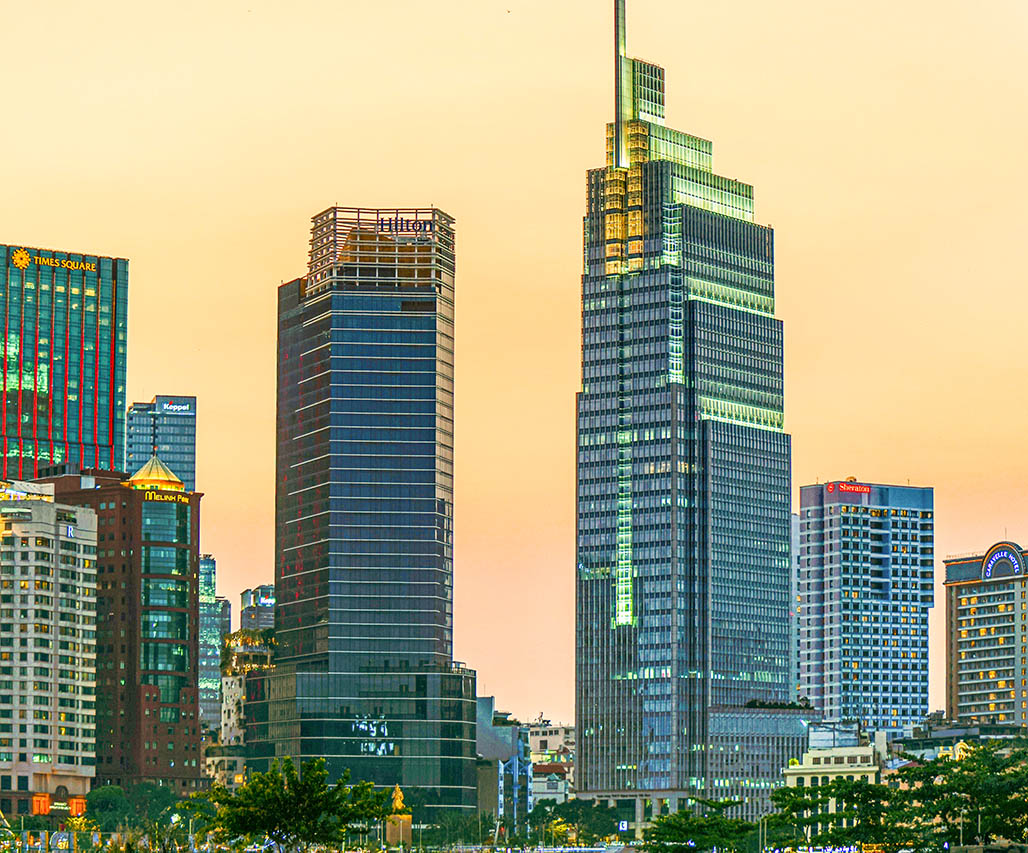
Vietnam’s real estate market showed signs of improvement in the third quarter of this year.
Prominent trends
A recent report by CBRE Vietnam showed that in Q3, the retail market became more vibrant, with new projects launched nationwide. Meanwhile, the industrial market continued to witness positive movements.
The introduction of new buildings created a major push for Vietnam’s real estate market. In Hanoi, Lotte Group has opened Lotte Mall West Lake Hanoi with a net leasable area of 72,000 square meters—one of the largest shopping malls in Hanoi. In HCMC, Hung Vuong Plaza reopened following its refurbishment. These shopping malls have been almost entirely occupied and have received positive consumer reviews, according to analysts at CBRE.
Retail developers such as Central Group and Aeon Mall have expanded their operations nationwide, not only in Hanoi and HCMC. In particular, Central Retail launched a new furniture brand in the central coastal province of Quang Nam and the southern province of Dong Nai. Aeon established a new “Super Supermarket” in Binh Duong, another southern province, while Aeon Mall Hue in Thua Thien Hue, another central province, is set to open in 2024 with a gross area of about 138,000 square meters, the first of its type in the region.
Regarding the industrial real estate sector, the upbeat trend looked the same. In northern Vietnam, the average occupancy rate of industrial parks in the Tier 1 market reached 80.2% in Q3, down 2.4 percentage points compared to the second quarter and up 0.4 percentage point year-on-year.
The decrease in the occupancy rate over quarters was attributed to new industrial parks being inaugurated in Bac Ninh and Hung Yen provinces, causing the total supply of industrial land to increase by 597 hectares. Regarding the demand, the market recorded large transactions from tenants producing plastics, textiles, and contact lenses in many provinces and cities.
In the northern provinces, the average rental rate for the Tier 1 market, or developed industrial capital, in the third quarter, hit US$131 per square meter for the remaining term, up 2% quarter-on-quarter and 12% year-on-year.
In the southern provinces, the average occupancy rate of industrial parks in the Tier 1 market was 81.9%, while the average rental rate of industrial land reached US$189 per square meter for the remaining term, up by 1% quarter-on-quarter and 13% against the same period last year. The market saw significant transactions from Chinese and Japanese manufacturers from various industries, such as mechanical engineering, chemicals, plastics, rubber, and electronics.
Insights from key markets
Experts at CBRE stated that the retail real estate market continued to enjoy good rental growth thanks to stable demand and limited new supply in Hanoi and HCMC, two of the top cities in the Asia-Pacific region with the highest central business district (CBD) rental growth.
In Q3, the asking rent for the ground floor in the CBD area in Hanoi remained at the same level as in Q2, at around US$162 per square meter per month. HCMC’s rent reached more than US$200 – US$350 per square meter per month. It is worth noting that there is no vacant retail space in the CBD areas of both cities.
In the non-CBD area, Hanoi saw a rental rate of more than US$28 per square meter per month, up by 5% year-on-year. In HCMC, the similar rate was US$48.5 per square meter, a staggering 20% increase over the same period in 2022. The average occupancy rate in Hanoi reached 87%, while it was 91.5% compared to that of HCMC.
Thanh Pham, associate director of CBRE Vietnam’s Research and Consulting Department, said, “The consumer market is facing some challenges in the short term, but categories like food and beverages, entertainment, and fast fashion still recorded continuous growth.”
Pham noted that the introduction and expansion of brands increased sharply compared to last year. “Shopping centers will reinvent themselves as mixed-use destinations with a range of entertainment, educational, and healthcare facilities, focusing on the customer experience, as this is the fundamental factor determining the shopping center’s success,” she added.
In HCMC, the majority of large realty transactions in Q3 were from new buildings completed since 2020, which are of good quality and have sufficient vacant space to lease. The majority of transactions recorded by CBRE Vietnam were for relocation and renewal leasing purposes, at 80% of the total transacted area. Experts believed that pharmaceuticals and flexible workspace were two primary sectors that contributed to the expansion transactions as they have not been heavily affected by economic challenges at home and abroad.
Meanwhile, the number of new condominium supplies in HCMC in Q3 was about 3,600 new units, accounting for a staggering 90% of the total new supply in the first six months of 2023. Notably, 96% of new supply during this period was from the high-end segment, while the remaining 4% was in the luxury segment, developed under the next phase of a project in Thu Thiem New Urban Area.
According to CBRE condominium ranking criteria, luxury projects have primary prices of US$4,000-US$12,000 per square meter, while primary prices of high-end projects range from US$2,000 to US$4,000 per square meter.
The primary price in Q3 of HCMC’s condominium market was VND60.6 million, or US$2,500, per square meter. This figure rose by 1.9% year-on-year, mainly driven by the price increase of new supply in luxury and high-end segments.
Prospects ahead
In the next two years, industrial land rents are expected to increase by 6-10% per year in the northern and southern regions, according to CBRE. In light of this, growing demand from various sectors may drive rental growth in many provinces and cities. To a certain extent, the flourishing trajectory in Vietnam’s relations with its comprehensive strategic partners such as the U.S., South Korea and China, particularly with economic cooperation, can provide momentum for Vietnam’s industrial real estate market in the future, as noted by analysts.
An Nguyen, senior director at CBRE Vietnam’s Hanoi Branch, said, “The Vietnam industrial market will further develop in the coming time with expectation for stronger foreign direct investment (FDI) flows, movements, and diversification of FDI enterprises towards more hi-tech industries.”
In addition, she highlighted that the development of green buildings in Vietnam may be spurred given that many corporations and tenants are setting goals for sustainable development and including them as a part of factory location criteria.