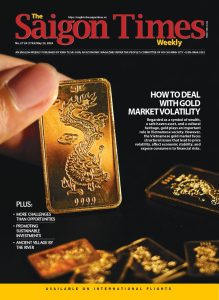
Regarded as a symbol of wealth, a safe haven asset, and a cultural heritage, gold plays an important role in Vietnamese society. However, the Vietnamese gold market faces structural issues that lead to price volatility, affect economic stability, and expose consumers to financial risks. This article attempts to analyze the structural factors of the gold market, identify the drivers behind the recent gold price spikes, and propose five measures to stabilize the market for a more sustainable financial environment.
Structural issues hindering the market
There are several structural factors that lead to the instability of Vietnam’s gold market. These include:
-
Limited investment options: Vietnam’s developing financial system lacks many safe and attractive investment tools. With low trust in the stock market and low bond yields, many Vietnamese turn to gold as a safe haven, especially in times of economic uncertainty.
-
High dependence on physical gold: Unlike developed markets where gold transactions mostly involve derivatives and ETFs, Vietnam heavily relies on physical gold and jewelry. This demand for physical gold piles pressure on domestic gold prices, making them susceptible to global market fluctuations.
-
Fragmented market structure: Vietnam’s gold market lacks a centralized exchange, with numerous small-scale gold shops and dealers operating independently. This fragmentation hinders price transparency and allows for price manipulation.
-
Government intervention: Government efforts to control gold prices through import duties and quotas often have unintended consequences. Such interventions can create artificial shortages, distort market signals, and encourage smuggling.
Factors driving gold price surges in Vietnam
Beyond structural issues, several external factors have caused gold prices to surge in Vietnam:
-
Global gold price movements: The Vietnamese gold market is heavily influenced by global gold prices. When global gold prices rise due to geopolitical tensions or economic instability, domestic prices would promptly follow suit. Recent military conflicts in Ukraine and the Middle East have driven up demand for gold reserves as a precaution. Particularly, China has increased gold reserves due to its trade tensions with the U.S. Domestic instability in China has prompted Chinese to invest in gold to hedge against a potential devaluation of the yuan, sending global gold prices up further. Higher demand has therefore pushed up the global gold price as supply has remained unchanged.
Why do central banks in some countries want to reduce their reliance on U.S. dollar reserves? The reason is quite understandable. Currently, around 65% of the foreign exchange reserves of central banks worldwide are held in U.S. dollars to settle import-export transactions and investments. However, by holding U.S. dollars in their foreign exchange reserves, they become dependent on the price movements of the U.S. dollar and the economic policies of the United States. For instance, when inflation in the U.S. rises due to excessive government spending, the value of these countries’ foreign exchange reserves would fall. Converting these foreign exchange reserves into gold helps these countries avoid this situation.
But why is the gold price in Vietnam significantly higher than the global gold price, even though the Government has instructed the State Bank of Vietnam (SBV) to narrow this gap to stabilize the domestic gold market? The price of SJC-brand gold bars in Vietnam recently soared to a new peak of over VND92 million per tael, which is more than 20% higher than the global gold price. The main reason is that domestic demand far exceeds supply due to Vietnamese people’s habit of holding on to gold to secure their assets and speculate, especially when they see a rising trend in global gold prices. Meanwhile, supply is limited because the SBV maintains its monopoly on the import of raw gold and the production of SJC-brand gold bars.
-
Dollar fluctuations: Since gold is priced in U.S. dollar, the weakening of the Vietnamese dong against the dollar leads to higher domestic gold prices. This creates a feedback loop where rising gold prices further weaken the dong, encouraging more gold purchases as a hedge against inflation.
-
Domestic economic conditions: In times of inflation or economic uncertainty, people rush to buy gold as a safe haven. This increases demand, pushing its prices up.
-
Speculation: The fragmented market structure and limited transparency provide fertile ground for speculation. Rumors, market manipulation by certain players, and herd mentality can amplify price volatility, leading to bubbles and subsequent crashes.
Consequences of a volatile gold market
Price volatility in Vietnam’s gold market has wide-ranging consequences:
-
Erosion of consumer trust: Fluctuating gold prices cause uncertainty and negatively affect long-term investments in productive sectors. Consumers wary of rising gold prices may delay essential purchases or savings plans, hindering economic growth.
-
Macroeconomic instability: Gold price volatility can destabilize the Vietnamese dong. Sudden changes in gold demand impact foreign reserves, restricting the Government’s ability to manage inflation and interest rates.
-
Inequality: High gold prices significantly impact low and middle-income people who rely on gold for savings and use it in customary events like weddings. Rising prices can hinder their ability to save for the future or afford essential purchases.
Five measures for a more stable gold market
To cope with these issues and stabilize Vietnam’s gold market, the following five measures are proposed, with the first two aimed at short-term market stabilization and the latter three at addressing long-term structural issues:
Abolish the monopoly on SJC-brand gold bar production and gold import: Establish a centralized gold trading mechanism where state-owned businesses can compete to import raw gold and produce SJC-standard gold bars in a transparent manner. This would improve price transparency and limit price manipulation.
Combat smuggling: Enhance border control and regional cooperation to curb gold smuggling. Smuggling undermines legal business operations, distorts market prices, and puts national security at risk.
Develop a diverse financial system: In the long run, the Government should prioritize developing safer and more attractive investment options, such as a healthy stock market, higher bond yields, and a robust pension fund system. This would offer alternatives to gold, especially in times of economic uncertainty.
Improve financial literacy: Establish and expand financial literacy programs to help the public make well-informed financial decisions. These programs should educate the public about the risks and benefits of various investments, including gold.
Establish market-based tools: Replace Government intervention with market-based tools like future contracts and gold-backed ETFs. These instruments provide an effective and transparent mechanism to hedge against price volatility. Future contracts are legal agreements to buy or sell a specific commodity or security at a predetermined price at a specified time in the future. Gold-backed ETFs are securities that track the price of gold and allow investors to gain access to gold without buying, storing, or reselling physical gold.
Impact of lifting gold import monopoly on exchange rates
As mentioned, gold prices and the exchange rate influence each other. A rise of the U.S. dollar weakens the Vietnamese dong, encouraging more gold purchases as a hedge against inflation. However, reducing gold prices through the above measures would lower demand for gold and the dollar, stabilizing the exchange rate.
Regarding foreign exchange, companies authorized to import gold must use their own dollars rather than the State Bank of Vietnam’s reserves. Furthermore, avoiding formal imports due to foreign exchange deficit concerns could lead to high demand for dollars on the informal market for gold smuggling, causing foreign currency outflow and impacting the formal market. The State Bank of Vietnam still holds some gold reserves not yet sold due to the recently canceled auctions. Selling this gold, combined with the proposed measures, would reduce gold and dollar demand.
Avoiding goldization
To prevent the economy from being overly dependent on gold, the Government should instill public confidence in the Vietnamese dong through appropriate economic policies. Vietnam is facing significant challenges in various aspects. Therefore, the Government needs a comprehensive program combining macroeconomic, microeconomic, and structural policies to address immediate, medium-term, and long-term challenges.
Conclusion
Vietnam’s gold market challenges require a multipronged approach. By addressing fundamental structural issues, fostering a stronger financial system, and enhancing financial literacy, Vietnam can create a more stable and efficient gold market. This will protect consumers, promote economic stability, and allow Vietnamese people to participate more effectively in a broader range of investment opportunities.
Despite global gold price spikes, no other country has experienced such a price surge as seen in Vietnam. In the U.S., few people invest in physical gold. Americans interested in gold typically buy shares in gold-producing companies or related ETFs. Asian Americans still buy gold from jewelry shops, but there are no big crowds at those shops as seen in Vietnam. In summary, there is no gold rush in the U.S. or Europe similar to that reported in Vietnamese media.