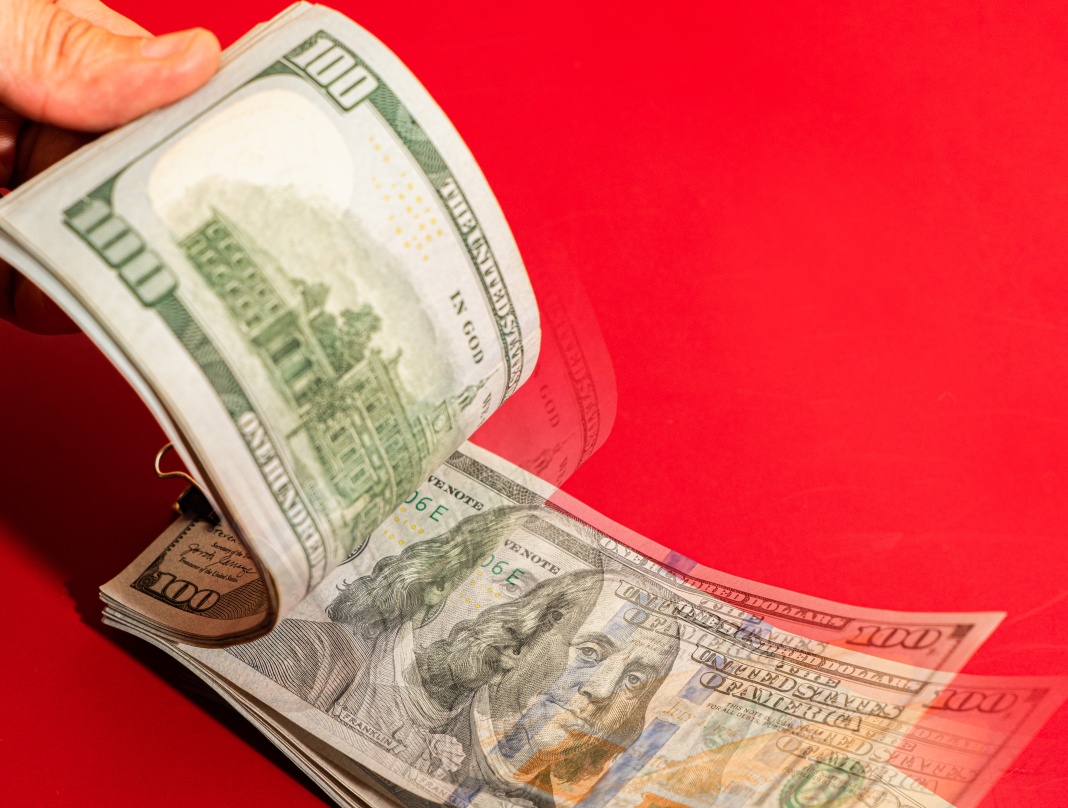
In response to the fall of domestic currencies, central banks in the region have two options. They can either sell foreign currency to intervene or raise interest rates. The State Bank of Vietnam (SBV) is flexibly using both.
Focusing on exchange rate
As of May 27, 2024, the central exchange rate between the Vietnam dong and the U.S. dollar had increased by VND22 against late April. Given that the dong fell by a total of VND243 against the dollar in April, the depreciation of the local currency slowed in May. The dollar price at Vietcombank, the country’s leading foreign trade bank, increased by VND638 in April for both buying and selling, but since early May, it has risen by a mere VND163 for buying and VND23 for selling compared to the previous month. On the informal market, the dollar has advanced by VND65 for buying and stayed almost unchanged for selling since early May, compared to a respective increase of VND275 and VND300 in April.
The SBV effort to increase dollar supply to regulate the foreign exchange market is seen as a key factor for stabilizing the exchange rate over the past month. Some sources said that from April 22 to May 24, 2024, the amount of dollars the SBV sold to commercial banks exceeded US$3.5 billion.
Due to an imbalance in foreign currency supply and demand, the SBV’s moves have produced immediate positive results and left positive impact on the market sentiment. However, recent data from the General Department of Vietnam Customs showed that in the first half of May, the country ran a trade deficit (of US$2.6 billion). The strong economic recovery has led to higher demand for importing raw materials for local production, which requires importers to buy foreign currency to pay for their import bills. Thus, the exchange rate is still under pressure.
Commercial banks have persistently quoted the dollar selling price at the upper limit. As of May 27, with the central exchange rate quoted at VND24,268 per dollar, and a trading band of 5% on either side of the central exchange rate, the ceiling rate is VND25,481, which is also the selling price posted by Vietcombank that day.
In the past, Vietcombank’s dollar selling price was often VND400-500 lower than the cap, sometimes over VND1,000 lower. The current zero gap is noteworthy. The last time this gap was that low was November 2022, when a liquidity crunch hit various markets. Possibly because the selling price has hit the ceiling, Vietcombank’s selling price has only inched up by a fractional VND23 since early May.
Last week, there was a rumor about the possibility of the dong-dollar exchange rate band being widened. However, the Monetary Policy Department of the SBV was quick to deny it, stating: “With the current central exchange rate mechanism and the 5% trading band, the rate has enough room to move.” A recent rumor about the SBV’s exchange rate policy change is inaccurate and not in line with the Government’s goal of market control and macroeconomic stability, the department said, adding businesses and individuals need to exercise caution over such rumors.
Another measure for underpinning the foreign exchange market that the SBV has taken recently is raising the coupon rate for Treasury bills and the refinancing rate via open market operations (OMO). Analysts suggest that this policy might help the SBV avoid hiking policy rates immediately while keeping interbank market rates high, limiting speculation on foreign currency using idle funds of credit institutions.
On May 22, the SBV raised the coupon for Treasury bills by 10 basis points to 4% per year, and the OMO rate also rose by 25 basis points to 4.5% per year. The next day, the SBV continued to hike the Treasury bill rate by 20 basis points to 4.2% per year. From 1.4% per year when the SBV resuming issuing Treasury bills on March 11, 2024, the rate has picked up sharply.
Is Vietnam dong liquidity under pressure?
In response to the fall of domestic currencies, central banks in the region have two options. They can either sell foreign currency, just as the Bank of Japan recently did, or raise interest rates to prop up their domestic currencies, like the Bank of Indonesia. The SBV are flexibly using both tools, especially as the U.S. dollar may remain high in the international market, with the U.S. Federal Reserve (Fed) still keeping interest rates high.
Recently, David Solomon, CEO of Goldman Sachs, predicted that the Fed would not cut rates in 2024. In April this year, Goldman Sachs economists forecast two rate cuts this year, with the first in July and the second in November.
The rise in OMO rates leading to higher interbank rates also indicates that liquidity in the banking system is not as abundant as before. Following the SBV’s OMO market movements, the overnight interbank rate surged to 5.1% per year on May 23, up by 55 basis points (bps) from the previous day. The one-week, two-week, and one-month terms also rose by 57 bps, 47 bps, and 55 bps, to 5.27%, 5.02%, and 5.42%, respectively.
Moreover, the increase in OMO rates was accompanied by sustained high borrowing volumes from credit institutions via this short-term funding channel. On May 22, all the nine participants won bids for VND25 trillion; on May 23, all the eight participants won a record of over VND43.06 trillion; and on May 24, all the seven participants won nearly VND27.02 trillion.

In just three days, net injections through the Treasury bill and OMO channels amounted to VND96.43 trillion. Notably, along with the OMO rate hike, the loan term also increased from seven to 14 days from May 23, indicating a longer liquidity support need.
From early May to May 24, the SBV was still withdrawing a net amount of almost VND18.63 trillion. But since March 11 this year, the central bank has net injected VND32.83 trillion through the Treasury bill and OMO channels. However, this net injection is insignificant compared to the amount of Vietnam dong absorbed through foreign currency and gold sales by the SBV.
Specifically, with US$3.5 billion sold at the rate of VND25,450, the estimated amount the SBV withdrew from the system is over VND89 trillion. Additionally, as of May 24, the SBV had sold 48,500 taels of SJC gold bars to stabilize the market. With winning bids ranging from VND81.3 million to VND89.4 million per tael, the estimated amount the SBV collected from gold auctions is about VND4.2 trillion. Therefore, the total amount of Vietnamese dong withdrawn through these two channels is VND93.2 trillion.
The Vietnam dong liquidity pressure is gradually increasing in the system, potentially driving up interest rates in other markets. Coupled with recent Treasury bill and OMO rate hikes, is the SBV prioritizing exchange rates over interest rates in the short term?