Just two leading Vietnamese logistics companies are able to compete with their foreign peers in Vietnam. While one operates more quietly, the other is ambitiously aiming to go beyond “end-point delivery” and fully integrate into the modern logistics supply chain.
According to GII Global Information, Vietnam’s cargo transport and logistics market is estimated to reach US$43.38 billion this year, with projections to grow to US$65.34 billion by 2029, reflecting a compound annual growth rate (CAGR) of 6.19% in the 2024-2029 period. In the fast mail and parcel delivery sector alone, the market is valued at VND58.9 trillion (about US$2.45 billion), according to data from Viet Data.
Despite the presence of over 3,000 logistics and transport companies in Vietnam, the market is dominated by global giants such as DHL, FedEx and Maersk, which collectively make up three-fourths of the sector’s revenue. In the ocean shipping segment, only a few domestic companies, like Vinalines and PV Trans, are able to compete with foreign players. In logistics, VNPost and Viettel Post remain the key Vietnamese competitors.
Facing tough logistics competition
The logistics sector in Vietnam offers significant opportunities for both investors and businesses, according to a report by Hong Kong law firm Dezan Shira & Associates, which has an office in HCMC. The report identifies five key segments within the logistics industry:
1. Warehousing and distribution system: This includes transportation, warehouse management, cold storage chains, and customs procedure facilities.
2. Software solutions: Many Vietnamese warehousing systems and distribution centers lack advanced software solutions such as Warehouse Management Systems (WMS) and Transport Management Systems (TMS). These systems are essential for automating order fulfillment, material handling, and optimizing the delivery process.
3. Learning resources: A well-developed logistics network requires a skilled workforce. This presents an opportunity for Vietnamese universities to offer logistics programs.
4. Delivery of perishable goods: This includes the logistics of handling food, pharmaceuticals, and vaccines, which require specialized solutions.
5. End-point delivery: This involves the delivery of mail, parcels and goods, a segment which many Vietnamese logistics businesses are currently focusing on.
Despite these opportunities, most Vietnamese logistics companies tend to center on a few of these segments, particularly end-point delivery, which requires relatively low investment and generates profit through the sale of services. However, this leaves them competing primarily with giants like VNPost, Viettel Post and foreign unicorns such as J&T Express, Best Express and Ninja Van, which have established a strong presence in the market.
Some domestic startups, such as Giao Hang Tiet Kiem (low-cost delivery), Nhat Tin Logistics, and GHN (Fast Delivery), have entered the market but have been facing challenges in terms of network expansion, technology adoption, and securing continuous funding from investors. To scale quickly and extensively, these logistics technology startups must make significant investments and be prepared to rack up losses for several years to secure a market share.
Ambitions of Vietnamese businesses
VNPost and Viettel Post stand as Vietnam’s main contenders in the competitive logistics market, facing off against foreign logistics unicorns.
VNPost has the largest system of post offices in Vietnam, which was largely inherited from the Vietnam Post and Telecommunications Corporation (VNPT). According to VNPost’s 2019 data, the company had over 13,000 service points, including various levels of post offices, village offices, postal agents, kiosks, and public mailboxes. Each transaction point can serve an average of 7,000 customers. An independent report indicated that by early 2024, VNPost had increased its number of service points to 19,000.
Despite its vast network and nearly 50,000 staff, including 18,000 postmen, VNPost is concerned about maintaining its No. 1 position amid the rapid growth of Viettel Post and competition from foreign rivals entering the Vietnamese market.
Viettel Post, on the other hand, has a significant advantage in resources and an extensive network, operating over 2,200 post offices and stores, 6,000 goods collection agents, six operation centers, and 1,000 satellite warehouses across the country’s 63 provinces and centrally run cities. The company also set up a presence in Cambodia and Myanmar and now employs around 22,000 people.
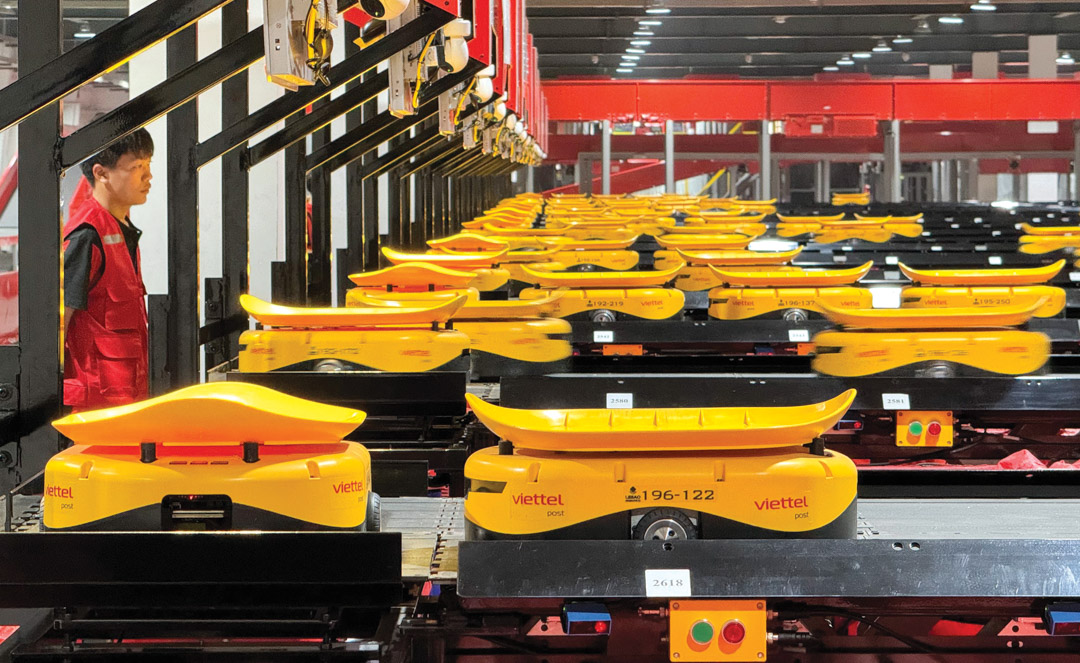
In January 2024, Viettel Post launched Vietnam’s first smart separation and sorting center at Quang Minh Industrial Zone in Hanoi. The center uses Automated Guided Vehicles (AGVs) for fully automated goods separation and sorting, boosting operational efficiency by 3.5 times, reducing delivery time by 8-10 hours, and cutting personnel costs by 60%.
With the investment in this system, Viettel Post said it can handle four million orders per day, representing 50% of the volume of e-commerce in Vietnam. The general director of Viettel Post, Hoang Trung Thanh, said: “The new technology will open up the new future for Viettel Post.”
In an interview with the press, Thanh did not hide the ambition that Viettel Post not only performs “end-point delivery” but also engages in all areas of the logistics supply chain in Vietnam, that is all the five areas mentioned above by Dezan Shira & Associates.
“They are the logistics park, smart border gates, cross-border logistics facilities and international rail transport,” Thanh said. He also mentioned the “dark industry” or “dark factory” supply chain, which are warehouses fully operated by robots in darkness with no light and so no energy consumption.
Viettel Post has quickly realized its dream of “in the dark”. In March 2024, it proposed mapping out the national strategy for green and smart logistics infrastructure with 37 major logistics centers across the country. In a working session with authorities of Binh Duong Province, the company suggested establishing an international agriculture logistics center with exhibition booths, post-harvest preservation warehouse, customs clearance area and standard inspection area for exports to Southeast Asia and China.
In a working session with the government of Nanning City, China in April, Viettel Post proposed development of international rail transport service invested by Viettel and customs clearance inspection at 30 centers in Vietnam.
Foreign unicorns enter the market
J&T Express, a unicorn startup from Indonesia, entered the Vietnamese market in 2018 and has since become the largest foreign logistics network in the country, with over 1,900 post offices across the nation’s 63 provinces and centrally run cities and a workforce of 19,000. In 2023, the company reduced parcel delivery time in Southeast Asia by 6.5% compared to the previous year.
Phan Binh, brand director of J&T Express Vietnam, highlighted the company’s significant investment in a 60,000-square-meter transshipment center in Cu Chi District, HCMC, in mid-2022, making it the largest facility of its kind at the time. The center boasts an automated system powered by AI, achieving an impressive classification accuracy rate of 99.9%. This system also stores coded information and goods images to ensure safety, security, and seamless control.

Nguyen Thi Phuong, J&T Express’ communications representative, told The Saigon Times that the company plans further investment by year-end in a large, modern operational center in northern Vietnam. The facility will feature cutting-edge technologies such as the “smart wheel drive,” the DWS (dimension weighing and scanning) system, a matrix system for automatic goods classification, and a three-level cross-belt system. The gray scale cameras and sensors will allow for automatic packaging stops once full. These innovations, with a 99.9% accuracy rate, are expected to boost performance tenfold and process parcels within 4-5 minutes.
Similarly, the Chinese logistics unicorn BEST Express entered Vietnam around the same time as J&T Express. The company now operates over 650 post offices and 35 sorting centers, with a total daily handling capacity of 2.2 million orders. Sorting times range from 0.5 to 2 seconds, depending on parcel size and weight, according to Eric Liang, deputy general director of BEST Global and general director of BEST Express Vietnam.
Liang noted that BEST Express is a key transport partner for most e-commerce platforms in Vietnam. The delivery time between Hanoi and HCMC has been reduced to 43 hours (less than two days), and in some cases, expedited delivery can be achieved within 12 hours at a higher fee.