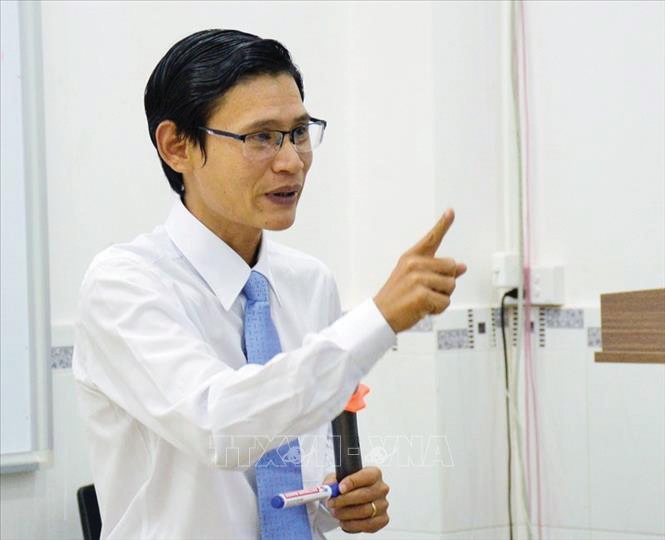
“Vietnam should adopt a new mindset in foreign direct investment (FDI) attraction, which shifts away from offering incentives to providing support, with a focus on key priorities and targeted objectives for the economy,” said Dr. Huynh Thanh Dien at Nguyen Tat Thanh University in an interview with The Saigon Times.
The challenge post-global minimum tax
The Saigon Times: In the impact assessment report on the draft of a Government decree on establishment and management of the Investment Support Fund, the Ministry of Planning and Investment said that many large FDI firms have explored the investment environment in Vietnam but have finally chosen other countries. According to the ministry, they have asked for direct financial support, but Vietnam currently has no relevant regulations. What do you think?
Dr. Huynh Thanh Dien: When FDI companies invest in a developing country like Vietnam, their primary goal is to produce goods at the lowest cost possible and export them globally as smoothly as possible. Hence, they choose countries that either offer good support and incentives, mainly taxes; have favorable production conditions including infrastructure like roads and ports; have a young and inexpensive workforce that can adapt well to new technology; or have a liberal environment for importing raw materials and exporting goods.
With the global minimum tax proposed by the Organization for Economic Cooperation and Development (OECD) and endorsed by many countries, FDI-reliant economies are compelled to find alternative measures to replace their current tax incentive systems. Direct financial support has been extended or studied by many countries but is usually executed through support for factory costs, machinery, equipment, technology, and research and development, instead of direct financial aid for businesses.
Thus, the information that FDI companies are requesting direct financial support needs to be disclosed in detail and thoroughly analyzed to find the best support method for foreign investors in Vietnam, and to identify and address weaknesses in the country’s investment environment. We must consider the possibility that businesses might perceive the investment environment as still unfavorable and thus pose a difficult request as an excuse not to invest or expand.
Many believe that with Vietnam officially collecting the global minimum tax from large corporations from January 1, 2024, we need to consider incentive compensation to ensure the investment environment is still attractive. What is your view?
- FDI businesses in Vietnam have enjoyed very high corporate income tax incentives for extended periods without transparency. In the past, some provinces and cities had their own policies when it came to competing for FDI. For example, Binh Duong Province offered tax exemptions for up to five years from the first profitable year. By the end of 2023, after 35 years of receiving FDI, Vietnam had attracted over US$438 billion from foreign investors.
However, focusing solely on tax incentives over the decades has resulted in significant inequality within the business community. Domestic businesses are subject to a corporate income tax of 20%, which is much higher than the rate for FDI companies. They also face heavier non-tax expenses, such as contributions and environmental costs. The Ministry of Finance estimates that with the global minimum tax in place, 112 foreign corporations might have to pay more in 2024, contributing over VND14,000 billion to the State budget.
Non-selective tax incentives have also led to uneven investment quality from FDI enterprises in Vietnam, including projects with outdated technology rejected by many countries, posing the risk of technological backwardness.
Initially, as we opened up our economy for integration and had to build our business, human resource, and technology foundations from scratch, we resorted to tax incentives to attract FDI. Currently, the economy has advanced, and we can’t use tax incentives due to the global minimum tax. Therefore, Vietnam should adopt a new mindset in FDI attraction, which shifts away from offering incentives to providing support, with a focus on key priorities and targeted objectives for the economy.
Identifying weaknesses
What is the most important aspect that foreign investors expect from Vietnam’s investment environment today, and to what extent can we meet these expectations? Given Vietnam’s current conditions, what type of support should we offer?
- We have many advantages. Vietnam is among the world’s fastest-growing economies and is located in the Indo-Pacific region, predicted to be the center of global economic development. Amid the fierce and unpredictable geopolitical and economic competition, political stability and friendly relations with all nations make Vietnam an attractive investment destination.
Secondly, our economy is highly integrated globally. As of May 2024, Vietnam has got involved in a total of 19 free trade agreements (FTAs), with 16 of them already signed and three under negotiation with economic regions in the Americas, Europe, East Asia, etc.
Thirdly, Vietnam is striving to improve business transparency and investor confidence.
However, the fourth and most crucial point is the long-standing weakness of Vietnam’s economy: production conditions. When FDI enterprises set up shop in Vietnam, they will definitely need a supportive ecosystem for their production.
Normally, an FDI enterprise producing an item in Vietnam will need partners in supporting industries to produce things like packaging, manuals, components and accessories. I have interacted with several FDI companies active in HCMC, and asked why they don’t support local enterprises. They said they were ready to cooperate because local parts were cheaper than foreign-made parts, but local enterprises are not yet capable of meeting their requirements. Clearly, after more than 35 years of rolling out the red carpet, the number of Vietnamese businesses eligible to participate in the FDI sector’s supply chains remains small.
Additionally, an FDI enterprise needs to connect with service providers for smooth and efficient operations, such as industrial catering, office supplies, tax services, legal support, etc. Even in this aspect, Vietnamese businesses do not fully meet the demand. This leads to the situation where many provinces have industrial zones but few could have attracted enough enterprises to fill them up. Or to ensure their industrial zones are fully occupied, provinces offer extremely high tax incentives as mentioned earlier.
For shared services for both FDI and domestic enterprises, it’s undeniable that Vietnam has actively invested in infrastructure, such as roads, warehouses, ports and airports. The existing issue is scattered investment and short-term vision. For instance, some expressways with only two lanes cannot meet future freight transport demand, and aviation still inadequately serves passenger transport, let alone cargo freight.
Notably, with public-private partnership for shared infrastructure, we mainly choose BOT (build-operate-transfer), giving rise to a myriad of road toll stations, which makes Vietnam’s logistics costs the least competitive in the region and the world.
It is apparent that we cannot use tax advantages to attract FDI. So, what is the alternative? Vietnam still has plenty of land for well-planned and connected economic and industrial zones. We can improve investment promotion efforts, using policies, infrastructure, human resources, and the dynamism of management agencies to enhance the investment environment’s attractiveness.
A different approach to FDI attraction policy
Many believe that adjusting FDI incentive policies as a result of the global minimum tax also presents an opportunity for Vietnam to adjust its overall FDI attraction strategy. What should we do according to this mindset?
- FDI attraction should be placed within the overall context of the economy. Vietnam needs a comprehensive economic development strategy to identify comparative advantages and prioritize sectors where we have the strongest advantages, while also finding potential sectors to encourage investment, such as semiconductors and renewable energy.
Once we’ve identified priority sectors, we must analyze their relationship with direct supporting industries and the overall support ecosystem. For example, developing semiconductor technology requires photolithography machines, semiconductor materials, R&D centers for circuit design, new materials, etc. High-tech parks for semiconductor development should be located in major cities with adequate infrastructure for electricity, water, and accompanying services.
From there, we propose a general development plan, identifying which sectors should develop in which localities, and determining the necessary infrastructure support to create a comprehensive ecosystem that facilitates smooth and efficient business operations.
Identifying priority sectors for investment is also a premise for Vietnam to selectively attract FDI and design policies that align with these objectives. For high-tech sectors and green transitions where domestic enterprises lack technology and resources, we need to invite FDI enterprises. Simultaneously, we should support domestic enterprises to participate in supply chains, gradually absorbing and learning the technology. For sectors where Vietnamese enterprises can already compete, we should maximize support for the domestic private sector. FDI attraction policies and criteria should be based on this foundation.
In reality, tax incentives are not necessarily the primary concern for FDI enterprises. They are multinational corporations that can easily handle technical maneuvers to pay taxes in countries or territories seen as tax havens. They care more about a convenient and transparent business environment and a comprehensive support ecosystem that help them lower production costs. That is the critical aspect to focus on now.
China and South Korea have successfully utilized FDI. What can we learn from them?
- In the past, when South Korea attracted FDI to promote industrialization, they offered significant support and incentives but required FDI companies to use inputs or parts produced by South Korean firms. As FDI companies grew, South Korea’s domestic business ecosystem also expanded.
Vietnam can’t exactly follow South Korea’s model because we’ve committed to equal treatment in trade between domestic and foreign enterprises. However, we must find a way to create maximum conditions for domestic enterprises to produce and supply services for FDI enterprises through support programs proposed by Vietnamese ministries and agencies.
Regarding China, from 1978 to 2001, they focused on attracting export-oriented FDI companies, primarily in labor-intensive manufacturing, while restricting FDI access to the domestic market. After 2001, when Chinese enterprises had gained experience and improved production levels, China allowed joint ventures with FDI firms and opened the domestic market to Chinese-foreign joint ventures, enabling domestic enterprises to access advanced technology.
The wave of FDI enterprises leaving the Chinese market is partly due to the repercussions of the U.S.-China trade war, and partly because the nation with a population of more than one billion no longer encourages FDI in sectors where Chinese companies are already strong.
For Vietnam, changes in thinking and policy to attract FDI are also a way to make large multinational companies stay. Only when the supporting ecosystem for FDI producers is well organized and deeply rooted in Vietnam, will FDI enterprises be compelled to maintain a long-term commitment with us.