The decision to merge Binh Duong and Ba Ria-Vung Tau provinces into HCMC to form an economic supercenter for Vietnam reflects a bold and visionary move by the nation’s leaders
For HCMC to truly thrive, realize its full potential, and fulfill its role as a leading force, it must adopt a long-term, ambitious, and feasible strategic vision. This vision must transcend administrative boundaries and firmly position HCMC at the heart of the national economic development strategy. To this end, this article proposes the “One Center – Three Corridors” vision as a blueprint for HCMC’s future growth.
Positioning HCMC in the national strategy
The goal of transforming Vietnam into a developed, high-income country by 2045 is an ambitious national aspiration. On this journey, HCMC must take a pioneering role, serving as the principal growth engine and the key gateway connecting Vietnam to regional and global economies. In the era of globalization, a nation’s competitiveness is increasingly defined by the strength of its megacities. HCMC has the qualities and potential to stand alongside Asia’s leading urban centers as a formidable competitor.
In a world marked by multipolarity and intense strategic competition, positioning
Vietnam as a dynamic “buffer zone” and a reliable hub connecting major powers and large economies is crucial to the country’s development. HCMC should serve as the focal point of this strategy, emerging as a premier destination for global investment, technology, and high-quality talent — a meeting ground where stakeholders collaborate and conduct major commercial and financial transactions.
HCMC should play a central role in tackling major national challenges, including: (i) positioning Vietnam as a key intermediary in managing economic flows and navigating issues in a polarized world dominated by superpowers; (ii) supporting the development of underperforming regions, such as the Central Highlands and the Mekong Delta; and (iii) strengthening Vietnam’s strategic standing within ASEAN.
The “One Center – Three Corridors” Vision
A 100-year development vision based on the strategic framework of “One Center – Three Corridors” would offer both a practical roadmap and an inspiring direction for HCMC and the nation as a whole. HCMC would serve as the core nucleus — not only economically, but also as a center of culture, science, technology, and innovation.
East Bank of the Saigon River – driving international integration
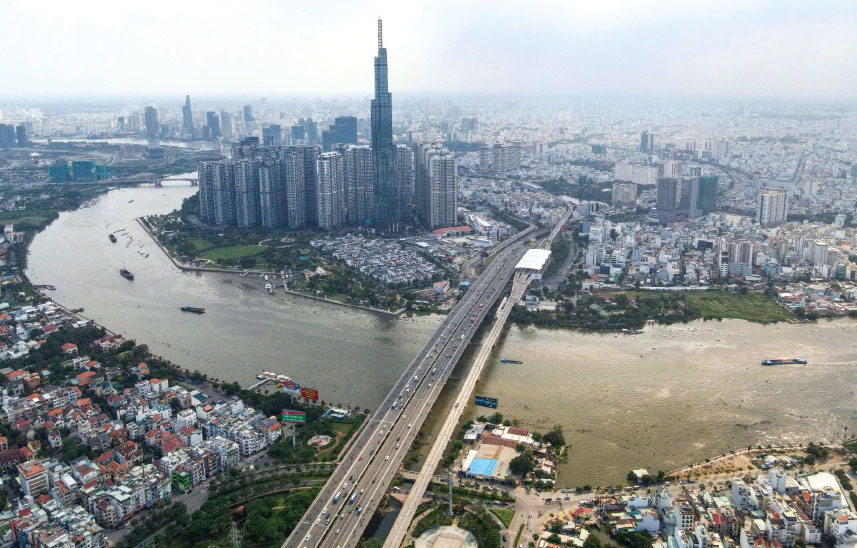
The centerpiece of this development model is the area east of the Saigon River. This location holds exceptional strategic importance, facing the East Sea, connecting directly to international maritime routes, and hosting a high-tech park, top universities, and research institutes. It also serves as a key crossroads for critical infrastructure networks.
With proper investment and seamless connectivity to key satellite areas such as Dong Nai (particularly the Long Thanh International Airport area) and the urban zones of Binh Duong, the East Bank of the Saigon River can emerge as a vibrant “heart” — an international center for finance, technology, commerce, and services. This hub would not only promote a maritime-oriented economy and deeper international integration but also create strong ripple effects northeastward, fostering smooth links with the south-central provinces. It is envisioned as a new growth engine for HCMC and the nation, embodying the ambition of creating a “new Singapore,” a “Pudong” of Shanghai, or an “Incheon” of Vietnam — symbols of Asia’s remarkable urban and economic transformation.
Three connecting corridors
From the center, three strategic corridors — Southwest, Northwest, and West — would extend outward, forming a comprehensive and balanced development network.
- The Southwest Corridor that connects to the Mekong Delta. This development direction is critically important. The Mekong Delta —
Vietnam’s rice, fruit, and seafood basket — requires prioritized investment to close development gaps. The Government has identified this as a strategic direction and is concentrating resources on infrastructure development. Integrating this corridor into the overall vision would create powerful synergies, linking HCMC’s industrial and service center with the Mekong Delta’s raw materials and high-tech agriculture base, while also advancing sustainable development in both the southwest and southeast regions.
- The Northwest Corridor that connects to the Central Highlands. This strategic direction aims to unlock the potential of the Central Highlands, an area of great geopolitical importance but with many challenges and underdeveloped infrastructure. Establishing a seamless transport axis from HCMC through the industrial zones of Binh Duong and Binh Phuoc to the Central Highlands would facilitate two-way flows of goods (agricultural and mineral products from the Central Highlands to ports, and industrial and consumer goods from the Southeast upward), attract investment into processing industries, high-tech agriculture, and tourism, and fundamentally solve the sustainable development challenges faced by the Central Highlands.
- The West Corridor that connects to ASEAN via Cambodia. This corridor would open a direct gateway to Cambodia and other continental ASEAN countries. Developing and upgrading transport infrastructure, particularly the HCMC-Moc Bai Expressway and railway links, would greatly boost cross-border trade, attract investment into border economic zones, enhance Vietnam’s role as a regional supply chain bridge, and fully realize the benefits of the ASEAN Economic Community (AEC).
The aspiration for a new “Pudong” on the East Bank: a superior model and mechanism
Transforming the East Bank of the Saigon River into a world-class development hub like Singapore, Pudong (Shanghai), or Incheon requires not only massive investment resources but also groundbreaking ideas regarding development models and policies.
The scale of this “special zone” should be around 650–700 square kilometers, equivalent to 10% of the expanded HCMC, comparable to Singapore, Incheon, or the core development zones of Tokyo, Seoul,
Jakarta, and Manila. This zone should adopt an internationally competitive institutional and policy framework: maximally streamlined administrative procedures, a fully integrated one-stop-shop mechanism, special preferential tax policies, flexible mechanisms for attracting talent, and greater autonomy in economic management.
Vietnam is fully capable of learning from and creatively adapting these experiences. The restructuring and reorganization of administrative units present a golden opportunity to implement these bold ideas. However, a practical and effective approach is essential: instead of spreading resources across a vast area, investments should focus on key areas with the greatest breakthrough potential, creating “growth poles” that drive broader development. This approach ensures investment efficiency while avoiding unnecessary social disruptions.
Lessons from successful places show that success stems not just from geographic location or capital investment but, more importantly, from a clear strategic vision, strong central government support, and the establishment of a modern, flexible, and efficient management system.
Removing bottlenecks in infrastructure and financial resources
Two key factors will determine either success or failure for this centennial vision: infrastructure and financial mechanisms.
An infrastructure revolution in connectivity. The current congestion and lack of synchronization in HCMCs regional transport network are major barriers, reducing economic efficiency and quality of life. A true revolution in infrastructure investment is needed, with the following priorities:
First, complete the beltways. Beltways 3 and 4 are not just transportation routes; they are new axes for urban, industrial, and logistics development, reshaping the region’s economic geography.
Second, accelerate radial and inter-regional expressways. Projects such as HCMC–Moc Bai, HCMC–Chon Thanh (connecting to the Central Highlands), and expressways to the Mekong Delta (Trung Luong–My Thuan–Can Tho, Ben Luc–Long Thanh, etc.) must be expedited.
Third, develop the railway system. Invest in high-speed rail (initially the HCMC–Nha Trang section) and urban railways connecting the city center with satellite cities and Long Thanh International Airport.
Fourth, position and develop seaports and logistics hubs. Maximize the potential of the regional port system, particularly leveraging the strategic importance of Cai Mep–Thi Vai Port. At the same time, building modern logistics centers is critically important.
Fifth, develop digital infrastructure. This is a strategic infrastructure foundation for future modern economic models.
A breakthrough in financial mechanisms. Infrastructure investment demands massive capital, yet the current financial mechanisms are too limited. HCMC needs breakthrough financial solutions to build sustainable resources, focusing on three main areas:
First, stronger fiscal decentralization. Give HCMC greater autonomy over revenues and expenditures, especially retaining a larger share of surplus budget revenues. This proposal would create a stable and predictable resource base, allowing the city to proactively plan long-term investments. One method could be maintaining current allocations but adjusting the sharing formula for surplus revenues.
Second, smart financial leverage. With a new budget allocation formula, incremental cash flows would be created. HCMC could use these flows as collateral to access concessional loans or issue large-scale municipal bonds (worth hundreds of billions of U.S. dollars), enough to undertake major infrastructure projects using a “rolling implementation” model, enabling infrastructure leaps, instead of slow, year-by-year accumulation. This is essentially “using future money to invest now,” unlocking growth potential.
Third, effective land resource utilization and private sector involvement. The National Assembly’s Resolution 98 (which provides special policies for HCMC’s development) has opened up important legal opportunities. It is necessary to concretize and accelerate the implementation of the Transit-Oriented Development (TOD) model, capturing land value increases from infrastructure investments (especially urban railway projects) for reinvestment. Simultaneously, perfecting the Public-Private Partnership (PPP) framework is essential to attract more private sector capital into infrastructure projects, following the formula where “1 dollar of public investment can leverage 4–8 dollars of private sector investment.” If successful, this mechanism will also help address housing challenges and restructure the urban form toward a modern, highly competitive metropolis.
In summary, the vision of “One Center – Three Corridors” is a long-term, breakthrough strategy for HCMC’s development. This vision is a practical way to realize the aspiration and strategy for advancement outlined by Party General Secretary To Lam. A political determination to address bottlenecks in institutions, infrastructure, and resources will be the key for HCMC to fully unlock its potential and successfully fulfill its historic mission.