
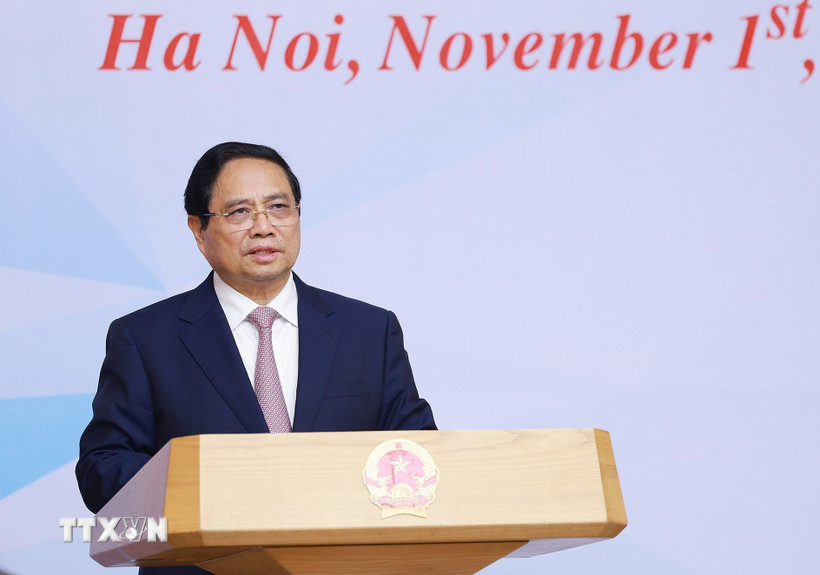

HCMC - Prime Minister Pham Minh Chinh has ordered that Vietnam’s international financial centers (IFCs) begin operations within November, calling the initiative challenging but essential for the country’s long-term growth.
Speaking at a national conference on November 1, which connected online with partners in the U.K., the Czech Republic, Hong Kong, and Indonesia, the prime minister emphasized that while establishing an IFC is a complex task, it must be done decisively and without delay.
Under Resolution No. 222/2025/QH15 of the National Assembly, the Government plans to establish two international financial centers—one in HCMC covering about 899 hectares, and another in Danang covering 300 hectares.
The HCMC IFC is expected to develop a diverse and modern financial ecosystem, offering advanced financial services such as capital markets, financial derivatives, asset and fund management, insurance, and green finance. It will also promote fintech and innovation-driven financial solutions.
Meanwhile, the Danang IFC will focus on technology, innovation, and digital infrastructure. It will operate under international standards to attract global capital, financial institutions, and high-quality human resources.
At the conference, experts and delegates discussed legal frameworks, governance structures, and risk management mechanisms. They also proposed measures to enhance transparency, attract investment, and develop supporting ecosystems for professionals and residents.
International participants expressed their support for Vietnam’s plan, saying the country’s move aligns with global trends and will strengthen its financial and economic integration. However, they noted that Vietnam’s IFCs should leverage the nation’s unique advantages to remain competitive.
PM Chinh said the centers must operate based on digitalization and artificial intelligence to boost competitiveness and efficiency. He stressed the importance of coordination between domestic agencies and international financial institutions, combining national strengths with global expertise.
Each IFC will have a steering committee led by the prime minister, two executive boards in HCMC and Danang, a supervisory body, and a court to resolve disputes.
The prime minister called for flexible policies, post-audit supervision instead of pre-approval mechanisms, and regulatory independence between domestic and international operations. He urged both cities to finalize infrastructure, policy frameworks, and management mechanisms to ensure the centers can begin operating this month.
The Ministry of Finance has been tasked with coordinating with relevant agencies to finalize the legal framework and submit it to the Government for approval, paving the way for the centers to launch within November 2025.