After years of ad hoc growth, Vietnam’s private sector is gaining clearer direction as the recent landmark resolutions from the Politburo and the National Assembly (NA) will help dismantle long-standing biases and institutional barriers, paving the way for a breakthrough.
Shifting mindset drives transformation
Vietnam’s private sector, with some 800,000 active businesses, accounts for nearly 45% of the country’s GDP, contributes about one-third of state budget revenue, makes up over 40% of total investments in the economy, and provides jobs for 85% of the national workforce, showed data from the Ministry of Finance. Yet the sector has not reached its full potential, as the Politburo once acknowledged. It has long been held back by old perceptions, inconsistent regulations, and limited access to capital, land, and skilled labor. High costs, weak policy support, and poor protection of business rights have hampered its growth.
Things are changing in response to the call of a new era. Fairer mechanisms and improved perceptions are being introduced to better recognize the vital role of the private sector. This transformation is backed by the Politburo’s Resolution 68, issued on May 4, and the National Assembly’s resolution passed on May 17, along with the Government’s action plan to support private firms, especially household businesses, small and medium enterprises (SME), and startups. The private sector is on the verge of a potential breakthrough as shifts in economic thinking take hold.
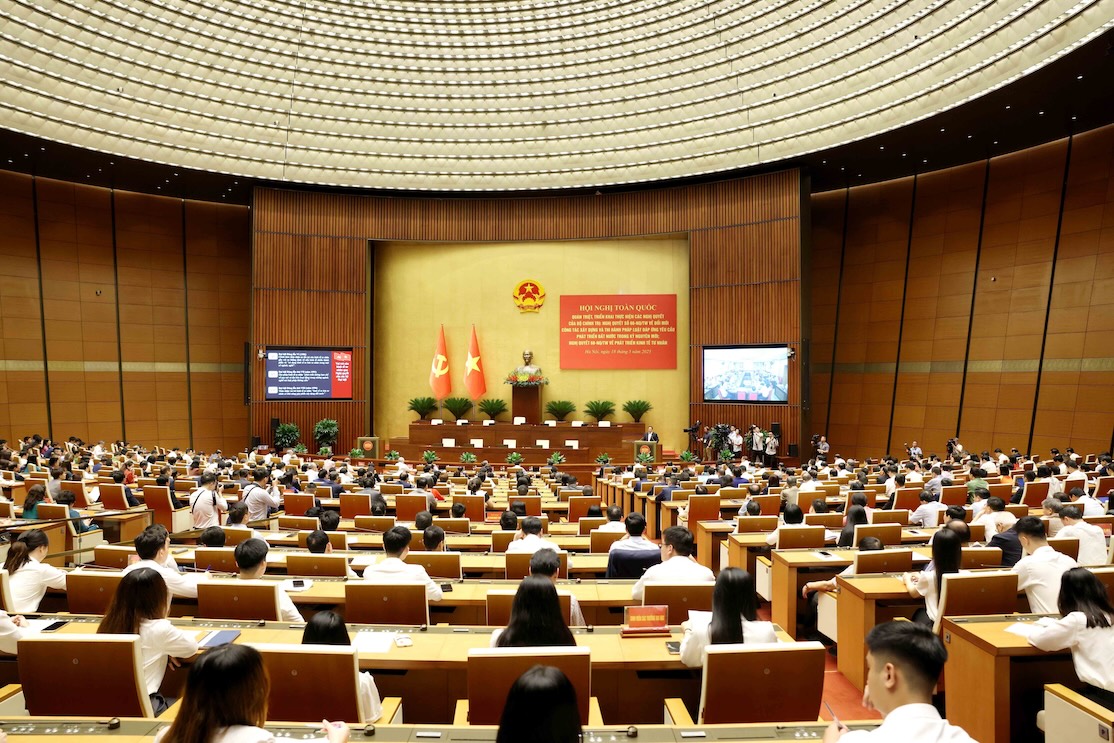
Speaking at a national hybrid conference on May 18 on Resolution 66 on legal system reform and Resolution 68 on private sector development,
Party General Secretary To Lam underscored the urgent need to unlock all social resources to drive fast and sustainable growth in a socialist-oriented market economy. Resolution 68 marks an unprecedented shift in the Party’s strategic thinking and leadership approach, officially recognizing the private sector as “one of the most important drivers of the national economy.” This represents a fundamental change: from viewing the private sector as a supplementary force to positioning it as a core pillar of development, alongside the state and collective sectors. These three form a solid foundation for building an independent, self-reliant, and deeply integrated economy. He said that strengthening the private sector is no longer just an economic priority, but a political mandate to boost national competitiveness and resilience in an increasingly volatile global environment.
The Government has issued Resolution 139/NQ-CP on the implementation plan for NA Resolution 198/2025/QH15, dated May 17, 2025, which outlines special mechanisms and policies to fuel private sector growth. Earlier in the same conference, Prime Minister Pham Minh Chinh stressed that “what is promised must be delivered, and commitments must yield concrete outcomes.” He also emphasized the need for sector-specific policies to support priority industries and called for an end to the disconnect between central-level pro-business commitments and local-level regulatory obstacles, saying the current “red carpet above, nails below” environment must change.
The mindset has shifted, and the business community has warmly welcomed both the resolutions and accompanying action plans. It feels as though long-constrained potential is finally being unleashed.
Sharing his views immediately after PM Chinh delivered a report on Resolution 68 at the conference, Vu Van Tien, chairman of Geleximco Group, described it as a strategic and transformative breakthrough. He said the resolution reflects a clear, forward-looking vision and properly acknowledges the private sector’s critical role, while decisively breaking away from long-held biases. “This is nothing short of a comprehensive revolution – one that frees the private sector. It is like long-awaited rain after a prolonged drought. For years, we have wanted to contribute but felt constrained,” Tien said, urging the business community to rally behind the resolution.
Major legal reforms
Under the newly passed resolution of the National Assembly on special policies for the private sector, Vietnam has introduced a policy framework to tackle barriers to the sector’s development and improve the business environment. The reforms focus on critical bottlenecks in the legal environment, fiscal and credit policies, and land access.
The legal and administrative environment is undergoing major reforms to ease burdens on businesses. A comprehensive review to eliminate unnecessary conditions and overlapping, outdated regulations that hinder private sector growth is slated for completion by the end of this year, under the NA’s Resolution 198. “The key is to reform our mindset in lawmaking and enforcement – removing administrative barriers, eliminating the ‘ask-give’ mechanism, and abandoning the mentality of banning what cannot be managed,” PM Pham Minh Chinh said, emphasizing the need to resolve conflicts and inconsistencies among ministries, agencies, and local authorities.
The resolution mandates at least a 30% reduction in administrative processing times, compliance costs, and business conditions, with further cuts in the years ahead. Businesses will face inspections or audits no more than once a year, unless violations are suspected. Civil and administrative remedies will be prioritized over criminal penalties for economic violations. Retroactive enforcement that do harm to businesses will be prohibited, and the presumption of innocence will be upheld, said the PM. These reforms aim to create a more transparent, predictable, and business-friendly regulatory environment.
Stronger support, greater opportunities
In the past, the private sector often found itself at a disadvantage compared to state-owned enterprises when it came to accessing preferential funds, land, natural resources, and public projects. Now, sweeping reforms are opening the door for the private sector’s deeper involvement in key value chains.
The NA resolution grants a three-year corporate income tax exemption for SMEs and a reduction in personal income tax for specialists. It also offers a 2% interest rate subsidy for projects aligned with green growth, the circular economy, and ESG standards. To encourage innovation, enterprises are allowed to allocate up to 20% of their taxable income to establish a fund for science, technology, innovation, and digital transformation development.
These measures are designed to ease financial burdens and foster growth, especially for SMEs. The tax incentives allow businesses to reinvest profits, while lower borrowing costs make it more feasible to implement sustainable and innovative projects. Meanwhile, the flexibility to invest in research and development (R&D) and digital transformation strengthens long-term competitiveness.
Moreover, the Government is expanding the participation of private enterprises in key national and socio-economic development projects. This includes direct investment, public-private partnership (PPP), or other forms of state-private cooperation in accordance with the law. As a result, the role of the private sector is being significantly elevated, positioning it as a more active contributor to the country’s development agenda.
Regarding land access, SMEs and high-tech startups will benefit from at least a 30% reduction in land lease fees during their first five years. In addition, provincial governments are required to reserve 5% of land in new industrial parks specifically for innovative businesses. The new policy has generated optimism among small businesses and startups, who see it as a chance to unlock new growth opportunities. For enterprises that have long faced challenges in securing suitable, reasonably priced production space, the policy offers a pathway to scale up operations, boost production capacity, and enhance competitiveness.
Empowering private businesses to go global
As outlined in the NA’s resolution, the Government will implement target programs and allocate budget resources to support the establishment of medium and large-sized private businesses to develop regionally and globally competitive private economic groups.
A key initiative is the development of 1,000 exemplary enterprises leading in science and technology, innovation, green and digital transformation, high-tech manufacturing, and supporting industries. These firms will act as trailblazers in driving productivity, sustainability, and private sector modernization.
Complementing this is the “Go Global” program, which will help private firms expand into international markets through support in market access, financing, technology, branding, distribution, logistics, insurance, legal services, consulting, and mergers and acquisitions. It also seeks to connect Vietnamese companies with multinational corporations to strengthen global integration.
Speaking at the May 18 conference, PM Chinh highlighted the power of branding, noting that products made from the same materials can differ significantly in price due to brand value. He stressed the need to help private firms build global brands and expand internationally. The PM also emphasized the role of science and technology, a transparent business environment, and stronger competitiveness. He called for a national push to foster entrepreneurship, promote lawful wealth creation, and elevate the private sector’s role in development.
As Vietnam redefines the role of its private sector through bold policy shifts, the foundations are being laid for a more dynamic, inclusive, and globally integrated economy. The combination of legal reforms, financial incentives, land access improvements, and internationalization support reflects a clear intent: to transform the private sector into a leading driver of national development. If these efforts are sustained, the private sector could become a key engine of resilience and growth in the face of global economic uncertainty, and a powerful force in shaping the country’s future on the world stage.