
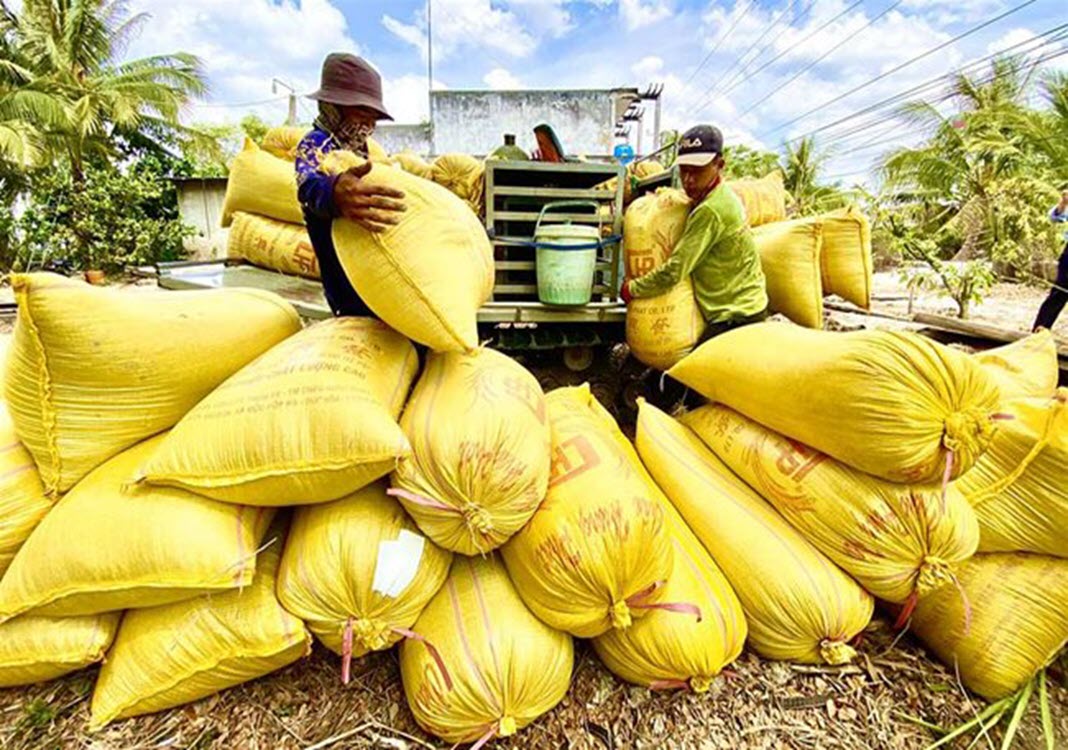



Confronted with food security risks as Covid-19 spreads, the Prime Minister decided on March 25, 2020 to suspend rice export and then regulate it using quotas. Cautious policies are important during this period of uncertainty, but the current mechanism is fraught with shortcomings that need addressing to ensure transparency and fairness.
To simplify matters, assume Vietnam is a small food exporter with insignificant impacts on global prices. Reality may be slightly different, but the key principle remains the same, albeit with some adjustments in impacts. When a quota is imposed, as represented by the red demand curve, domestic price will fall to Pq. The welfare loss incurred by food producers is represented by a + b + c + d + e. Local consumer surplus is a + b, those eligible for rice export have a surplus of d and deadweight loss is c + e. If an export tax is imposed instead of a quota, d will belong to the Government.Lack of transparency and fairness in quota
Empirical evidence shows that quotas lack transparency and may breed corruption. The export price disparity will benefit those offered the quota. This is significant, so rent-seeking behavior will be rife. Quotas inflict damage on society because an export price tax or quota bidding will enable the Government to gain from the price disparity. Moreover, the disadvantaged group will bear a greater cost. Statistics show that Vietnam’s rice output in 2019 was about 22 million tons, including 9.3 million tons for local consumption and 6.37 million tons for export (earning US$2.81 billion). The remainder is for manufacturing, animal husbandry, national stockpiling and so on. If corn, sweet potatoes and similar crops are taken into account, the value that producers gain, after self-consumption is considered, can surpass VND200 trillion. Compared with normal rice export, a 10% decrease in the prices of rice and food stuff triggered by rice export restriction will impose a damage surpassing VND20 trillion, equivalent to about one-third of the support package (VND62 trillion). Those benefiting from the restriction include consumers, the Government hoping to have more rice reserves and those eligible for rice export. It is worth noting that rice sellers tend to be farmers and the poor in rural areas while consumers are often the more affluent people.
What are the solutions?
Transparency and fairness need to be enhanced. First, an export tax ensures transparency and benefits the State budget and society more. The imposition of an export tax will transfer the gains from price disparity to the State budget instead of those eligible for rice export. If one of the objectives of export restriction is to maintain the Government’s stockpile at affordable prices, an export tax will be the most effective since the Government can use the tax extracted to offset the purchase of rice for stockpiling; otherwise, the revenue can be given to farmers. If the Government is concerned about excessive export, it can track the quantity exported by asking firms to register immediately after export agreements have been signed, so that the authorities can impose a circuit breaker where necessary. If an export tax is not feasibility, quota bidding should be used. Those with the highest bid can export rice and the revenue extracted from bidding can be used to support farmers. Second, those with agricultural land should be supported to improve fairness. In order not to punish the disadvantaged group more, the Government should consider offering those with agricultural land either a subsidy or a transfer. This mechanism is based on a ceiling such as one hectare per person. Those given land within this range will receive the same subsidy or transfer. The total value of support is the estimated damage arising from export restriction. Ideally, there should be a fee or tax imposed on food consumption, together with the aforementioned export tax, to generate funding for a support package. Taxes should be computed such that the revenue equals the damage incurred by consumers. If this is not feasible, the State budget may be used. However, it will be crucial to balance government revenue and spending in that case. In short, the current export restriction via quotas does not ensure transparency and fairness. The Government needs to make the necessary adjustments to address existing challenges.By Huynh The Du