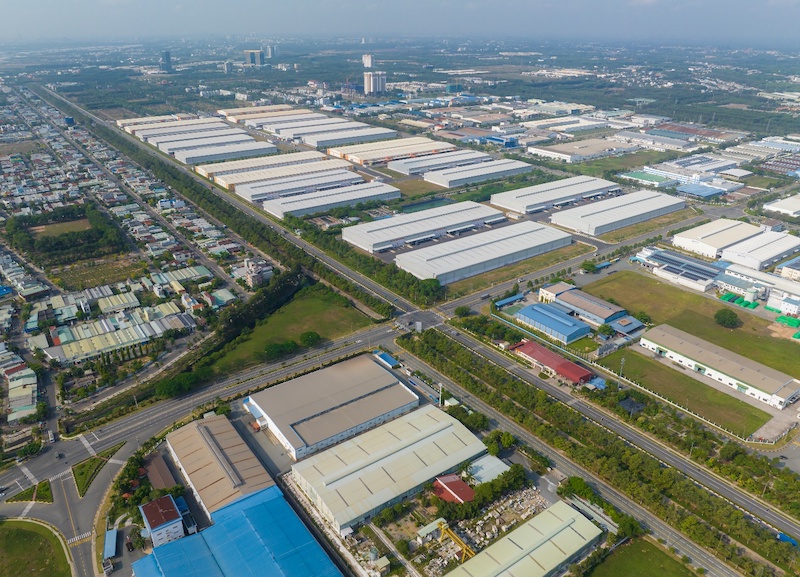
The industrial real estate sector in Vietnam is exhibiting signs of robust growth, driven by an influx of foreign manufacturers. These businesses are choosing Vietnam as their investment destination, attracted by opportunities for supply chain diversification and market expansion.
Q1 business performance
In the first quarter of 2024, industrial real estate, particularly through the leasing of ready-built factories and warehouses, stood out as a beacon of success in an otherwise lackluster real estate market in Vietnam. This trend was reflected in the strong business performance of numerous listed companies.
For instance, the Q1/2024 consolidated financial statement of IDICO Corporation JSC indicated a remarkable performance. The company booked over VND2,467 billion in revenue, up by a staggering 115% against the same period last year. A significant portion of this revenue, nearly VND1,308 billion or 53% of the total, came from industrial park infrastructure, which saw a six-fold increase in revenue compared to the previous year. Its revenue from real estate investments reached VND281 billion, up by nearly ten-fold.
The company credited the substantial profit growth to the high number of industrial park infrastructure leasing contracts. With the solid performance in the first quarter, IDICO achieved 30% of its annual revenue target and 40% of its full-year pre-tax profit target.
The Investment and Industrial Development Corporation (Becamex IDC) reported net revenue of VND812 billion in January-March 2024, a 3% year-on-year increase. The real estate business segment was a significant contributor, accounting for VND450 billion of the total revenue. After expenses, Becamex IDC made VND119 billion in after-tax profit, a substantial 60% increase from the previous year. Notably, the company still has over 600 hectares of land available for leasing.
Lu Thanh Nha, general director of Saigon VRG Investment Corporation, told shareholders that the company’s Q1 revenue rose by 30% year-on-year to VND1,826 billion. Its after-tax profit in the quarter amounted to VND257 billion, a 43% increase from last year. These positive results enabled the firm to obtain 34% of its revenue target and 32% of its profit target for this year.
Sonadezi Corporation reported a year-on-year revenue increase of 21% in the first quarter, totaling VND1,292 billion. The industrial park business segment displayed a strong performance, generating over VND390 billion, up by 57% compared to the same period last year.
While some enterprises active in land and factory leasing for production are thriving, the industrial real estate sector presents a mixed picture. Despite the sector’s overall growth, some developers have not fared as well as expected. For instance, Kinh Bac City Development Holding Corporation JSC (KBC) saw its revenue plummet by 93% year-on-year to just VND152 billion between January and March. Its net loss totaled nearly VND86 billion as the firm did not take into account its revenue from the leasing of land and industrial park infrastructure. Similarly, Long Hau Corporation (LHG) experienced a downturn, with its after-tax profit falling by 32% to VND31.4 billion. This underscores the challenges faced by the sector.
Rising land rents
The influx of foreign capital into Vietnam, particularly into the manufacturing and technology sectors, is expected to continue rising in the coming years. This trend is likely to further fuel the already-high demand for industrial park land and factory rentals, according to industry experts.
Thanks to this robust demand, rental prices for industrial real estate have seen a consistent uptick. The Q1/2024 report from CBRE Vietnam indicated that industrial land rents in the northern region of Vietnam have increased by approximately 8% year-on-year to an average of US$133 per square meter per lease term, or about VND3.2 million per square meter per lease term.
In the southern region, the increase has been more modest but still significant, with industrial land rental prices averaging US$189 per square meter per lease term, equivalent to over VND4.5 million per square meter per lease term, a 2.4% rise from the previous year.
Avison Young Vietnam’s Q1/2024 analysis of the Vietnamese industrial real estate market
highlights a mismatch between the high rental demand and the insufficient supply in the country’s three main industrial centers—HCMC, Danang and Hanoi. This gap has spurred the development of new industrial zones in adjacent provinces.
In the northern region, the rental rate for industrial park infrastructure in Hanoi is about US$214 per square meter per lease term, showing a modest increase of 1% from the previous quarter. Meanwhile, rental prices tend to decrease in peripheral areas, ranging from US$120 to US$165 per square meter per lease term in provinces such as Bac Ninh, Bac Giang, Hung Yen and Vinh Phuc. Emerging industrial centers like Haiphong, Quang Ninh, Thai Binh, and Ha Nam are showing promising growth, with rental rates ranging from US$90 to US$120 per square meter per lease term, positioning these localities as potential focal points for future industrial expansion.
In Danang, industrial rental prices have remained steady at US$95 per square meter per lease term, with no new supply reported in Q1/2024.
Meanwhile, HCMC maintained an average rental price of US$230 per square meter per lease term. Nearby, in Dong Nai and Binh Duong, prices hovered between US$170 and US$175 per square meter per lease term. Long An and Ba Ria-Vung Tau are emerging as potential industrial hubs, with prices ranging from US$100 to US$110 per square meter per lease term.
CBRE Vietnam’s recent review highlights a bright outlook for the industrial real estate sector in Vietnam, fueled by the ongoing global supply chain diversification. The firm anticipates industrial property rental prices to continue rising in the coming years. Specifically, an annual increase of 5-9% is expected in the northern region and 3-7% in the southern region. The demand for ready-built warehouses is projected to grow substantially, driven by enhancements in the logistics sector and increasing foreign investment needs.
Bright spots and challenges
Vietnam continues to benefit from the “China Plus One” strategy, as manufacturers are diversifying away from China to other markets, including Vietnam. This trend is further bolstered by the free trade agreements to which Vietnam is a signatory, such as the Regional Comprehensive Economic Partnership (RCEP) and the European Union-Vietnam Free Trade Agreement (EVFTA), which are expected to boost foreign direct investment in the country.
Vietnam’s strengthened diplomatic relations with world powers have significantly benefited its overall economic landscape, particularly the manufacturing and industrial real estate sectors. This positive environment has prompted industrial real estate developers to actively acquire land and expand warehouse capacities nationwide. Moreover, companies traditionally not specialized in industrial infrastructure, such as Ha Do, Taseco Land, Hoa Phat and Son Ha, are now looking to invest in this burgeoning sector to capitalize on its current growth trajectory.

Investing in industrial real estate in Vietnam requires a long-term vision and robust financial health, as it takes 12 to 15 years to recover capital. Prospective investors face numerous bureaucratic hurdles, including the lengthy procedures for investment approval, land clearance, land acquisition, and construction—all of which can significantly delay project timelines.
Currently, even seasoned industrial park developers are encountering challenges. The traditional multi-sector industrial park model, which primarily relies on land potential, is increasingly seen as unsuitable given the current market dynamics. Experts are advocating for a shift towards eco-friendly industrial parks, which necessitate substantial changes in technology, workforce, and production processes, along with significant capital investments.
The transition to eco-friendly industrial park models is fraught with obstacles, such as limited capital sources, inadequate legal frameworks, and a lack of incentives for business participation. Additional concerns include the potential electricity shortages for manufacturing and the challenges associated with integrating solar power solutions within industrial parks. These issues complicate the ability to satisfy the growing demands for environmentally sustainable production practices demanded by international corporations.