If Vietnam’s gold market policy resembles bathwater that needs changing, which water should be discarded without throwing out the baby in the tub?
Throughout the endless debates of human intellectual history, philosophers have made it their responsibility to discard the bathwater—the outdated ideas they considered no longer valid. Yet, they also acknowledged and respected their predecessors, recognizing that within each discarded bathwater remains a child worth preserving. The task of later generations is to pour away the water while ensuring that the baby survives.
To better understand the origins and rationale behind Decree 24/2012/ND-CP, dated April 3, 2012, concerning the management of gold trading, readers may refer to my earlier article published in The Saigon Times in April 2013. In that piece, I explained the fundamental objective of Vietnam’s gold policy, which was implemented for the first time: to remove gold from circulation. In other words, it aimed to separate gold from the credit system and eliminate its role in the financial system as a means of monetary exchange, restoring its status purely as an asset. This is the “baby” of the gold policy.
At that time, the power of the gold market was so strong that the monetary regulator (i.e., the State Bank of Vietnam - SBV) was nearly powerless to control the gold market and its spillover effects on macroeconomic factors like the foreign exchange market, which was fragile due to Vietnam’s low foreign exchange reserves.
The evidence resides in Circular No. 11/2011/TT-NHNN issued by the SBV two years earlier, on April 29, 2011, which regulated the “termination of mobilization and lending of capital in gold by credit institutions.” However, it had little effect due to the influence of interest groups that dominated the gold market.
As I will explain once again in this article, the principle of a sound gold market and a healthy financial-monetary system is that gold should not be used as a tool for mobilization and lending in the credit market, which means it should not function as a circulating monetary instrument.
The same principle should apply to the U.S. dollar or any foreign currency. The only thing that should be mobilized and lent in the credit market is the national currency, as it is the exclusive legal tender for monetary circulation.
Only in this way can a country maintain and implement an independent monetary policy, thereby exercising economic and monetary sovereignty within its territory. Gold and foreign currencies may be widely used in the market, but only as assets for buying and selling, not as instruments for monetary circulation in the manner mentioned above.
From the early steps into a market economy until just before 2011, Vietnam’s financial system had been chronically affected by goldization and dollarization—persistent conditions that left monetary regulators nearly powerless. The core issue was that, due to historical reasons, banks and credit institutions were allowed to mobilize gold and foreign currency from the public and subsequently lend them out, similar to any monetary business operation. This made solving the puzzle of “gold price - exchange rate - inflation” almost impossible.
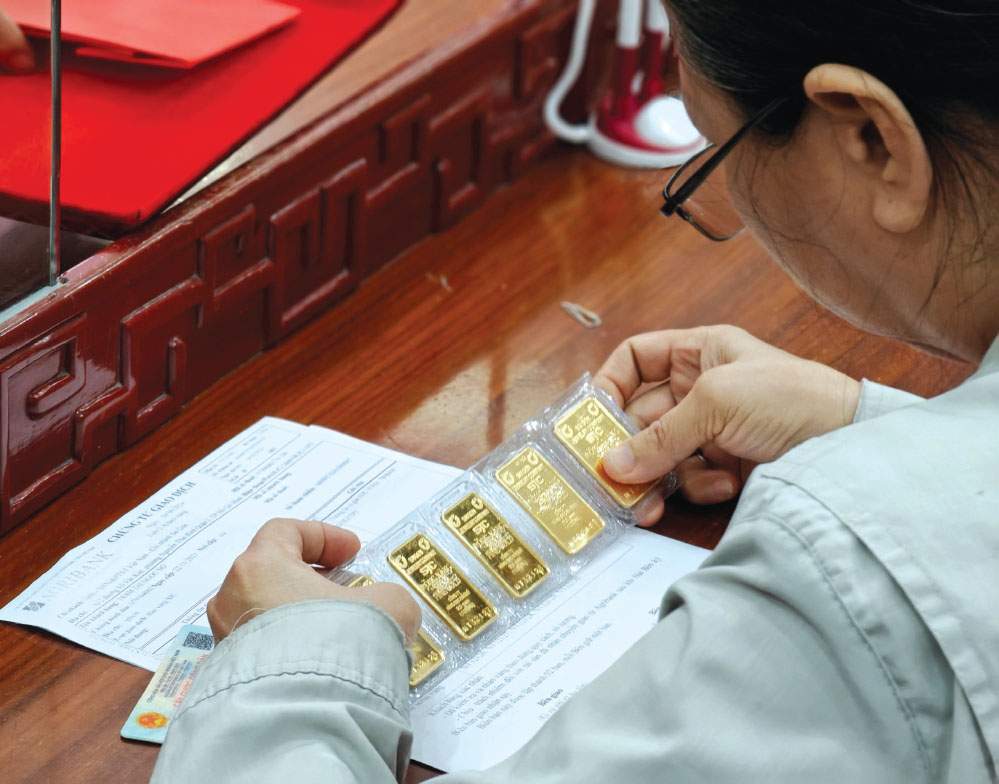
In that context, Decree 24 was introduced to replace Circular 11, bringing forth several strict measures. One of the temporary solutions was the state’s monopoly over the gold bullion market through the SJC gold bullion brand. At the time, this sparked a significant debate.
For me, this was part of the bathwater, not the baby. I supported this policy as a temporary measure to achieve a goal that Vietnam had never attained before: eliminating the credit nature of gold and restoring gold to its rightful place as an asset.
The same approach has been implemented in the foreign exchange market. Banks no longer accept foreign currency deposits, nor do they officially lend foreign currency for business purposes. If businesses or individuals need foreign currency, they can purchase it on the forex market. They can hold foreign currency as an asset, store it in a private safe or a bank account (for payment purposes), or keep it elsewhere—as long as they do not receive interest from holding it, and storage institutions (such as banks) are prohibited from lending it out.
In April 2016, when asked about the biggest challenge facing the new governor of the SBV, I stated in an interview that it was the return of gold to the market. By then, four years after Decree 24 was introduced and implemented, the temporary solution—the state’s monopoly over gold bullion through the SJC brand—had fulfilled its mission. It was time for the baby to get a new bath. And 2016 was the right moment, as Vietnam had achieved macroeconomic stability and the global gold market was relatively calm.
However, one characteristic that any policymaker must understand and anticipate is that when a policy is established to achieve goal A, it simultaneously dismantles an existing interest group X while forming a new interest group Y within the context of the new policy. Thus, when policy goal A has been successfully achieved and the policymaker seeks to shift toward a new goal B, they will inevitably face resistance from interest group Y—simply because Y sees its benefits at risk of being eliminated.
This is when fairness and courage are most needed in policy-making. If policymakers lack a resolve, they risk being “captured” and manipulated by the very interest group shaped and nurtured by their previous policy. This pattern holds true across many domains, including telecommunications policy, energy policy, infrastructure development, corporate development (whether private or state-owned), education policy, healthcare policy—and in this particular case, gold market policy.
Nearly a decade has passed since we missed an opportunity to adjust gold market policy. One can imagine how enormous the benefits accumulated within the groups that profited from that policy. Now, are we ready to pour out the old bathwater—the monopoly over the gold market?
The monetary and foreign exchange markets have become much more stable than before. Therefore, the new bath for the gold market should be a healthy asset market, where ownership and transaction rights are legally protected, where trading mechanisms are transparent and reliable, and where competition is ensured. A diverse range of participants and appropriate rules of the game should be in place to foster a fair and sustainable market.
Gold is an asset which people can own, and it should be protected like any other form of property. At the same time, there is no need to fear that people will hold too much gold. In a competitive, transparent domestic market that is flexibly connected to global markets, individuals are wise enough to determine which assets best serve their interests—and, by extension, the nation’s.
If the goal is to reduce gold holdings among the population, then more attractive financial instruments must be made available to provide them with better alternatives. This, in turn, depends on the overall development of the domestic economy and the financial market.
While reshaping the gold market, it is essential to maintain the core principle that gold must not re-enter the credit system in any form. Preserving this ensures a stable financial system where gold functions solely as an asset rather than a monetary instrument, preventing distortions in monetary policy and market dynamics.
This principle must be upheld across all levels of financial policy, from prohibiting credit institutions from mobilizing and lending gold to ensuring that the state does not issue gold-denominated bonds or return to the old practice of “mobilizing gold from the public.”
While seeking to replace the bathwater with a new one, it is essential to remember that there is always a baby in it that must not be thrown out: the principle that gold must not be reintroduced into the credit market in any form.