The Middle East military conflict has indirectly pushed up agricultural production costs in Vietnam, particularly for rice farmers in the Mekong Delta. The challenge now is how to bring costs down as fertilizer prices could climb past VND1 million per 50-kg bag.
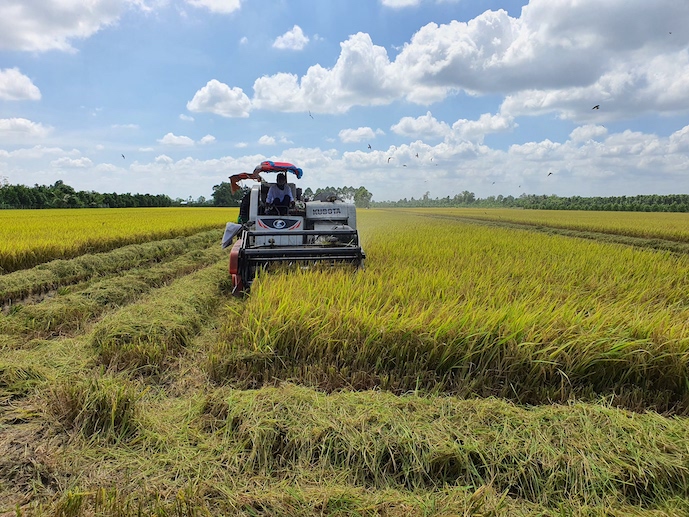
For the 2026 summer–autumn crop, the Mekong Delta is expected to sow around 1.3 million hectares of rice, boosting fertilizer demand. However, this key input has risen sharply in recent days.
Nitrogen fertilizer may exceed VND1 million per bag
Fertilizer dealers in the Mekong Delta say prices have increased rapidly since late February 2026 and could return to more than VND1 million per 50-kg bag, a level last seen during the Covid-19 pandemic.
Currently, Ca Mau urea is being sold to farmers at about VND930,000–950,000 per 50-kg bag, while Phu My urea costs VND900,000–920,000 depending on dealership.
By comparison, at the end of February 2026, Ca Mau urea sold for roughly VND690,000 per bag, and Phu My urea for about VND660,000 per bag.
In just over 10 days, the price of Ca Mau urea has risen by VND240,000–260,000 per bag, or 34.8–37.7%. Phu My urea has increased by a similar amount.
The surge is becoming a major burden for agricultural production, particularly rice farming, and could push many farmers into the red.
Some fertilizer dealers in the Mekong Delta warn that prices farmers pay could exceed VND1 million per 50-kg bag if supply disruptions linked to the Middle East tensions persist.
Urgent need to cut production costs
With costs rising sharply, attention is turning to technical solutions that could help farmers reduce production expenses.
Dao Thi Nhu He, director of Sai Gon Kim Hong Trading Service Company, told The Saigon Times that cost-saving farming techniques should be applied more widely.
Before the Government launched its one-million-hectare high-quality, low-emission rice program, her company and several partners had already tested cluster sowing combined with soil-applied fertilizer to help farmers lower costs.
Cluster sowing significantly reduces the amount of seeds needed, while burying fertilizer in the soil helps limit nutrient loss, especially nitrogen fertilizer.
“Research shows that with traditional methods, 40–50% of nitrogen fertilizer can evaporate. When fertilizer is placed in the soil, nutrients are retained and released gradually for the rice plant,” He said.
This method is also part of the production process used in the one-million-hectare high-quality, low-emission rice program in the Mekong Delta.
Pilot projects have shown clear cost reductions, particularly in seeds and fertilizers.
According to the Department of Crop Production and Plant Protection, after two years of implementing the program, seed use has fallen by 30–50% compared with traditional methods. Nitrogen fertilizer use has declined by about 30%, while pesticide spraying has been reduced by two to three applications per crop.
These results provide a practical basis for expanding the approach, especially as input costs continue to rise.
Nguyen Van Doi, director of Binh Thanh Agricultural Cooperative in Dong Thap Province, told The Saigon Times that under traditional farming methods, fertilizer use for the 2026 summer–autumn crop could reach 600–700 kg per hectare.
Reducing fertilizer use by 30% would allow farmers to save around 180–210kg per hectare, equivalent to about 3.6–4.2 bags of 50kg.
With nitrogen fertilizer averaging roughly VND930,000 per bag, this reduction could save farmers about VND3.35–3.91 million per hectare, excluding additional savings from lower seed use and fewer pesticide sprays.
Tran Van Binh, a farmer in Phu Hoa Hamlet, Tan Hoi Commune in An Giang Province who joined the pilot high-quality, low-emission rice project, said reducing seed use and pesticide spraying could save about VND300,000 per large cong (a local unit equivalent to 1,300 square meters).
Even after the pilot ended, many farmers have continued using sparse sowing methods, applying about 100 kg of seed per hectare for varieties such as OM18 and Dai Thom 8.
“For Japanese rice varieties like DS1, the seeding rate is even lower, at about 60 kg per hectare,” Binh said.
Applying even part of the cultivation practices from the high-quality, low-emission rice program could significantly reduce farmers’ production costs. The remaining question is how quickly authorities can scale up these solutions for the 2026 summer–autumn crop as farmers brace for a potential fertilizer price shock.