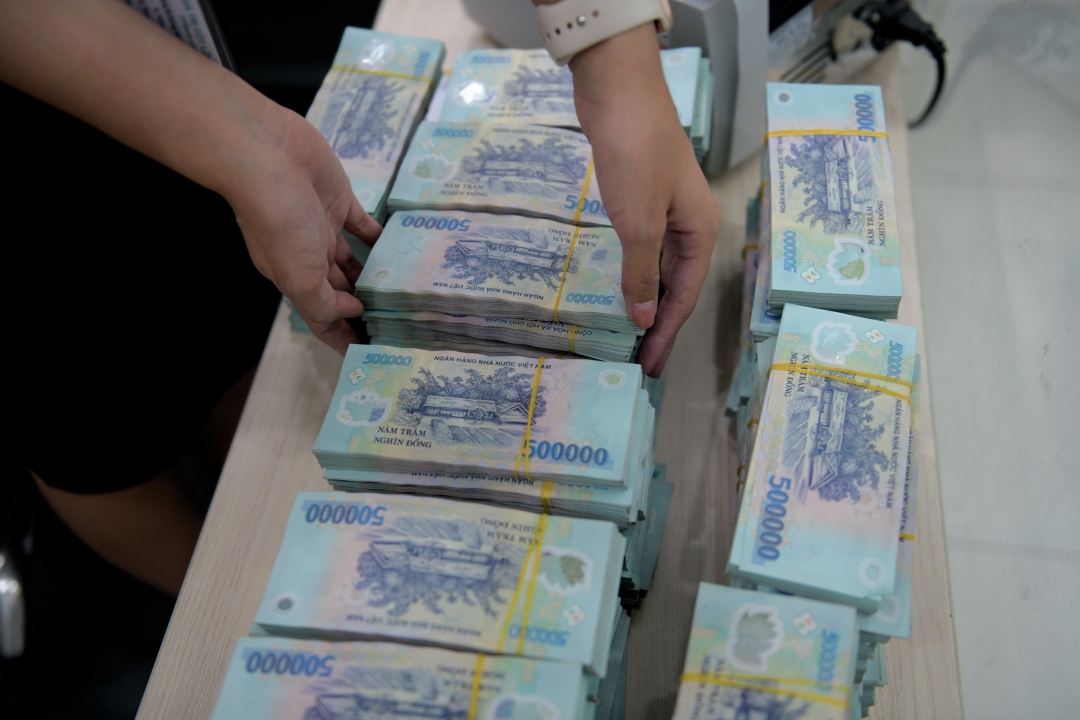
Since the beginning of the year, credit growth has shown signs of recovery as demand for loans has improved across various sectors. However, this growth has been accompanied by an increase in bad debt, and the Vietnamese economy is facing a myriad of challenges given ongoing global geopolitical tensions.
Credit plays a crucial role in capital flow, so boosting credit growth is essential for economic development. Yet, given Vietnam’s small, highly-exposed economy, accelerating credit growth requires strict risk management to avoid negative repercussions.
Current state of credit growth
As of October 11, 2024, credit in the banking system expanded by 8.78% against the end of 2023, a slight increase from 8.53% at the end of Q3 2024. Credit balances have generally accelerated since the latter half of Q2, following a slow start in the first five months of the year. Credit growth at the end of Q3 was much higher than at the same time in 2023 (5.73%) and 2021 (7.17%), though significantly lower than in 2022 when the real estate and corporate bond markets faced disruptions.
While credit growth improved significantly in Q2 and Q3, it remains well below the State Bank of Vietnam’s (SBV) 15% target for 2024. Growth has been uneven among credit institutions: some exhausted their credit limits for the year by Q3, while others experienced slower or even negative growth at times.
Rising bad debt
The rise in credit has been accompanied by an increase in bad debt, which has continued to climb through Q2 and Q3 this year. According to SBV surveys, the bad debt ratio of credit balances in Q3 2024 picked up slightly from Q2, with the end-of-year projection at 4.66% (compared to 4.55% at the end of 2023). State-run commercial banks expect a lower bad debt ratio of 1.55%, while finance companies project a higher 9.71% by the end of 2024. This reflects differing credit quality across groups of credit institutions and sectoral risks within the economy, especially in real estate and consumer lending.
First, regarding real estate debt, the proportion of real estate debt in total credit has leapt from 18.93% in the corresponding period in 2019 to 21.46% but has slowed since 2023. As of May 2024, real estate credit amounted to over VND3,000 trillion, up by 4.61% in the year to date and 12.82% year-on-year, representing 21.51% of total outstanding loans in the system. However, real estate-related bad debt as of the end of May had surged by 43.84% from late 2023 and 49.73% year-on-year, taking this sector’s bad debt ratio to 3.51% of total outstanding loans, or an increase of 0.58 percentage point against the end of 2023 and 0.87 point year-on-year. By the end of Q2 2024, the bad debt ratio in this sector had reached 3.8%, up by 1.25 percentage points against the end of 2023 and 0.67 point against the previous quarter. That real estate enterprises have had a tough time settling debt has negatively impacted the business community and the population at large.

Risks in the real estate and corporate bond markets are cross-spreading, creating a chain reaction that impacts credit quality and banking system safety. According to the Vietnam Bond Market Report by the Vietnam Bond Market Association (VBMA), the real estate sector ranked second in bond issuance volume in Q2 2024 after the banking sector, with a total of VND16.9 trillion, accounting for 19% of total issuance value—a 164% year-over-year increase—and was the only sector to see a spike in average bond rate versus Q1 2024.
The value of corporate bonds set to mature in the second half of this year is VND139.76 trillion, of which over VND58.78 trillion, or 42%, is real estate bonds, and almost VND22.5 trillion, or 16%, is bonds issued by banks. The value of delayed interest and principal payments for corporate bonds in Q2 2024 was VND11.36 trillion, a slight rise from Q1 2024. Most of the delayed bonds, accumulating since November 2022, are in the real estate sector, accounting for 63% of total delayed payments, signaling high risk.
Secondly, the non-performing loan (NPL) ratio for consumer loans in Q2 2024 continued to grow compared to the previous quarter in both volume and proportion. By the end of Q2 2024, outstanding consumer loans were estimated at VND127.51 trillion, up by 24% from the end of 2023, up by over 47% year-over-year, and up by more than 13% from the previous quarter. The NPL ratio continued its upward trend from 3.96% in Q1 2024 to 4.27% in Q2 2024 (Q2 2023: 3.23%; Q4 2023: 3.58%). This indicates a clear decline in household repayment capacity against the end of last year, with no recovery in sight yet.
Challenges for credit growth in late 2024
There will be significant challenges for credit growth in the final months of 2024. These include:
Geopolitical tensions: Middle East and Russia-Ukraine conflicts, and tensions surrounding Taiwan could disrupt operations of domestic businesses due to Vietnam’s high level of economic openness.
Macroeconomic risks: Global supply disruptions may increase imported inflation, and Vietnam dong/U.S. dollar exchange rate volatility could affect the SBV’s monetary policy, especially at a time when commercial bank interest rates are needed to be kept low to stimulate demand.
Managing bad debt alongside credit growth: As bad debt rises, the banking sector is grappling with huge risks, which would impact not only credit institutions but the economy as well.
According to a survey by the SBV, commercial banks expect total outstanding loans across the system to edge up by an average of 4.8% in Q4 2024 and by 13.2% in all of 2024, below the SBV’s full-year target of 15%. Banks are looking to a recovery in credit demand in sectors like manufacturing, trade, and services, as well as improvements in export-import activities and consumer spending, with positive signals also emerging in the real estate market. Notably, state-run commercial banks expect Q4 2024 to see quarterly credit growth at its lowest; these four banks had accounted for 45.76% of total outstanding loans in the economy as of the end of Q2 2024.
Capital disbursement for several major infrastructure projects of national importance, such as the Long Thanh International Airport, and the North-South Expressway, is expected to accelerate in the final months of the year, thereby driving up investment and credit demand in the economy.
The real estate market is gradually showing signs of improving after years of being dormant, especially in the inner-city and suburban housing segments, which will likely incentivize the demand for property finance.
However, with rising non-performing loans (NPLs) and international financial market challenges, it is challenging to maintain macroeconomic stability and credit growth in the rest of the year. The foreign exchange rate has become more volatile recently, briefly approaching the ceiling rate, which has made it difficult for the SBV to regulate interest rates. In particular, the SBV has had to issue bills to raise Vietnam dong interest rates, thereby easing some pressure on the dong/dollar exchange rate. The growth rate of capital mobilization in Market 1 (between credit institutions and individuals or organizations) remains generally much lower than the credit growth rate, pushing up both deposit and lending rates. Stabilizing the exchange rate and interest rates is therefore crucial for securing higher credit growth and requires the central bank to adopt a flexible monetary policy management approach.
Additionally, the SBV needs to extend a fresh push to credit packages, such as the VND120-trillion social housing credit package and the VND30-trillion credit package for agriculture, forestry, and fisheries. It has also proposed that the Government expedite public investment disbursement, creating a spillover effect across various sectors, generating new jobs, and increasing incomes for the population. Alongside stimulating demand for capital and credit use, it is also essential to control credit quality, channeling capital into priority sectors designated by the Government to mitigate concentration risks.