Those who have traveled to the Malaysian capital, Kuala Lumpur, will still remember the Petronas Twin Towers. At approximately 452 meters, they are the tallest twin towers in Malaysia and the world. Saigon - HCMC might not have twin towers but still boasts many interesting stories of pairs and couples.
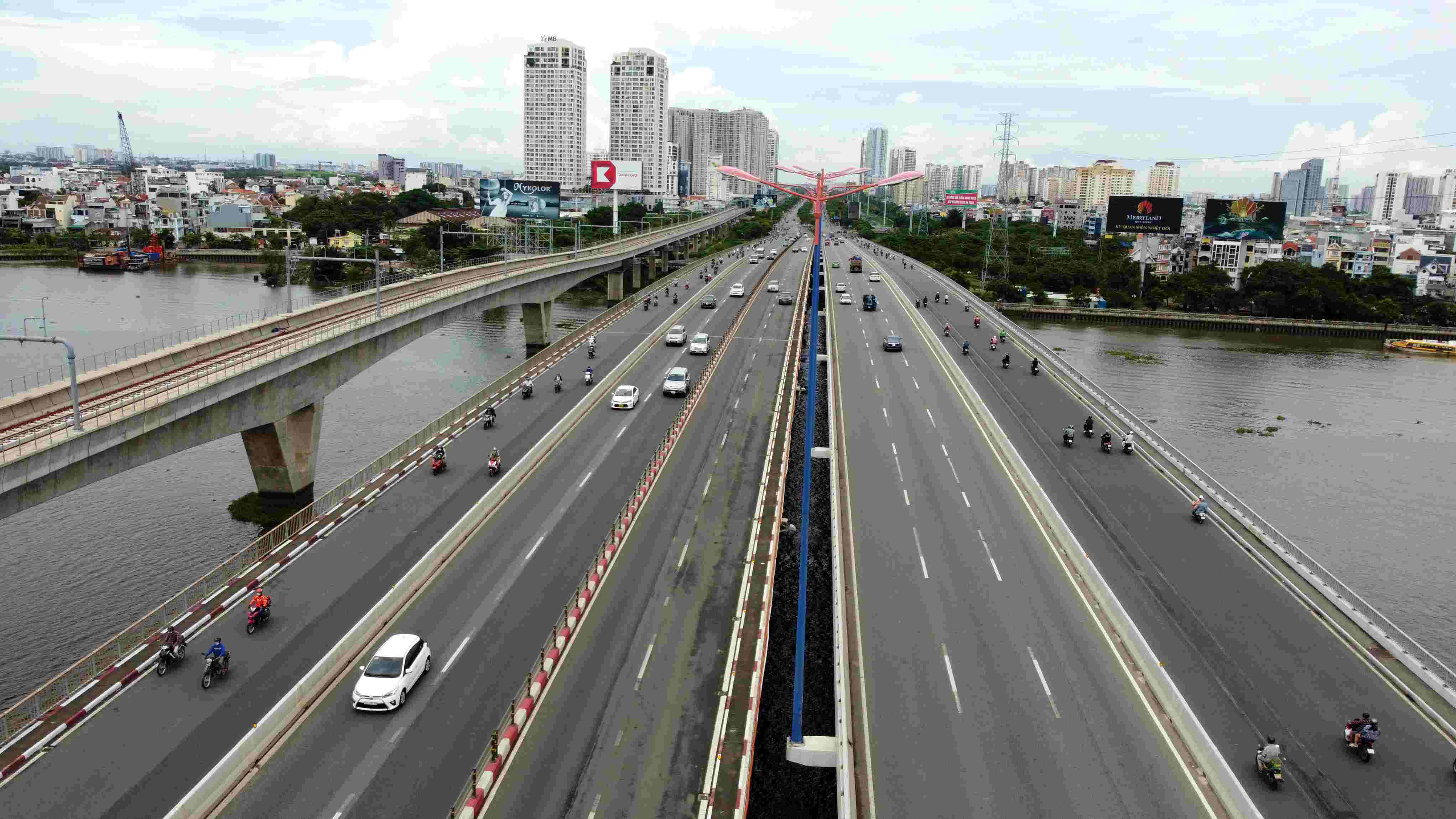
One such “pair of bridges” in Saigon, located next to each other and with the same name, the oldest of which are Saigon 1 and 2, are the most important gateways leading to central Vietnam. The Saigon 1 Bridge is 66 years old, more than 986 meters long (excluding the approach roads at both ends), and its construction started in 1958 and was completed in 1961. The Saigon 2 Bridge has the same length with a shorter construction period; it was constructed from April 2012 to October 2013.
Similarly, the Binh Trieu 1 Bridge, which is 554 meters long (excluding the approach roads at both ends), welcomed road users before 1975, while its younger sibling, Binh Trieu 2, was built in 2001 and completed in 2003. Recently, Thu Thiem 2 Bridge, nearly 1,500 meters long (including the approach roads at both ends), has just been opened, and with the Thu Thiem 1 Bridge, they will become the third-largest pair of bridges with the same name in HCMC.
It also has streets named after famous people linked to the country’s history. Perhaps the most beautiful of these is the story of Nguyen Thai Hoc (1902-1930) and Co Giang (1909-1930). During his lifetime, scholar Nguyen Thai Hoc was the leader of the Vietnam Nationalist Party, leading the uprising against the French in Yen Bai, while Co Giang, whose real name was Nguyen Thi Giang, also joined the uprising led by Nguyen Thai Hoc. They fell in love and got engaged, but then the uprising failed, Nguyen Thai Hoc was arrested and executed by guillotine on June 17, 1930. His fiancée, Co Giang, committed suicide a day later, at 21.
Although it is a short road, Nguyen Thai Hoc Street in District 1, formerly known as Nguyen Thai Hoc Avenue, is the main connection between District 1 and District 4. Near the Ben Nghe Canal, which flows into the Saigon River, is Co Giang Street, a small road that flows into Nguyen Thai Hoc Street as a reminder that even death cannot do the couple apart.
Parallel to Co Giang Street is Co Bac Street. Co Bac, whose real name was Nguyen Thi Bac, is Co Giang’s sister, who was three years older. She joined the revolution with her sister and was also arrested after the unsuccessful uprising in Yen Bai. However, Co Bac was not executed like Nguyen Thai Hoc, but was released and passed away later at 39. Now, in Saigon, the siblings Co Bac - Co Giang, are located next to each other, just a block away from each other, and both lead to Nguyen Thai Hoc Street.
District 1 also has another couple that is even more “famous” in history. Hai Ba Trung Street, nearly three kilometers long, crosses District 1 and District 3. Starting from the same point, Thi Sach Street “goes hand in hand” with Hai Ba Trung Street. Thus, the older sister of the two would forever be with her fiancé and not a heartbroken widow like in history.
While Nguyen Thai Hoc can be considered an “avenue”, Co Giang is just a small street. In contrast, Hai Ba Trung is a big street compared to her less prominent fiancé, Thi Sach. In both cases, the size and length of the streets completely correspond to the reputations of these figures in Vietnamese history.
Dien Bien Phu Street is nearly seven kilometers from Ly Thai To roundabout in District 10 to the Saigon Bridge in Binh Thanh District. To the area of Le Van Tam Park in District 1 (formerly Mac Dinh Chi cemetery), this road still witnesses the reunion of not only the couple but almost a whole family. The brothers, Phan Ton and Phan Liem, are now two intersecting roads leading into Dien Bien Phu Street, which was formerly named Phan Thanh Gian.
Phan Thanh Gian (1796-1867) was a great minister of the Nguyen Dynasty, who committed suicide with poison after turning the city over to the French invaders because he could not fight the enemy. Contrary to the father, his children Phan Ton and Phan Liem fought against the French. In Saigon, Phan reunited with his children until the day the street named after him was renamed a place of historical significance for a unified Vietnam.
Foreigners visiting the center of HCMC should not ignore Le Loi Avenue. In Saigon, Le Lai was reunited with his soulmate, who sacrificed his life to save Le Loi in the final victory of the Lam Son revolution against the Ming army. Le Lai Street is still connected to Le Loi Avenue through Quach Thi Trang roundabout as if they had not been apart for more than six centuries when Le Lai changed into the king’s robe to sacrifice himself for Le Loi.
Similarly, in District 3, there is also a couple comprising two female poets who are among the most prominent in the history of Vietnamese literature. Ba Huyen Thanh Quan (1805-1848) was the name of the 1.5km street from Rach Bung Binh to Nguyen Thi Minh Khai Street. Crossing this street is Ho Xuan Huong (1772-1822) Street, named after another famous female poet. The names of the streets cleverly put these two female poets together despite their difference in poetic styles. On the one side is Ba Huyen Thanh Quan, the author of masterpieces such as “Thang Long Thanh Hoai Co” or “Qua Deo Ngang”, and on the other side is Ho Xuan Huong with many “breakthrough” poems; though it was the 18th century, she already had a “feminist” scent with sexuality in her works while Vietnam was still heavily feudal.
All combinations of Vietnamese historical figures through street names above were arranged before 1975 when HCMC was still Saigon. The author also found that since the reunification day, there have been at least two similar combinations in the city.
First, Le Hong Phong Street that replaced Petrus Ky Street, and not far away is Nguyen Thi Minh Khai Street instead of Hong Thap Tu. It should also be recalled that Le Hong Phong (1902-1942) was a Vietnamese revolutionary, General Secretary of the Communist Party of Indochina, and fiancé of Nguyen Thi Minh Khai (1910-1941), also a revolutionary. In August 1941, Nguyen Thi Minh Khai was sentenced to death by the French. Then a year later, in September 1942, on her husband’s 40th birthday, he passed away in Con Dao prison. Up to now, similar to Nguyen Thai Hoc and Co Giang, in HCMC, their names are also used for two streets. Unfortunately, despite being close to each other, these two roads do not intersect like the other “couples” mentioned above.
The second case is rather a happy reunion, although not between two historical figures, it brings emotions to many Saigonese. After 1975, Le Van Duyet Street in Saigon was merged into Dinh Tien Hoang Street. In 2020, Le Van Duyet Street was restored to its original name on the 188th anniversary of his passing, as a sign of recognition of his contribution to expanding and developing the South of the country. The reunion between Le Van Duyet (1764-1832) and Lang Ong Ba Chieu, where he has been worshiped since the early 20th century until now, is the result of many polls by experts, historians, and locals. Thus, it is a reasonable and meaningful reunion after 45 years.
Among the most famous temples in HCMC, Chua Ong (Nghia An Hoi Quan) and Chua Ba (Ba Thien Hau) temples, both located in Ward 11, District 5, are the top religious sites in terms of “pairs and couples”.
I would also like to quote the words of researcher Le Trung Hoa from the article “Tan man ve dia danh o Sai Gon”. According to him, there could be up to 6,000 destinations in HCMC. About 260 of these have “ba” as preceded element and about 220 of these have “ong” as preceded element.
Saigon now has enough “ong” and “ba”. The city contains all harmonious elements that support each other for a complete formation. Perhaps, for that reason, HCMC attracts and gathers talents from other places. No matter how modern the hardware – the facilities and infrastructure, it is difficult to operate optimally without the software – the best human resources; these two are born for each other.
Fancy making a trip to see Saigon’s pairs and couples with your better half?