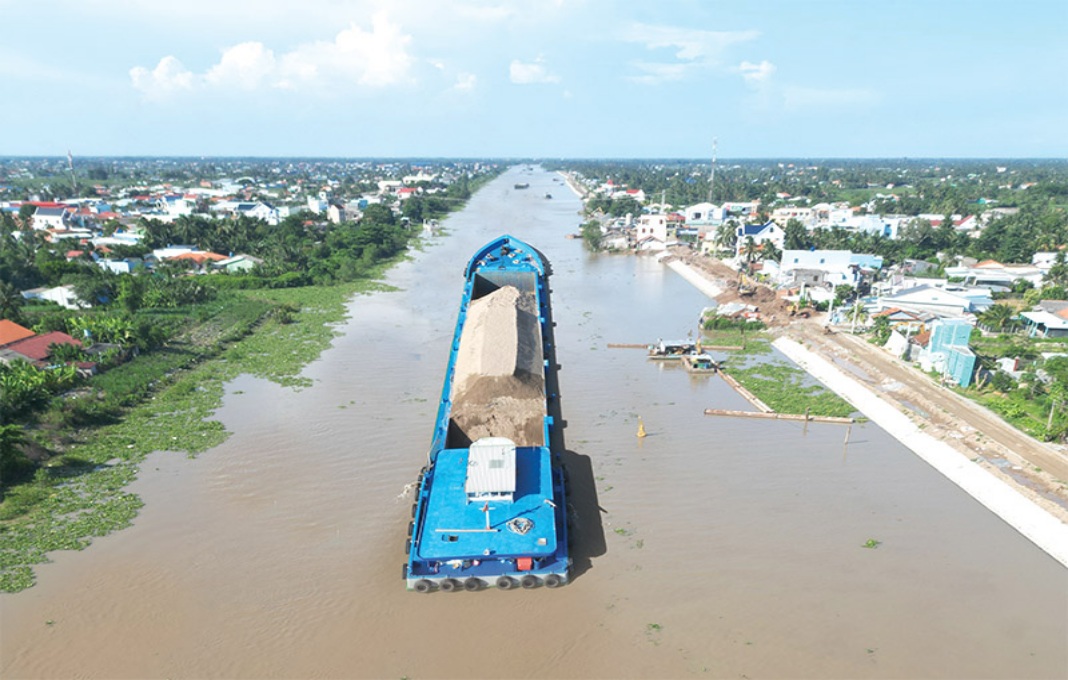
Addressing the severe shortage of sand for infrastructure projects has become an urgent global priority, presenting significant challenges for Vietnam and other regions worldwide.
Rising global demand
Driven by economic growth, urbanization, population expansion, and climate change, the global demand for sand has skyrocketed to 50 billion tons annually over the past two decades, tripling since the late 20th century.
The Asia-Pacific region leads in sand mining, followed by Europe and North America. China stands out as the largest consumer, having used more construction concrete from 2011 to 2013 than the entire U.S. did in the 20th century. Singapore and the UAE also demand substantial amounts, with the latter using 185 million cubic meters to construct artificial islands for tourism, depleting local offshore sources and necessitating sand imports from Australia.
Notably, sand ranks as the second most extracted resource after water. From 1985 to 2015, humans utilized vast amounts to create 13,500 square kilometers of artificial land, equivalent to Puerto Rico's size.
The global sand scarcity has driven prices up sixfold in the past two decades. In 2022, the average price in the U.S. was US$11 per ton, rising to US$10-50 per ton across various countries and territories by 2023, according to Statista.
Limited types of sand suitable for construction
Not all types of sand are suitable for construction purposes. Desert sand, despite its abundance, is unsuitable due to its fine particles, low hardness, and poor cement bonding capabilities. Similarly, sea sand, with its fine, rounded particles, low bearing capacity, and high chloride salt and organic impurity content, is only suitable for filling.
Silica sand, though expensive, finds use primarily in specialized manufacturing sectors such as paints, coatings, and various chemical industries. It is essential in applications like epoxy resin casting, electronic sealing, mold casting, fireproofing, ceramics, and glass production. However, it is not suitable for mortar or concrete mixing due to its specific properties focused on enhancing durability and structural stability.
Granite sand is the only natural sand suitable for construction purposes. It is sourced from natural deposits such as yellow sand in Bien Hoa, riverbeds like those in the Tien and Hau rivers of the Mekong Delta, and specific beaches.
However, excessive extraction of granite sand has led to significant environmental consequences. Research by the Water Integrity Network has shown that since 2008, 90% of the world's beaches have narrowed due to excessive offshore sand mining. Erosion threatens around 70% of beautiful beaches worldwide with potential disappearance by 2100, exacerbated by indiscriminate sand mining that endangers critically endangered species.
Alternatives to natural sand in construction
Currently, there are no artificial materials that can fully replace natural sand in construction and industry. Scientists in the U.S. and Europe are exploring innovative solutions that involve blending cement with materials such as synthetic plastics, copper flakes, non-ferrous metals, and blast furnace slag to create concrete. Initial findings suggest that this composite concrete exhibits superior quality compared to traditional sand-based mixes. While technical challenges remain before widespread adoption in production, these solutions are promising due to their feasibility, economic efficiency, and potential to address future sand shortages.
Another approach involves utilizing finely crushed glass waste in industrial applications and beach restoration efforts. Successful implementation of this method could potentially conserve billions of tons of natural sand.

Currently, the global construction materials industry is ramping up production of crushed industrial sand—also known as synthetic sand—from sources like granite, basalt rock, and recycled concrete debris. This type of sand is ideal for concrete production, offering uniform particle size, high compressive strength, excellent cement bonding, and minimal impurities and dust. However, its production costs are higher compared to natural sand.
Consequently, several developed countries have taken measures such as higher tax on natural sand extraction to incentivize the industrial sand production sector. European nations, for instance, are actively promoting the recycling of concrete waste for construction instead of using natural sand.
In related efforts, the United Nations Environment Programme (UNEP) has recommended global collaboration to establish standardized regulations for managing natural sand mining. Such regulations aim to better control sand exploitation and combat issues associated with illegal mining practices. Without coordinated efforts to improve oversight of sand mining, promote recycling of construction waste, and advance research into alternative materials, the scarcity of sand is likely to worsen in the future.