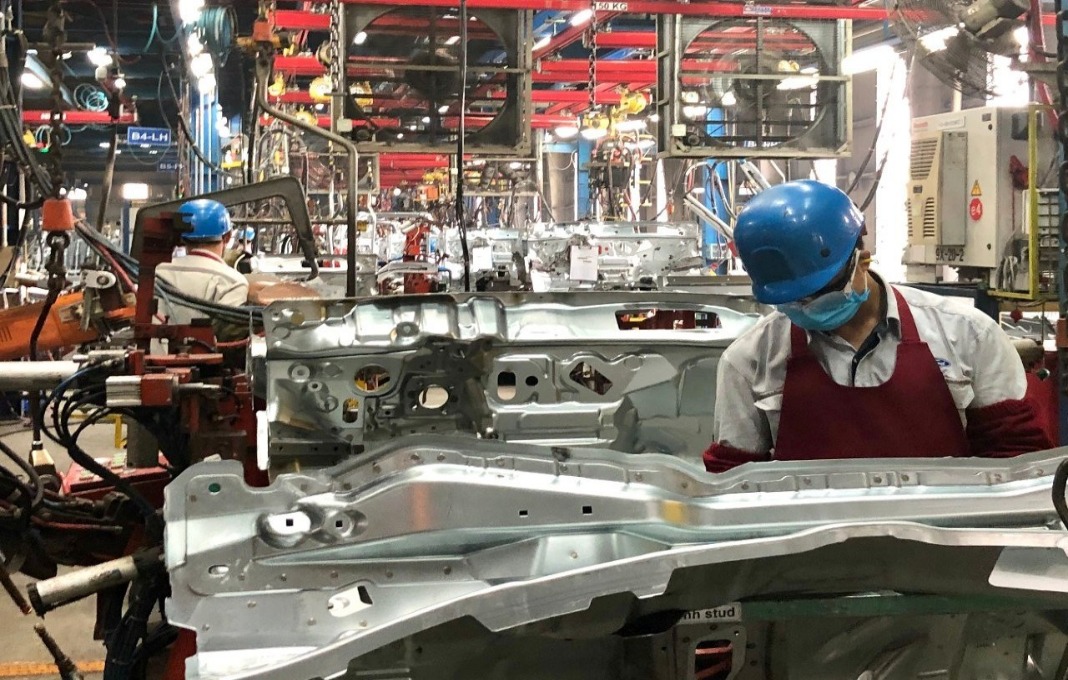
Vietnamese guest workers who receive training in countries with advanced production standards can significantly enhance the skill set of the local labor force.
In 2022, close to 143,000 Vietnamese workers were dispatched to approximately 40 countries, and this number is projected to continue its upward trajectory. According to data from the Ministry of Labor, Invalids, and Social Affairs, Vietnamese workers abroad send home over US$3 billion annually. Vietnam's abundant and affordable labor force, coupled with its youthful population, has positioned it as an attractive destination for foreign direct investment (FDI).
Vietnam has emerged as a prominent labor supplier for economies facing a shortage of young workers, primarily for physically demanding jobs. However, the pressing challenge is to cultivate a pool of high-quality human resources capable of meeting the increasingly stringent requirements of FDI firms and local enterprises. Addressing the shortage of technically skilled workers is crucial to help the nation navigate the middle-income trap. In pursuit of this goal, the focus should be on developing human resources with experience in countries with advanced production methods, rather than merely increasing remittances or securing higher-paying employment opportunities.
The concept of leveraging returning trainees who have worked overseas to enhance the quality of the domestic workforce was first proposed several years ago by Professor Tran Van Tho in Japan. According to a study on the overall development of industrial human resources in Vietnam, published by the Japan International Cooperation Agency (JICA) in May 2022, as of June 2021, Vietnamese nationals constituted 63.8% of approximately 317,000 trainee workers in Japan. Many Vietnamese trainees are engaged in sectors such as construction, mechanical engineering, apparel, agriculture, and fisheries, all of which have a demand for highly skilled workers in Japan, a nation with a population exceeding 122 million. However, upon their return to Vietnam, this labor force from Japan often struggles to secure employment, creating a paradox.
The JICA study reveals that compared to other countries in the region, only 26.7% of Vietnamese trainees find employment upon returning home, a significantly lower figure than the rates exceeding 50% in China, Thailand, and the Philippines. Additionally, the percentage of Vietnamese technical trainees securing jobs in the same or similar roles as their positions in Japan is lower than that of these countries. Among the 390 businesses surveyed in the report, 43% hire skilled trainees returning from Japan, while 33% anticipate a demand for such workers in the next five years. Consequently, the aim of transferring skills through the trainee program for subsequent application in the local labor market appears to be falling short of expectations.
One possible explanation for this paradox is that most laborers in the trainee program possess skills suited for manual and demanding roles in construction, mechanical engineering, and agriculture. They often need to independently acquire additional skills to catch up with their peers, but this learning process is frequently limited in scope and simplicity. Upon returning to Vietnam, these individuals may not possess any significant advantages over the local workforce, yet they anticipate higher positions and salaries that may exceed their skill sets.
Efforts to integrate trainees returning from countries like Japan and South Korea into the existing labor force through job fairs have been ongoing over the years. However, these initiatives have not effectively addressed the bottleneck in labor quality among individuals who have worked overseas and subsequently returned to Vietnam. The challenge of skill transfer persists. It is clear that to resolve the aforementioned paradox, the primary objective of sending workers abroad must be shifted. Instead of viewing overseas employment as a means of "poverty reduction" and as a way to provide employment for rural laborers primarily based on the criterion of physical capability to perform demanding jobs, Vietnamese laborers should be trained to acquire the skills necessary for positions requiring greater expertise and craftsmanship in foreign countries.
To achieve this goal, pre-departure training for overseas work becomes a matter of paramount importance. An exemplary model for this approach is the successful operation of the first upper secondary school in Nam Dinh Province, which teaches students agricultural technology across the value chain, from production to processing agricultural products and foods, following the Japanese model. Graduates from this school not only have opportunities for employment with Japanese-invested agricultural enterprises but can also participate in trainee programs as skilled workers.
Currently, the percentage of Vietnamese guest workers with high-level skills or expertise is no more than 10%. If this situation remains unchanged, Vietnam will not be able to transform labor export into a channel for training high-quality human resources for its economy; instead, it will continue to be primarily a means for selling physical labor.