Amidst challenging economic conditions, a Vietnamese insulation materials company has experienced significant growth by focusing on core production and implementing a new management approach.
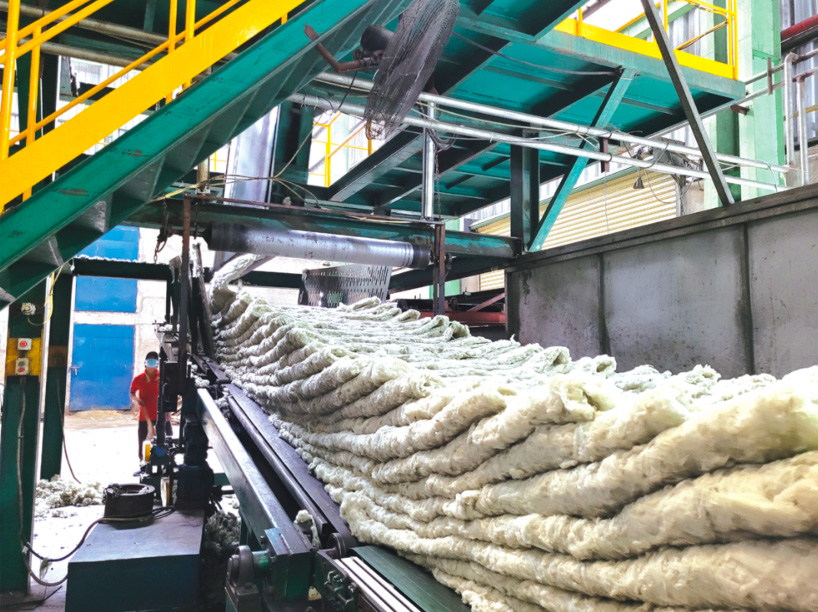
The Viet Long factory, one of the three facilities operated by Khai Hoan Insulation Joint Stock Company, stands as a unique manufacturing plant in Vietnam. It directly produces rockwool, a crucial raw material for insulation boards. The production technology, including blending ratios, has been developed in-house by the company, and their engineers have upgraded machinery themselves instead of relying solely on imports.
Currently, Viet Long is operating at 60% of its designed capacity, producing 25,000 tons of raw materials annually. Ngo Nguyen Ngoc San, CEO of Khai Hoan Insulation JSC, remarked, “The factory boasts significant production capacity, yet the domestic market remains relatively small. We are actively pursuing opportunities in international markets.”
From “a corner store” to industry leader
Over two decades ago, Khai Hoan Insulation was nothing more than a trading enterprise, often likened to a “corner store,” dealing in construction, interior furnishings, and HVAC products. However, with a well-planned strategy and unwavering determination, the company has transformed itself into a prominent manufacturer in the Vietnamese insulation material market.
Khai Hoan made its foray into the insulation material sector with a focus on processing products in the early 2000s, a period characterized by rapid growth in the Vietnamese industrial sector. During this time, the industry faced significant material shortages and relied heavily on imports, particularly from China. In an effort to gain control over this situation, Khai Hoan Insulation considered producing its own materials.
Initially, the company imported machinery from China, but this equipment was ill-suited for Vietnam’s mineral supply, resulting in low-quality rockwool. Despite pressure from the technology provider to continue importing materials from China, Khai Hoan Insulation was determined to reduce its reliance on imported materials.
Undaunted, Khai Hoan Insulation’s engineers embarked on independent research, machinery upgrades, and numerous trials to manufacture rockwool using local materials. “We spent around VND17 million on every furnace test. It took us more than 100 trials worth VND1.7 billion to succeed,” recalled the leader of Khai Hoan Insulation.
Sixteen years since the establishment of the Viet Long factory, the company’s leader remained convinced that their decision to focus solely on manufacturing was risky. At the time, Khai Hoan Insulation was the third-largest supplier of copper pipes for high-rise buildings in HCMC. In contrast, rockwool production was a completely new field in Vietnam with no existing factories. When the company nearly ran out of capital, Khai Hoan Insulation succeeded in pioneering its own rockwool production.
“We will achieve success with constant efforts and determination, even though the path is very narrow,” declared the leader of Khai Hoan Insulation.
Many entrepreneurs might have stepped back and abandoned their efforts to enter a new industrial sector due to challenging market conditions, but Khai Hoan Insulation persisted. Even in a small market, businesses can seize opportunities for growth and become pioneers in their respective sectors, San said with hope.
The Vietnamese insulation material market remains relatively small due to the country’s tropical climate, which generally results in mild weather and low demand for insulation materials. Nevertheless, Khai Hoan Insulation has firmly established itself in the market, capturing 55% of the domestic market and effectively competing with imported products from China. In recent years, the company has also expanded into the Asia-Pacific markets, delivering approximately 3,000 containers to international markets each year.
The “three-legged stool” system
“It is necessary to focus your efforts on core production. As your business grows significantly, it will be easier to allocate resources for expansion into other sectors. That is the power of concentration,” San concluded, drawing from Khai Hoan’s experience.
Currently, Khai Hoan Insulation remains committed to its chosen path of producing high-quality insulation products. With a substantial manufacturing facility and the capacity for continuous improvement, the company believes there is still significant potential for expansion into foreign markets.
San also emphasized that his success came from leveraging the strength of concentration in management. From the very beginning of its establishment, Khai Hoan Insulation has operated under a “three-legged stool” system, with three individuals in charge of three distinct aspects: business, finance, and technical operations. Despite being a family-owned company with both his wife and brother-in-law involved in management, this three-legged stool system has consistently ensured that Khai Hoan Insulation remains free from disruptions. Each person is responsible for a specific aspect, dedicating their full expertise and focusing on excelling in their respective roles.
“Of course, we sometimes have conflicts when working together. However, once we pinpoint the core issue, we allow the person with expertise in that area to concentrate on their tasks,” said San.
As a business grows to a certain scale, it frequently encounters a scenario where a leader in a rapidly expanding area wishes to intervene in a slower-paced one. Nevertheless, such interference should be avoided in management.
Drawing from his own experience, San explained that a CEO is not expected to handle every task within a company. Instead, a CEO’s strength should lie in sales. In a well-structured business, a CEO can concentrate on their areas of expertise rather than getting involved in other aspects.
Le Duc Nghia, chairman of the Board of Directors at An Cuong Wood Working JSC, also expressed a similar idea, defining it as professionalism in business management. In this top-tier industrial wood business, each department is entrusted with a clear focus on their specific roles, along with decision-making authority. An Cuong Wood is also another prime example of a company dedicated to its core products.
The leadership of both major companies in the industrial wood production and insulation material industries emphasizes the importance of focusing on core business activities and professionalism within their teams. Even in the absence of the top leaders, the companies can continue to operate smoothly.