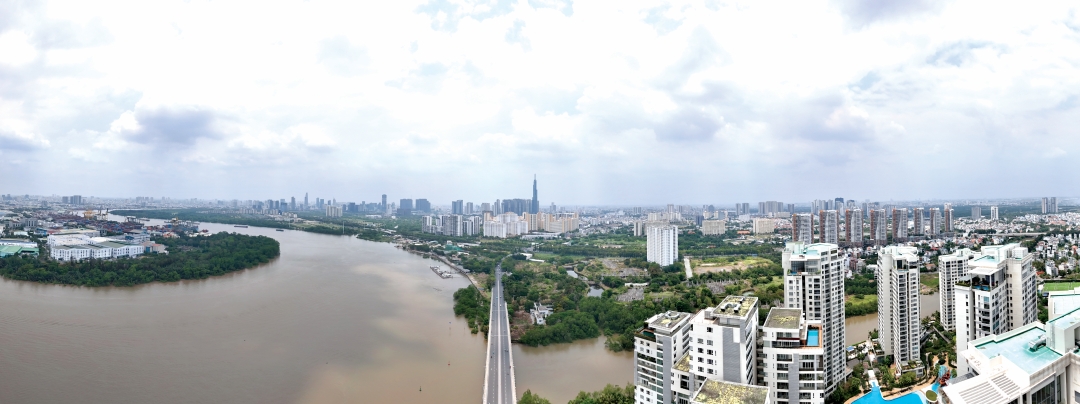
For HCMC to truly become a “megacity—a regional and global hub for finance, manufacturing, logistics and innovation,” and to realize its development goals for 2030 with a vision to 2045, it is necessary to implement far more comprehensive and breakthrough reforms in institutions, policies and legislation than the current special mechanisms and policies.
On November 27, 2025, the Central Policy and Strategy Commission, in coordination with the HCMC Party Committee, People’s Council and People’s Committee, co-chaired a workshop titled “Special and Breakthrough Mechanisms and Policies to Attract Investment and Strategic Investors to HCMC in the New Context.”
According to the Central Policy and Strategy Commission, in addition to providing input on amendments to Resolution 98/2023/QH15 on piloting a number of special mechanisms and policies for the development of HCMC, participants at the workshop proposed six strategic solutions aimed at transforming the city into a “megacity—a regional and global center for finance, manufacturing, logistics and innovation,” and at realizing the development targets for 2030 with a vision to 2045.
First, it is necessary to further strengthen decentralization and delegation of authority in a manner that enhances HCMC’s autonomy and accountability, in line with the principle of “local decision-making, local implementation, local responsibility.” Priority should be given to areas such as planning, investment, urban management, natural resources and the environment, as well as the issuance of special policies and regulations within the overarching legal and policy framework of the central government. For matters beyond its authority, the city should be allowed to report directly to the central government, which in turn should designate a focal body to handle such issues within a defined timeframe.
Second, the attraction of strategic investors should follow the principle of “selective attraction combined with long-term nurturing,” viewing strategic investors as “development partners” who accompany the city and jointly shape its growth.
Under this approach, the portfolio of strategic investment projects would comprise three groups.
The first group includes sectors with strong spillover effects and system-wide synergies, focusing on industries capable of driving growth, upgrading production and industrial capacity, reducing systemic costs, and elevating value chains. This group covers projects in high-tech processing and manufacturing, automation, biomedicine, regional and interregional logistics, and global maritime services; projects to upgrade socio-economic infrastructure, governance systems and smart urban development; projects to improve public services and reduce compliance costs; as well as projects in tourism, high-quality services and the creative and cultural industries.
The second group consists of high-tech fields or those aligned with emerging technological trends, including strategic projects in large-scale data centers and green data, cloud computing, artificial intelligence (AI), the Internet of Things (IoT), cybersecurity, digital platforms for smart cities, chips and semiconductors, financial services, digital finance, financial technology (FinTech), innovation and start-up hubs, software development, and education technology; as well as submarine fiber-optic cable infrastructure and landing stations in coastal and riverine areas.
The third group comprises strategically essential sectors aimed at enhancing resilience and self-reliance. These include industries that play a critical role in regional and national economic security, help reduce the risk of supply chain disruptions, strengthen autonomy in energy, food, healthcare and data, and improve long-term resilience, such as clean energy, the green economy and the circular economy.
Beyond capital scale, the selection of strategic investors should also take into account factors such as technological capability, commitments to research and development (R&D), localization rates, and the number of Vietnamese small and medium-sized enterprises integrated into the value chain. For certain key projects, additional requirements may be attached regarding budget contributions, environmental indicators and social responsibility.
To build confidence among leading global investors, investment contract mechanisms should be applied. HCMC needs to be granted the authority to negotiate and sign such investment contracts or strategic agreements.
To compete for global corporations, breakthrough financial and tax incentives are needed, particularly preferential personal income tax regimes, import tax exemptions for R&D equipment, and value-added tax incentives for high-tech services. Models such as “Technology Visas” or “Golden Visas” for experts should also be applied. Strategic investors should be granted integrated development rights for a defined period within a designated area, including the right to prepare detailed plans, invest in internal infrastructure, conduct commercial exploitation, and develop supporting services. The state would supervise these activities based on land-use performance indicators.
Third, with regard to urban management, natural resources and the environment, mechanisms are needed to create clean land reserves for industry and services. The HCMC People’s Council should be allowed to decide on the conversion of rice land and protection forest land, within certain limits (for example, less than 500 hectares per year), into industrial and service land for strategic investment projects in the city. At the same time, the scope of applying the transit-oriented development (TOD) model should be expanded, rather than being limited only to areas around urban metro lines as at present.
Fourth, in developing strategic industry clusters, HCMC must form clusters with sufficient density and strong linkages among enterprises, universities, research institutes and the state. Priority clusters include high technology, semiconductors and AI; international finance, FinTech and business services; logistics, seaports and maritime industries; the marine economy, clean energy and oil and gas services; and cultural industries and creative research.
Fifth, regarding the introduction of sandbox mechanisms (controlled experimentation) in finance, technology and smart urban development, HCMC could establish a multi-layered sandbox system.
In finance and FinTech, pilot programs should be allowed for cross-border payments, digital banking, digital assets, carbon trading and open banking services, under close but flexible regulatory supervision. In smart urban development, certain areas could serve as testbeds for autonomous vehicles, AI-based traffic management, smart energy management, integrated IoT systems and data-driven smart zoning models. For seaports and logistics, pilot programs could be permitted for smart port technologies, automated terminals, logistics robots, blockchain-based supply chain tracking systems and smart container management models.
Finally, regarding implementation mechanisms, first and foremost, a dedicated unit for attracting and supporting strategic investors is needed. This unit should be empowered to handle investment procedures end-to-end for strategic projects, have the authority to coordinate across sectors, and is staffed with an elite workforce recruited to international standards and remunerated under market-based mechanisms. HCMC also needs to accelerate digital governance, transparency and data integration to minimize transaction costs for businesses.
Alongside mobilizing and utilizing private-sector resources, state-owned enterprises play an important role in leading and serving as the backbone in many economic, social and political sectors. Therefore, it is proposed that the central government approve the establishment of wholly state-owned corporations under HCMC’s jurisdiction, including: (1) a public utility services corporation; (2) a financial investment corporation; (3) a digital infrastructure corporation; and (4) an urban railway corporation.
To ensure sufficient financial capacity to implement large-scale projects and to partner with strategic investors over the long term, the city needs a development financial institution modeled on Singapore’s Temasek or Malaysia’s Khazanah, but designed to suit Vietnam’s context—potentially to be called the HCMC Development Investment Fund.