The United States remains Vietnam’s largest export market, with nearly US$90 billion in export revenue recorded in the first nine months of 2024.
Rising tensions in the Red Sea have forced shipping lines to reroute vessels to bypass the Suez Canal due to attacks on commercial ships by Yemen’s Houthi rebels. These diversions to longer routes, primarily around the Cape of Good Hope, have sent fuel and other costs soaring, contributed to vessel shortages, and driven up freight rates, as more ships are needed to maintain cargo flow on extended routes.
The impact of disruptions goes beyond international waters. In the U.S., the collapse of the Francis Scott Key Bridge in March 2024 halted traffic for months at Baltimore—a key roll-on/roll-off cargo port. Further disruptions followed with a work stoppage at U.S. East and Gulf Coast ports on October 1, 2024, underscoring that supply chain disruptions are now a consistent challenge.
Building and investing for the future
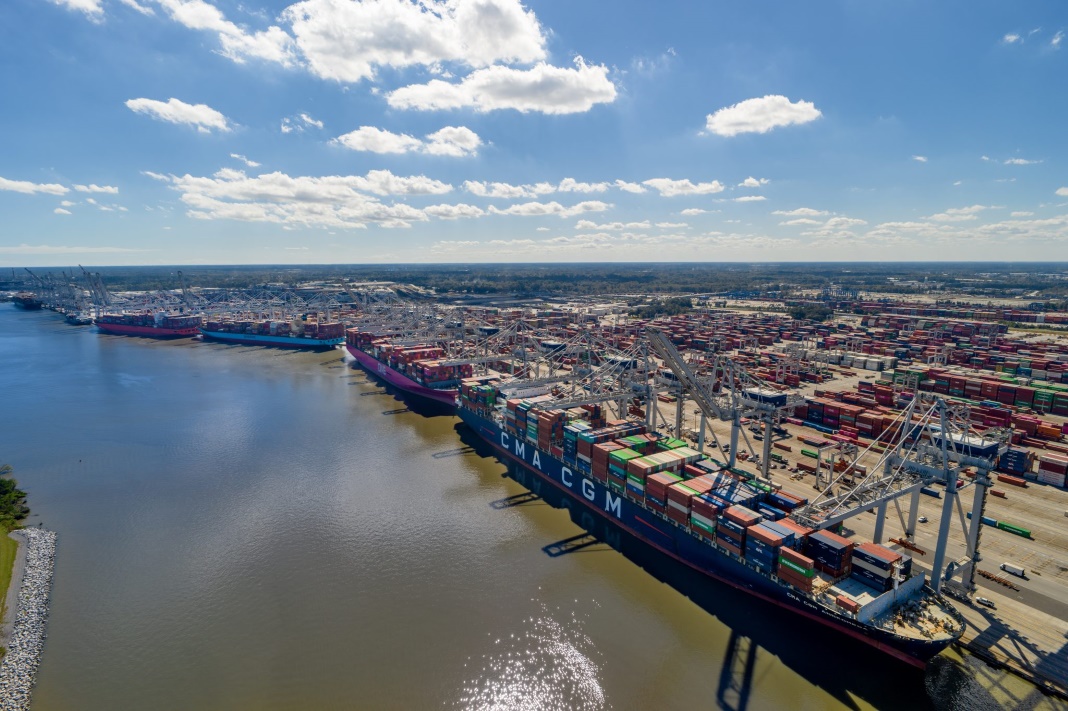
The Georgia Ports Authority (GPA), the owner and operator of the Port of Savannah, exemplifies proactive investment to tackle supply chain challenges. GPA’s two-pronged strategy focuses on expanding the Port of Savannah into the premier container terminal on the U.S. East Coast and developing the Port of Brunswick into the leading RoRo terminal in the nation.
As part of its master plan, GPA has earmarked US$4.2 billion for projects aimed at increasing capacity and enhancing inland supply chain connections. Additionally, Georgia’s rapidly growing economy, favorable business environment, and ample land for development make it an attractive destination for foreign direct investment. With its access to the Southeast’s expanding consumer market and proximity to Atlanta—the region’s business hub—Georgia is well-positioned to strengthen its role in U.S. logistics and supply chains.
Several key trends are shaping the GPA’s strategic market position in the U.S. Southeast. Since 2012, the region’s population has surged by 9%, adding 6.5 million people and fueling consumer demand. Rapidly growing states like Texas, Florida, North Carolina, Georgia, South Carolina, and Tennessee are leading this trend, which has also attracted significant manufacturing investments to the Southeast. Georgia has seen notable success in the automotive sector, with Hyundai’s US$10 billion Metaplant and its suppliers set to generate 15,000 new jobs, positioning the state as a key player in automotive manufacturing.
Beyond demographic and manufacturing shifts, sourcing trends are also accelerating GPA’s growth. As businesses adopt a “China Plus One” strategy to diversify supply chains in Southeast Asia, demand for U.S. East Coast routes has risen due to faster shipping times than the West Coast.
This shift has significantly altered the balance of U.S. port traffic. In 2002, West Coast ports handled 56% (14.5 million TEUs) of U.S. container volume, while East and Gulf Coast ports accounted for 44% (11.3 million TEUs). By 2024, the West Coast’s share dropped to 45% (24.0 million TEUs), while East and Gulf Coast ports handled 55% (29.2 million TEUs).
Vietnam has become a critical growth market for Savannah, Georgia. In fiscal year 2024, container imports from Vietnam to the U.S. rose by 26% year-on-year, with Vietnam’s share of Far East imports reaching 14%, up from just 5% a decade ago. During the same period, 295,500 TEUs were recorded between Vietnam and the U.S. Southeast port, a 50% increase in Vietnam-Savannah trade between FY2020 and FY2024.
Savannah has emerged as the leading U.S. Southeast port for trade with Vietnam, handling 10.4% of U.S. container trade with the country in FY2024. Vietnam is now Savannah’s second-largest trade partner, accounting for 7.8% of the port’s total trade volume in FY2024, up from 5.6% in FY2020.
To manage future growth and supply chain challenges, the GPA is undertaking projects to double berth capacity and expand yard, gate, and rail infrastructure, prioritizing landside efficiency.
Key developments at the Port of Savannah include the operational Mason Mega Rail, with a capacity of two million TEUs, and Garden City Terminal West, which adds another one million TEUs. Additional infrastructure plans include Ocean Terminal (2 million TEUs) and Savannah Container Terminal (3.5 million TEUs). With these enhancements, Savannah’s capacity will grow from seven million TEUs today to 12 million TEUs by 2030.
“We’re building and investing in capacity for future growth to help customers make long-term plans for their supply chains and tap into the U.S. consumer market,” said Ed McCarthy, Georgia Ports Authority’s Chief Operating Officer, speaking at AmCham Vietnam in HCMC on October 29, 2024. “Our port and inland operations are among the best in the U.S. We handle over 35 ships per week in Savannah with 24/7 operations, ensuring faster turnaround times. Additionally, we offer a wide range of on-terminal cargo storage options to adjust supply chain speed, enabling customers to easily adapt to changing market demands.”

“At Georgia Ports, we’re building a gateway port and world-class supply chain connectivity unmatched in the U.S.,” said Flavio Batista, GPA’s Chief Commercial Officer. “Our gateway port model boasts the fastest-growing capacity in the country, with inland connections that are quicker than any other port. Imports move inland by rail within 24 hours of arrival, compared to U.S. West Coast ports where cargo can sit 6-9 days waiting for rail departure.
Our truck turn times at the gates are just 50 minutes for a dual transaction, with around 7,000 trucks entering and exiting the terminal daily. This rapid rail and truck system for inland deliveries enhances supply chain speed, offering a financial advantage for inventory management and e-commerce fulfillment. This resilience and wide range of options are essential for supply chain planners as they tackle disruptions.”
The United States remains Vietnam’s largest export market, with nearly US$90 billion in export revenue recorded in the first nine months of 2024. Key U.S. imports from Vietnam include textiles, footwear, furniture, seafood, high-tech products, and machinery. Meanwhile, the U.S. exports machinery, electronics, cotton, and agricultural products to Vietnam.
These infrastructure and operational advancements position GPA to support the increasing trade between the U.S. and Southeast Asia, providing a robust, high-velocity solution to meet evolving supply chain needs.