“I first began reading The Saigon Times during my earlier posting at the Consulate-General of Japan in Ho Chi Minh City, from 1994 to 1998. Those were exciting times, with Vietnam opening up under the Doi Moi reforms and many Japanese companies were establishing their presence in southern Vietnam. As an officer responsible for economic affairs at the Consulate-General in those days, I found the up-to-date information The Saigon Times provided on Vietnam’s economy truly invaluable — and I am sure the Japanese business community here shared that sentiment.
There is a question that has occupied philosophers across cultures and centuries: what does it mean to live in a world where everything changes, and nothing lasts?
"The Saigon Times has been a trusted source of information for the French Consulate for many years. Its English edition enables expats like me to stay well informed about business, economic and social developments in Vietnam. It has also been one of the reliable sources we use for our daily news round-ups and updates, helping us keep track of what is happening both locally and nationally.
Officially launched in 2018, Vietnam’s One Commune One Product (OCOP) program now sees over 14,000 products certified with 3-5 star ratings, and produced by more than 8,000 entities including cooperatives, small production units, and cooperation groups. However, despite these achievements, OCOP products are rarely seen in supermarkets, and their prices often exceed standard levels.
To strengthen its presence both domestically and internationally, the OCOP movement should move away from outdated practices and embrace innovation to meet the expectations of consumers worldwide.
From seasonal to year-round availability
The foundation for OCOP was laid in 2008 when the Ministry of Agriculture and Rural Development piloted the “One Village, One Trade” model in several cities and provinces, such as Dien Bien, Hanoi, Bac Ninh, Nam Dinh, Thua Thien-Hue and An Giang. Local governments leveraged this initiative to develop rural trades by creating value chains, linking production entities with specific products, and helping farmers access markets more effectively.
In 2013, Quang Ninh Province introduced the “One Commune One Ward, One Product” program as part of its rural development strategy. This initiative demonstrated significant success, fostering local strengths and expanding market access for farmers.
The program was officially expanded nationwide in 2018 with the Prime Minister’s endorsement of the OCOP program for the 2018-2020 period. Over this timeframe, nearly US$1 billion was mobilized, with the State budget contributing 2.7%, bank loans 76.6%, and producers’ capital 16.5% (1).
OCOP products face several hurdles, including inconsistent packaging standards and difficulties in scaling production. According to a supermarket purchasing representative, even when production meets demand, maintaining consistent quality and timely delivery remains a challenge.
A representative of MM Mega Market told The Saigon Times that OCOP products are perceived as “fine products with high prices,” which is why they are mainly featured in special booths and stalls during the Tet (Lunar New Year) festival. During this festive season, consumers are more inclined to pay a premium for unique and high-quality items.
Hanoi recently organized three OCOP product fairs, while HCMC hosted an agro-product festival showcasing OCOP products nationwide. Similar fairs in other localities attracted significant consumer interest. However, despite their appeal, maintaining enthusiasm and long-term consumer recognition of OCOP products remains a challenge.
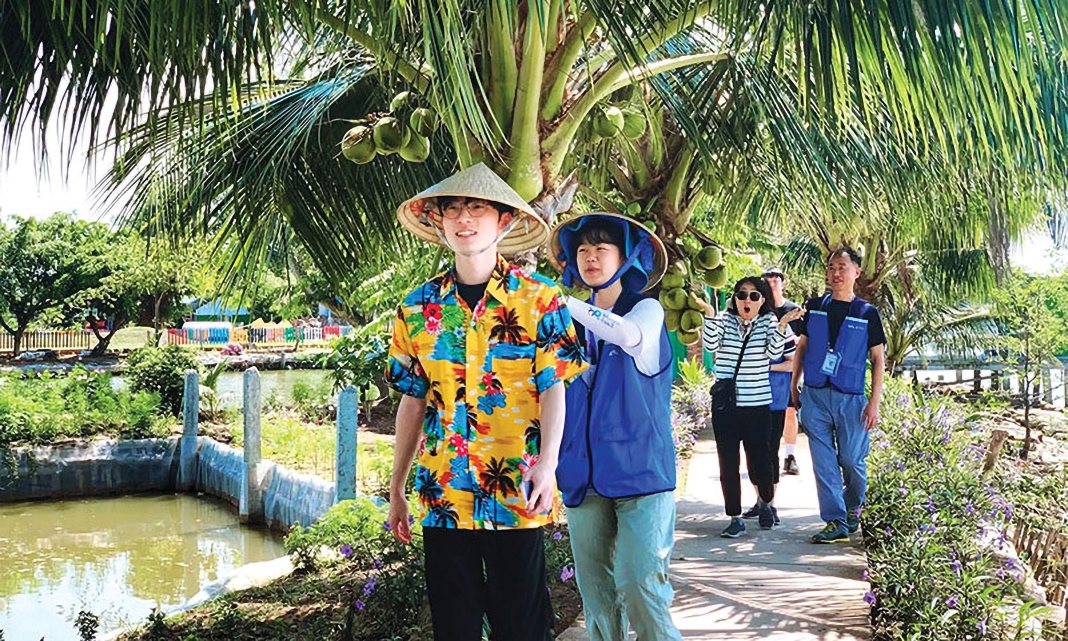
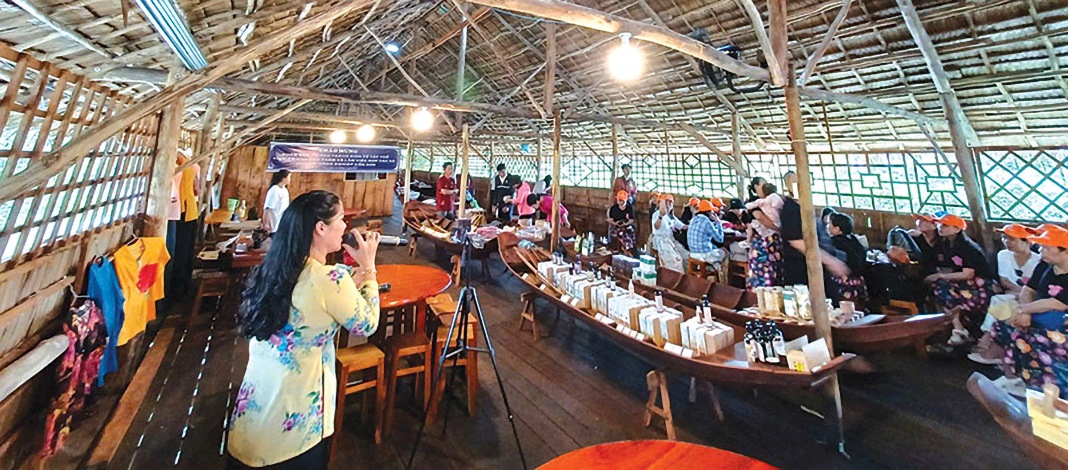
Rural areas in the Mekong Delta account for approximately 25% of Vietnam’s OCOP products, yet tourist destinations featuring these items are limited. In Can Tho City, for instance, only about 10 spots actively sell OCOP products.
Visitors to Son Islet in Can Tho City can enjoy southern traditional songs and OCOP specialties - PHOTO: NGOC BICH
Visitors to Ms. Diep’s guava orchard in Thot Not District are captivated by its lush greenery and the chance to pick guavas and sample fermented guava juice, an OCOP-certified product. According to orchard owner Le Hong Diep, her guava juice “sells like hot cakes,” and she plans to introduce guava leaf tea soon.
Similarly, Ut Anh’s tra fish (pangasius) paste facility in the same district offers specialties like tra fish sauce and dried tra fish, which are popular among urban customers. Tourist attractions such as the My Khanh Village in Phong Dien District, the Con Son Agri-Tourism Cooperative in Binh Thuy District, and the Nha Be rice noodle exhibition point at the Cho Noi floating market in Cai Rang District also see significant visitor traffic.
While these efforts showcase the potential of OCOP products to draw interest, their success is often limited when promoted in isolation.
A new direction for Vietnam’s OCOP products
Vietnam’s OCOP (One Commune One Product) program is facing fresh challenges as it seeks to compete in international markets. Issues such as meeting global standards for quality and packaging, addressing pricing concerns, leveraging modern marketing tools, and building strong brand recognition are now pivotal for its success. Additionally, achieving sustainability, embracing technological innovation, and enhancing ties with experiential tourism require urgent attention.
The Ministry of Agriculture and Rural Development has identified green standards as a significant challenge for Vietnam’s OCOP products. In collaboration with the United Nations Food and Agriculture Organization (FAO), Vietnam is working to develop “Green OCOP Criteria” and aims to elevate them to international standards (2).
At the Mekong Connect 2024 exhibition, Stephen Kreppel, a globally renowned marketer and advertiser, highlighted the unique appeal of products rooted in local characteristics. “These products still make a strong impression on international buyers,” said Kreppel, who has served as a consultant to the United Nations and various European and Asian political leaders, currently the CEO of The Nation Consultancy, headquartered in London and Strasbourg.
“In an international market, local authenticity is the key differentiator,” said Kreppel. He shared an example from a coffee and tea stall at a recent exhibition in Long Xuyen City, An Giang Province. “Coffee is a specialty of Daklak, and tea comes from Lam Dong and Thai Nguyen provinces. However, this company also operates a jasmine orchid in An Giang. To stand out internationally, they should highlight their jasmine products tied to An Giang’s local identity, rather than competing in broader markets for coffee and tea,” Kreppel told The Saigon Times.
Kreppel noted that businesses in the Mekong Delta are beginning to understand global food industry trends, but he urged them to “think differently” when creating OCOP products for international audiences.
One unique product that captured Kreppel’s attention was the floating rice developed by An Giang University and other Mekong Delta farming models. Floating rice, an iconic crop of the Mekong Delta, is underutilized in processed products.
“In global markets, rice is typically milled but not polished or whitened after harvest,” Kreppel explained. “This results in rice with a milky, brown, or crimson hue. Whole grain rice retains its bran layer, either entirely or partially, unlike husked rice. It offers higher nutritional value compared to polished white rice and is widely regarded as a healthier option. Whole grain rice and rice with bran are increasingly preferred by consumers worldwide.”
Kreppel noted that many Vietnamese businesses are cultivating Japan’s Japonica rice, believing it fetches a higher export price compared to local rice varieties. “If the ST25 rice is recognized as the world’s best, my question is why Vietnam isn’t promoting it more aggressively,” he said. “It represents the story of the Mekong Delta and serves as a symbol of Vietnam’s rice industry. With high-quality rice varieties and compelling narratives, the Delta’s rice can achieve values equal to or surpassing Japonica or other global varieties.”
He also pointed out that global consumers are increasingly drawn to products with little or no sugar added and are willing to pay a premium for them. However, Vietnamese businesses offer few such options. Candies and jams with reduced sugar may not look as appealing as their sugar-laden counterparts, but customers prioritize health and are ready to pay more for healthier alternatives, Kreppel emphasized.
Kreppel expressed admiration for the Delta’s innovative circular and green economic models. At a booth from Hau Giang Province, he learned about a 4- to 5-star OCOP liquor producer that repurposes excess yeast as animal feed or fertilizer and transforms liquor into herbal massage oil. “This kind of ingenuity showcases the unique qualities of Delta products,” the brand consultant remarked.
(1), (2) https://openknowledge.fao.org/server/api/core/bitstreams/e5db9abd-059b-4f9d-8b9d-130d101d8a94/content
“I first began reading The Saigon Times during my earlier posting at the Consulate-General of Japan in Ho Chi Minh City, from 1994 to 1998. Those were exciting times, with Vietnam opening up under the Doi Moi reforms and many Japanese companies were establishing their presence in southern Vietnam. As an officer responsible for economic affairs at the Consulate-General in those days, I found the up-to-date information The Saigon Times provided on Vietnam’s economy truly invaluable — and I am sure the Japanese business community here shared that sentiment.
There is a question that has occupied philosophers across cultures and centuries: what does it mean to live in a world where everything changes, and nothing lasts?
"The Saigon Times has been a trusted source of information for the French Consulate for many years. Its English edition enables expats like me to stay well informed about business, economic and social developments in Vietnam. It has also been one of the reliable sources we use for our daily news round-ups and updates, helping us keep track of what is happening both locally and nationally.





 Kreppel noted that many Vietnamese businesses are cultivating Japan’s Japonica rice, believing it fetches a higher export price compared to local rice varieties. “If the ST25 rice is recognized as the world’s best, my question is why Vietnam isn’t promoting it more aggressively,” he said. “It represents the story of the Mekong Delta and serves as a symbol of Vietnam’s rice industry. With high-quality rice varieties and compelling narratives, the Delta’s rice can achieve values equal to or surpassing Japonica or other global varieties.”
He also pointed out that global consumers are increasingly drawn to products with little or no sugar added and are willing to pay a premium for them. However, Vietnamese businesses offer few such options. Candies and jams with reduced sugar may not look as appealing as their sugar-laden counterparts, but customers prioritize health and are ready to pay more for healthier alternatives, Kreppel emphasized.
Kreppel expressed admiration for the Delta’s innovative circular and green economic models. At a booth from Hau Giang Province, he learned about a 4- to 5-star OCOP liquor producer that repurposes excess yeast as animal feed or fertilizer and transforms liquor into herbal massage oil. “This kind of ingenuity showcases the unique qualities of Delta products,” the brand consultant remarked.
(1), (2) https://openknowledge.fao.org/server/api/core/bitstreams/e5db9abd-059b-4f9d-8b9d-130d101d8a94/content





