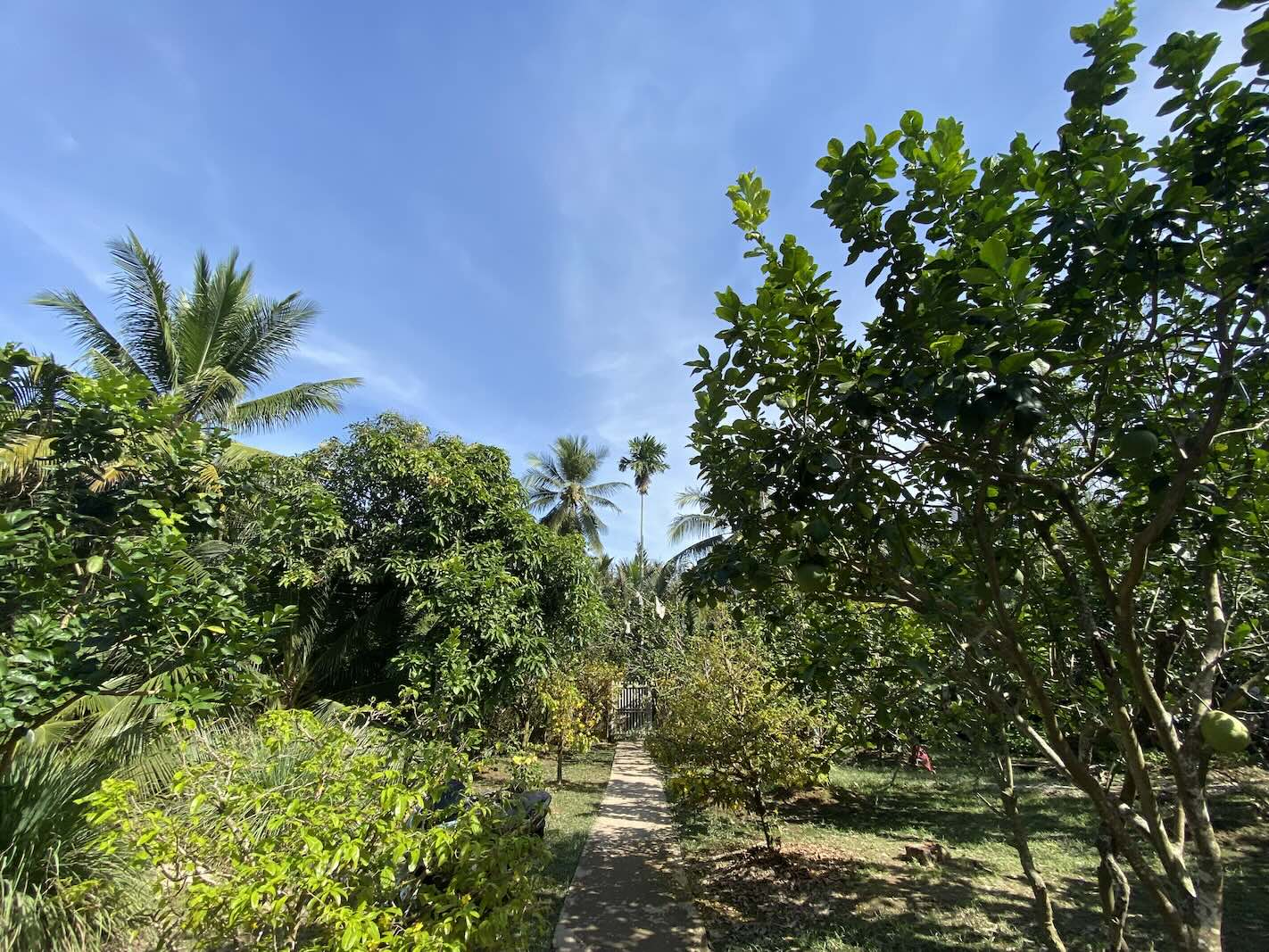
The coconut land of Ben Tre has no mountain, no cave and no beautiful beach, but a young man has discovered abundant native resources and created tours that delight tourists.
Abundant local resources
Eight years ago, when Vo Van Phong started tourism business in the former province of Ben Tre (now merged with Vinh Long Province), he realized that tours bringing tourists to tourist spots with recreation games and parties with familiar foods, such as fried giant gourami like in the Mekong Delta region’s tours, would soon make tourists bored and not return. However, Ben Tre does not have mountains, caves, or beautiful beaches, so how can the province attract tourists who are keen on exploration? The young director was preoccupied with this question and decided to choose his own way: doing tourism business with native resources.
Ben Tre is home to orchards with delicious fruit, coconut gardens, rivers and canals lined with cork trees and nipa palms, mangrove forests, coconut markets, and the Giong Trom (Trom Islet), the land of many generals and national leaders, and is also the birthplace of the Dong Khoi (general uprising movement). These are precious resources to Phong, but the interesting thing is the way he exploits these resources.
Phong has designed the seaward tours with the slogan C2T, the Vietnamese abbreviation of the company’s slogan, “Only dedicated and conscientious to serve tourists,” under his leadership as director of C2T Tourism Communications. The seaward tour allows tourists to learn how to catch mudskippers in mangrove forests and grill them to enjoy with chili salt, as well as how to catch sea crabs and bind their sharp claws. Tourists can wade in the alluvial ground of mangrove forests and plant the forest with locals to keep the soil and allow the alluvial ground to expand towards the sea. They can explore the Chay Muoi Islet at Binh Dai Beach, which features a dike over one meter high formed by sea snails brought ashore by waves over a long period. There, they can catch snails, boil them, and enjoy their meat with chili salt. Although Ben Tre’s 65-kilometer coastline does not have beautiful sandy beaches for those who love bathing, C2T allows tourists to experience the daily, familiar life of locals in a lively and impressive way through such tours.
Phong also offers tours under the shadow of coconut trees in Ben Tre. With his cruise tour, tourists can admire the river, and the tourist boat brings them near the mangrove forest by the Ben Tre River to pick mangrove apples, which are used as sauce to enjoy with freshly caught giant river prawns, boiled by the boat owner at the order of C2T. They can visit canals shaded with nipa palm trees and take a photo of this typical, idyllic scenery of the Mekong Delta region. Upon arriving ashore, they can enjoy pineapple-scented coconut drinks for refreshment at Ms. Sau Diep Garden, learn how to differentiate the pineapple-scented coconut and the Siamese coconut, paddle canoes, ride bicycles on roads full of flowers in the rural village and experience making coconut candies and weaving mats with locals. During the return trip at night, tourists are brought to the quay under the light of coconut leaf torches, and the cruise tour allows them to admire the mangrove trees by the riverside, illuminated by the flickering light of fireflies—a wonderful natural scene that urbanites can hardly experience.

Phong also collaborates with local fruit farmers to bring tourists to their orchards, where they can pick rambutans, durians, and mangosteens and enjoy meals under the shade of the trees or participate in other services. The orchard owners have pledged with C2T to charge tourists a fair price for enjoying don ca tai tu (southern amateur singing) or learning mat weaving. He also signs contracts with local households to allow tourists to visit on the occasion of a death anniversary or wedding parties to learn about the local culture. He said that studying local culture and including this activity in tours is different and is based on the particular “taste” of each tourist group. “It is like preparing dishes to the taste of diners. When their own taste is taken care of, diners feel more satisfied as if they are loved and respected. Therefore, tourists in other regions, as well as foreign and overseas Vietnamese visitors, are very pleased. They are eager to return to C2T every year and ask if there is something interesting offered,” Phong told The Saigon Times.
Net zero tours
C2T tours offer a variety of features that always delight tourists. In 2018, the company received the top award for its project “Exploiting native resources for tourism,” granted by the Center for Business Research and Enterprise Support (BSA). It was also selected by the Institute for Business Application and Innovation (3AI) for collaboration on pilot Net Zero tours in tourism and became the first net-zero tour operator in the Mekong Delta.
“The city under the coconut tree shade” has a new name, courtesy of the Net Zero tour, which promotes eco-friendly activities aimed at reducing carbon emissions. With this tour, C2T has replaced fruit baskets, tissue paper boxes, and table napkins used in tourist boats with coconut leaf counterparts. The tour guide offers each tourist a green passport with a pencil to note acts that help reduce emissions during the tour.
For example, for tourists traveling in a four-seat sedan from HCMC, the emission volume is 22 kilos of CO2. For a 16-member tour group traveling in four sedans, the volume is 88 kilograms of CO2. The tour guide would suggest that tourists do things that can help neutralize emissions during the tour, such as drinking coconut milk instead of plastic-bottled water, using biodegradable straws made from grey sedge, and eating giant river prawns caught in the river, but only one prawn per tourist, to help preserve the fishery resources. Tourists can give the river prawn fisherman some money for releasing small shrimps and shrimp roe into the river, while roots, palms, and nylon garbage in the river will be brought to a collection point for disposal. After dining on the boat, tourists can wash their hands with mangrove apples instead of soap, which is a polluter of the river environment. These are CO2 emission reduction acts that are counted to deduct the initial emissions.
Tourists are also requested to participate in CO2 reduction activities, such as planting cork trees on the riverbank alluvial ground. The cork tree not only retains soil and absorbs CO2 but is also the habitat of many flora and fauna, including birds and bees. Its ripe fruit falls into the river and serves as feed for fish, and the fish is the food for humans. Under the shade of cork trees are many kinds of plants and fish.
The Net Zero tour also suggests reducing carbon emissions in eating and drinking, such as boiling food instead of frying or grilling it. Ingredients for making sour soup should include river fish, banana flowers, cork fruit, and vegetables sourced from local gardens, avoiding transportation from afar, which increases emissions.
Responsible tourism
The tour itinerary features coconut tree-shaded canals and creeks in Nhon Thanh Village (now An Hoi Ward). Tourists visit the two-hectare coconut garden of Sau Diep, where they may be surprised to see this coconut introduction board: “I’m the cocos nucifera. I am 30 years old. I absorb 250.8 kilos of CO2 each year.” Many tourists are delighted to take a photo of this coconut tree.
Joining the tour was Dr. Le Anh Tuan, former vice president of the Institute for Climate Change Research of Can Tho University. Tuan said, “The coconut tree is a climate change adaptation tree. The older the tree, the more CO2 absorption.” During the tour, tourists can purchase coconut handicrafts and bags of organic fertilizer, sold by locals at tourist spots, for use in tending plants or ornamental flowers at home. This act helps rural people earn an income through the sale of eco-friendly products and contributes to reducing CO2 emissions.
With many activities towards the CO2 emission reduction target, on November 22, 2024, the Net Zero Tour Ben Tre of Vo Van Phong received the top prize of the Kotler Awards initiated by American professor Philip Kotler to honor marketers, marketing experts, strategy managers, and prominent businesses with outstanding contributions to sustainable development and national brand promotion.
“Besides joining efforts to fight climate change and help realize Vietnam’s net zero commitment by 2050, Net Zero Tour Ben Tre wants tourists to learn environmental protection lessons from small but meaningful acts and make tourists feel happy to show their goodwill through emission reduction activities,” said Phong.