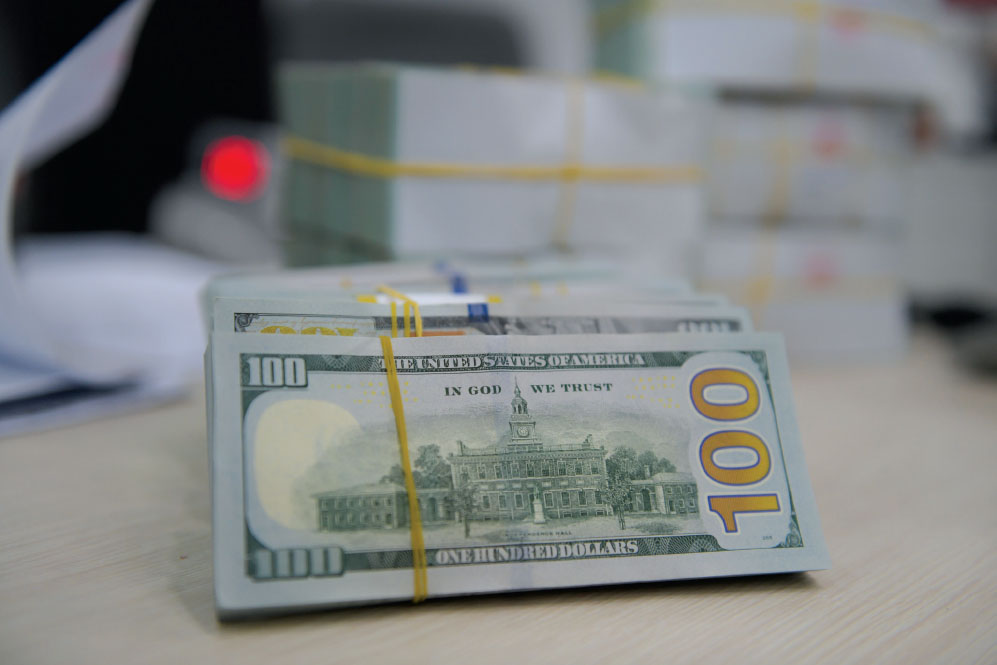
Having dropped from over VND25,400 to nearly VND24,500 per dollar in September this year, the U.S. dollar unexpectedly rebounded. Is this a sign of reversal, or a temporary reaction?
External pressure on the exchange rate eases
Given a slow global economic recovery, widespread international geopolitical tensions, and growing uncertainties, central banks worldwide have tightened their monetary policies, causing capital flows to return to developed nations. In Vietnam, the total net foreign currency deficit in the first half of 2024 exceeded US$7.4 billion, mainly due to foreign direct investment (FDI) enterprises ramping up repatriation of profits abroad. At the same time, businesses and individuals reduced foreign borrowings and focused on debt repayment to avoid the pressure from foreign exchange rates.
During this period, the dollar increased by more than 5% against the Vietnam dong currency, reaching its peak around June 2024, which forced the State Bank of Vietnam (SBV) to intervene with measures such as controlling money supply, adjusting interest rates, and eventually selling foreign currency directly into the market. The liquidity squeeze in the market persisted until mid-September 2024 and only eased when the U.S. Federal Reserve (Fed) made the first sharp rate cut since the Covid-19 pandemic in early 2020.
Currently, a wave of global monetary policy easing is underway, with interest rates in developed countries spiraling downwards, reducing the pressure on foreign exchange rates and giving the SBV more scope to implement its own monetary easing measures.
Market liquidity improves
In the first seven months of 2024, credit grew by around 5.93% while M2 money supply growth was only 2.52%, less than half the rate of credit growth. This low total money supply helped control the foreign exchange rate and inflation but also slowed economic growth.
The reasons for the low money supply stemmed from key factors: (1) SBV's active regulation to stabilize foreign exchange and inflation rates, (2) capital outflows due to debt repayments and foreign companies withdrawing funds, and (3) possible speculation on gold and foreign currencies.
However, by September 2024, credit and money supply growth began to accelerate, reaching 8.53% and 5.1%, respectively (data as of September 27, 2024), with money supply doubling in just two months.
Since August 2024, the SBV stopped issuing Treasury bills, and open market operations (OMO) interest rates were lowered twice in August and September, down to 4% annually. Interbank market rates also dropped significantly, ranging from 3.3% to 3.5% per year for overnight to two-week terms.
With GDP growth in the first nine months of 2024 reaching 6.82% and average CPI at around 3.88%, the SBV now has more room to further lower its policy interest rates. In particular, the OMO rate could decrease by an additional 0.25-0.5 point in the near future.
Should we worry about the dollar increase?
In early October 2024, the U.S. dollar unexpectedly rose by about VND200 against the Vietnam dong, bringing the dollar’s cumulative increase in the year to nearly 2.5%. This has caused concern over whether this spike will persist.
The main reason for this rise is the increase in the U.S. Dollar Index (DXY) from nearly 100 to around 103 points in the first half of October 2024. This reflects the following factors:
Firstly, there are concerns about an escalation of tensions in the Middle East, especially after Iran's second attack on Israel this year. This has prompted investors to hold on to stronger currencies, particularly the U.S. dollar.
Secondly, China has announced a large economic stimulus package to support its markets, including interest rate cuts to support the real estate and stock markets. This devaluation of the yuan has made the U.S. dollar relatively stronger through arbitrage activities.

Thirdly, some of the U.S. macroeconomic data in September was better than expected, such as non-farm payrolls (254,000 compared to an expected 147,000) and the unemployment rate (4.1% compared to 4.2%). This has led investors to believe that the Fed's interest rate cuts may be milder, reducing the likelihood of further cuts in November and December this year.
Finally, Vietnam's interbank market interest rates have also declined, which could widen the negative interest rate differential between the dong and the dollar.
Despite this, the overall trend in developed countries remains one of monetary policy easing, which means that the pressure on the dong/dollar exchange rate is not too acute. The SBV maintains a cautious approach towards interest rates and liquidity. Macroeconomic data also indicates positive trends in trade surplus, FDI, remittances, and foreign borrowings. The repatriation of profits by FDI firms, foreign portfolio withdrawals, and external debt repayments are expected to gradually decrease. Therefore, it can be said that exchange rate fluctuations in the near future will likely remain within a narrow range, with little chance of significant volatility.