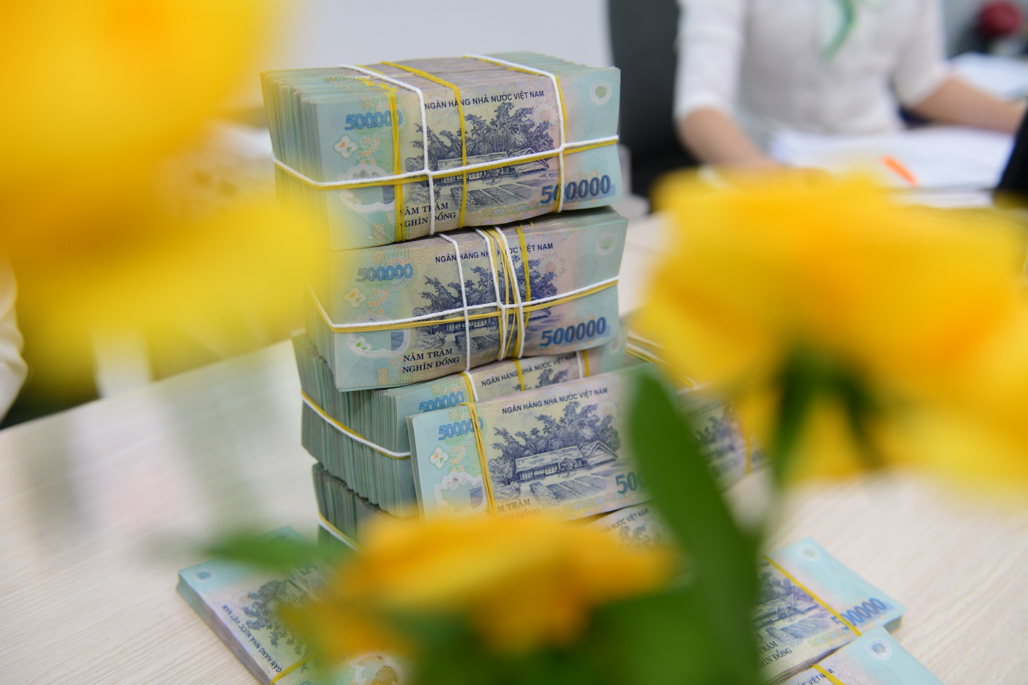
The central bank’s seven-day bank bill buybacks and its additional issues of 28-day bills indicate a clear divergence in the current liquidity landscape among banks. While some banks have ample liquidity to continue buying bills issued by the central bank, others have resorted to short-term borrowings from the central bank.
Resumption of net injection
On April 15, the State Bank of Vietnam (SBV), the central bank, resumed purchasing nearly VND12 trillion worth of seven-day bills. All eight participating members won deals selling bills at a coupon rate of 4%. This marks the second consecutive session in which the SBV has bought back bonds. Prior to this, on April 12, the central bank bought back VND10 trillion of bills from two banks, also at a 4% coupon. Thus, within just two sessions, a total of VND22 trillion has been injected into the banking system through the buyback channel.
On April 2 and 3, the SBV’s buybacks of seven-day bills totaled VND5.95 trillion and VND2.513 trillion, respectively. The injection of cash into the system through the buybacks of valuable papers has become frequent and it seems to be a support policy for credit institutions in liquidity constraints.
Meanwhile, the SBV continues to issue bills, although the volume has decreased significantly. For instance, in the sessions on April 12 and 15, the respective value of issued bills amounted to VND8.6 trillion and VND2.8 trillion, much lower than the maturing volume of VND15 trillion per session. Thus, a total of VND18.6 trillion has returned to the market, in addition to the VND22 trillion worth of bills bought back by the SBV as mentioned earlier, resulting in a total cash injection into the market during these two days reaching VND40.6 trillion.
In the first half of April this year, an additional VND29.65 trillion of 28-day bills was issued, while the volume of maturing bonds issued from March 8 to April 15 amounted to VND90 trillion (VND15 trillion of bills falling due per session in six sessions). The total net injection volume in the first 11 sessions of April was VND82.35 trillion.
It is worth noting that the bill issuing policy reintroduced by the SBV since the beginning of March 2024 is aimed at draining excess liquidity from the market, limiting credit institutions from utilizing this idle capital for currency speculation and profiting from the large interest rate spread between the Vietnamese dong and the U.S. dollar in market 2, or the interbank market. Therefore, with maturing bills and large amounts of dong returning to the system, the possibility of a return to dollar speculation cannot be ruled out, especially considering the ongoing exchange rate volatility.
In just three days (April 11, 12, and 15), the SBV’s reference exchange rate between the U.S. dollar and the Vietnamese dong increased by VND60, while the greenback at banks also increased by an additional VND170-200. In the informal market, the U.S. dollar has been unpredictably volatile, surging by VND205 on April 10 and 11, and then decreasing by VND55 on April 12. Compared to the beginning of the year, the price of the U.S. dollar on the informal market is still about 3% higher.
Furthermore, the short-term bill buybacks and the additional issues of 28-day bills by the SBV indicate a clear divergence of liquidity among banks. While some banks still have abundant liquidity to continue investing in the central bank’s bills, others are making use of short-term borrowings from the SBV. Overall, the net injections are gaining traction, as a large volume of bills from previous periods are about to fall due.
Liquidity divergence?
In addition to open market operations, several other indicators suggest a more pronounced differentiation in the liquidity situation among banks. Firstly, interbank interest rates, after a sharp increase at the end of March 2024, have remained high since then. As of April 12, the overnight interbank rate was 4.18%, while the one-week and two-week rates were 4.33% and 4.24%, respectively. Compared to the recent low of 0.13% on March 22, the overnight rate has clearly increased significantly within just a fortnight.
Secondly, alongside some banks continuing to reduce deposit rates, others have revised up deposit rates since the beginning of April. Recent volatility in the foreign exchange and gold markets has made it harder for banks to raise funds, with the total mobilization industry-wide decreasing by 0.76% as of March 25, a rare occurrence of negative growth in capital mobilization by banks in the first quarter in years.
Several banks have lately increased deposit rates. For example, VPBank raised rates by 0.3 percentage point for terms of 12 months or longer, the second rate increase in just over half a month, following a 0.2 percentage point increase at the end of March. However, the most significant increases are seen at MSB, with a 0.7 percentage point increase for terms of 1-2 months and 6 months or more, and a 0.5 percentage point increase for terms of 3-5 months. In particular, in the first week of April, MSB cut deposit interest rates by 0.5-0.7 point depending on terms, but then had to raise them again after just one week.

Meanwhile, Eximbank increased rates by 0.2 percentage point for terms of 6-9 months, the second increase in just over half a month. Its previous increase was 0.3 point for terms of 1-3 months. KienLong Bank also increased deposit rates by 0.2 percentage point for terms of six months or longer. NCB increased rates by 0.1 percentage point for terms of four months, 0.2 percentage point for terms of five months, and 0.15 percentage point for terms of 10-11 months, although the bank also reduced rates for terms of one and 6-7 months.
Regarding the reasons for this situation, in addition to different growth rates in deposit mobilization, which may have led to opposite adjustments in deposit interest rate policies, the differentiation in credit growth from the beginning of the year until now has also led to a differentiation in liquidity growth among banks. Although the overall credit growth rate for the banking sector in the first quarter of 2024 was only 0.9%, many banks have reported growth of 3% to 5%.
Banks with strong credit growth since the beginning of the year include HDBank at 6%, MSB, MB, and VietinBank at 5%, Sacombank at 4%, ACB at 3.7%, and OCB at 4.6%. The outstanding results helped these banks achieve strong profit growth in the first quarter of 2024 compared to the same period last year.
This trend may continue, as lending will remain a fiercely competitive activity among banks this year, as all banks were already allocated full credit growth quotas at the beginning of the year. Moreover, with banks required to publicly disclose average lending rates on their websites from April 1, 2024, coupled with the pressure to disburse capital shown through a series of preferential credit packages recently launched by many banks, the challenges and competition among lenders are becoming increasingly intense.