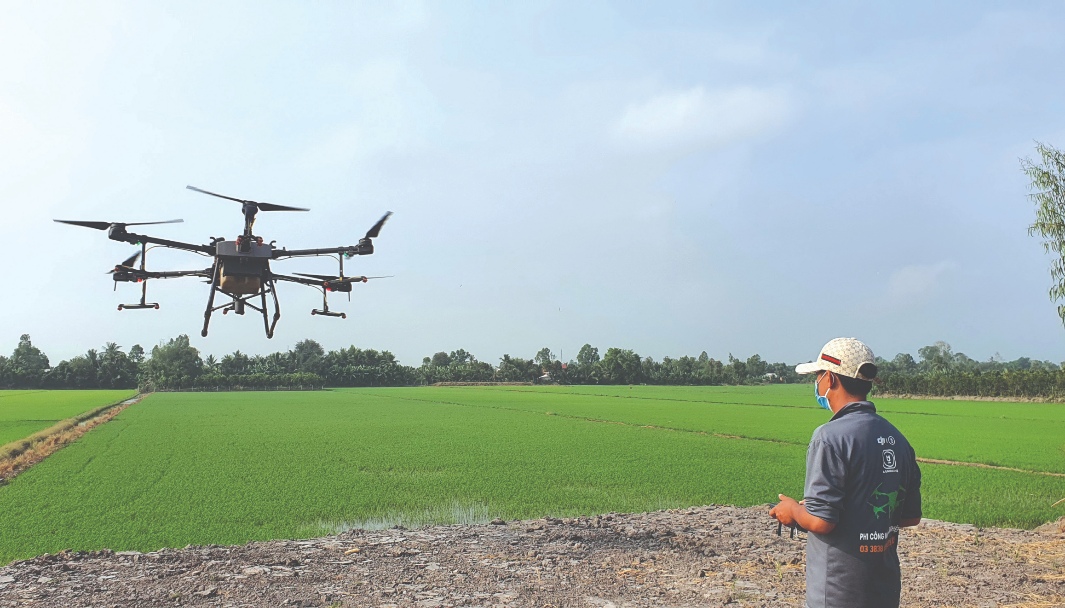
An agricultural revolution is quietly unfolding in Vietnam’s Mekong Delta, the nation’s key rice growing area. Farmers are adopting practices that reduce greenhouse gas emissions, cut costs, boost productivity, and protect the environment (*). During the 2024–2025 winter-spring crop, six projects following this model are being implemented in Can Tho City and the provinces of Kien Giang, Soc Trang, and Dong Thap.
For many years, rice farming in the Mekong Delta has relied on dense seeding, heavy fertilization, and frequent chemical spraying—practices that have driven up costs, degraded soil quality, and caused serious environmental pollution. Submerged paddy fields, in particular, have become major sources of greenhouse gas emissions, especially methane. Against this backdrop, a low-emission rice cultivation model has emerged, offering a new direction centered on efficiency, sustainability, and environmental stewardship.
Phan Van Tam, deputy general director of Binh Dien Fertilizer Company, said, “Building on the success of the smart, climate-adapted rice cultivation program in the Mekong Delta, Binh Dien has been entrusted with implementing the Central Agricultural Promotion Project. This initiative is carried out in collaboration with provincial agricultural promotion centers, agricultural service providers, scientists, and partner businesses across the rice production chain. Launched during the 2024–2025 winter-spring crop, the project has yielded promising results—helping farmers cut costs, raise incomes, and reduce greenhouse gas emissions.”
Fewer seeds, fertilizers, and chemicals but more profit
According to data from the 2024–2025 winter-spring crop project, seed use per hectare was reduced by 30 to 84 kilograms. This lighter sowing density has helped rice plants grow more vigorously, reduced pest pressure, and lowered early-stage production costs. Fertilizer application was also optimized based on actual crop demand, leading to average reductions of 34.8% in nitrogen, 30% in phosphate, and 20% in potassium compared to conventional farming areas. These cuts not only reduced input costs for farmers but also helped curb emissions of nitrous oxide (N2O)—a greenhouse gas 298 times more potent than carbon dioxide (CO2).
In addition, the frequency of chemical spraying was reduced by an average of 1.81 times per crop, cutting related costs by 22% and lowering the risk of environmental pollution that can harm farmers’ health. The economic benefits of the low-emission rice cultivation model have been highly encouraging. Profits increased by an average of VND7.5 million per hectare, while the rate of return reached 159%—42% higher than that of traditional rice farming areas. Notably, at the Vinacam Hon Dat Agricultural Cooperative in Kien Giang Province, the model using the DS1 rice variety achieved a yield of 10.3 tons per hectare and reduced emissions by the equivalent of more than 13 tons of carbon dioxide (CO2) per hectare compared to conventional methods.
When farmers want to change
Farmers have played a vital role in the success of the low-emission rice cultivation model. Their willingness to embrace change after witnessing its practical benefits has been a key driver of the project’s progress. “I was very anxious when trying the new method for the first time,” said Le Minh Khem, a farmer with 10 hectares under the model in Hon Dat, Kien Giang Province. “But after receiving thorough training and seeing that the rice plants were stronger, had fewer pests, required less fertilizer, yet still delivered high yields and higher profits—I was thrilled!”
Khem is one of hundreds of farmers who have participated in training sessions for the new rice cultivation model. Through these classes, more than 660 farmers have mastered key techniques, including water management using the AWD (alternate wetting and drying) method, and the use of organic fertilizers—such as Dau Trau (“Buffalo Head”), which supports root development and plant health—alongside NPK fertilizers like Dau Trau TE A1 and TE A2. Farmers also apply Dau Trau Bio-Canxi to raise soil pH and prevent organic poisoning. In addition, they have adopted integrated pest management (IPM) practices and the measurement, reporting, and verification (MRV) system to monitor and quantify emissions reductions.
The example set by farmers producing clean rice at lower costs while earning higher profits has inspired many other localities across the Mekong Delta. It also serves as clear evidence that reducing emissions does not mean sacrificing productivity. On the contrary, it is a powerful approach to enhancing both the value of rice and the livelihoods of farmers—while fostering a shift in mindset toward environmental protection.
Opportunity for earning from green agriculture
Le Quoc Thanh, director of the National Agricultural Promotion Center, emphasized the need to maintain and scale up the model, as well as form community-based agricultural promotion groups to support farmers and cooperatives in sustainably participating in the one-million-hectare high-quality rice initiative. The project recommends expanding the model in the 2025 summer-fall crop and beyond, integrating it into the broader plan for developing low-emission, export-oriented rice production zones. With the systematic application of technology and the MRV (measurement, reporting, and verification) process, farmers will be better positioned to access carbon credit mechanisms—creating new opportunities for income through green agriculture.
(*) Binh Dien Fertilizer Company implements the project in collaboration with local agricultural promotion centers.