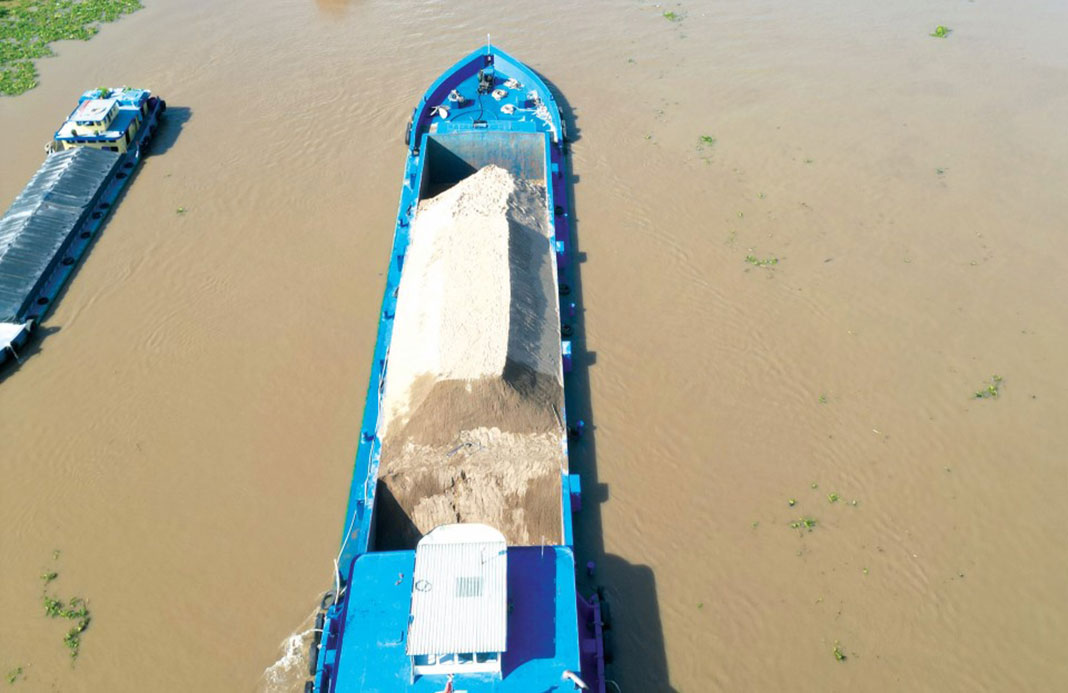
Despite having sufficient manpower and equipment, the contractors of expressway projects in the Mekong Delta have been either operating perfunctorily or have suspended work due to a severe shortage of sand for roadbed construction. If the problem is not timely tackled, these projects would fall behind schedule.
Construction slows down
“The shortage of sand for roadbeds in the Mekong Delta is very acute. We do not mean to complain; we raise the issue to call for solutions,” said Nguyen Tuan Anh, deputy general director of Truong Son Construction Corporation, at a conference on efficiently using materials for traffic infrastructure projects organized by the Ministry of Construction.
Truong Son Construction Corporation is a contractor of five expressway projects in the Mekong Delta. “We need 1.8 million cubic meters of sand in 2023 alone. An Giang Province pledged to supply us 1.1 million cubic meters, but none has been delivered following a case of illegal sand mining there. Dong Thap and Vinh Long have also promised to supply 800,000 and 400,000 cubic meters, respectively, but we have received none. We have been operating perfunctorily, or have even suspended certain components while all the required manpower and machinery have been mobilized. Construction cannot go on if the roadbed is not consolidated (with sand),” Nguyen Tuan Anh said.
Khuong Van Cuong, CEO of Deo Ca Group as another major contractor, said the shortage of sand for roadbeds has put road projects in the Mekong Delta on hold. Certain projects have to rely on sand supplies from Cambodia, but the cost is higher due to the long distance.
Infrastructure works in general and expressways in particular require materials for roadbeds, platforms and surfaces. While roads across mountainous areas or midlands can be seft-sufficient in terms of filling materials, using soil and rock in the vicinity, other low-land roads are developed on soft-ground areas that require huge amount of soil and sand to strengthen roadbeds and build platforms.

There are now five expressway projects underway in the Mekong Delta with a combined length of 463 kilometers. Nguyen Quang Hiep, deputy chief of the Building Materials Department under the Ministry of Construction, said these projects require some 53.69 million cubic meters of sand, mostly in 2023 and 2024, with 16.8 and 23.6 million cubic meters, respectively. However, the reserve is only 37 million cubic meters, meeting 70% of the demand of the expressway projects, excluding other road projects.
Sand mining is also hindered by paperwork, further constraining sand supply. According to the contractors, the project owners should have obtained mining licenses alongside the approval of construction projects, and hand over all to the contractors at the same time. They failed to do so, however, and after kicking off project commencement, the contractors have to wait until mining licenses are given.
To deal with this hiccup, some contractors have to take a stopgap measure, approaching other commercial sand mines, all to no avail. On the one hand, such mine owners do not want to supply the contractors due to price control, and on the other hand, paperwork for supply, payment, handover and acceptance is lengthy, discouraging any such transactions, Nguyen Tuan Anh said.
Cutting corners for mining licences
To remove bottlenecks, the Government and provincial authorities have agreed to hand over sand mines to contractors for extraction under a special mechanism. However, it still takes time for contractors, between eight months and one year, to obtain a mining license, except that they do not have to enter bidding procedures for the mining right. “It takes up to one year to obtain a sand mining license, while contractors should start work on the project right after signing the contract. Slowness in sand extraction will surely pull back the project progress,” Nguyen Tuan Anh said.
Facing such impediments, Vinaconex Corporation as a giant builder has sought approval from the Ministry of Environment and Natural Resources and provincial authorities to allow contractors to extract sand while pending the issuance of mining licenses provided that they ensure safety and environmental protection conditions.
Nguyen Tuan Anh proposed that the Government and provincial authorities simplify administrative procedures to cut short the licensing period, allowing contractors to quickly exploit sand, soil and rock to build the expressways.
“The Mekong Delta is in dire need of sand, soil and rock, so the Prime Minister should instruct provincial governments to urge mine owners to supply sufficient materials for projects. Any mine owner failing to supply materials as required should have their licenses revoked. In addition, prices must be closely controlled to prevent any collusion among mine owners to hike prices of materials,” Nguyen Tuan Anh suggested.
Khuong Van Cuong, meanwhile, said project owners need to ensure sufficient conditions for contractors to extract materials when handing over the projects. Therefore, they need to work with other relevant agencies over the mining licenses during the process of formulating and approving the projects.
Many contractors at the conference also proposed that the Ministry of Transport and the Ministry of Construction include mining activities into project formulation from the onset before appraising and approving projects. It is important to consider material mining as an integral part of a project’s feasibility study. The two ministries should also quickly consider using other materials like sea sand and slag from thermal power plants to replace river sand, and developing viaducts instead of flat roads in certain areas of weak ground. It is because even if mining activities are not hindered, the sand reserve in the Mekong Delta can meet only 70% of the demand for the eight under-construction expressway projects.