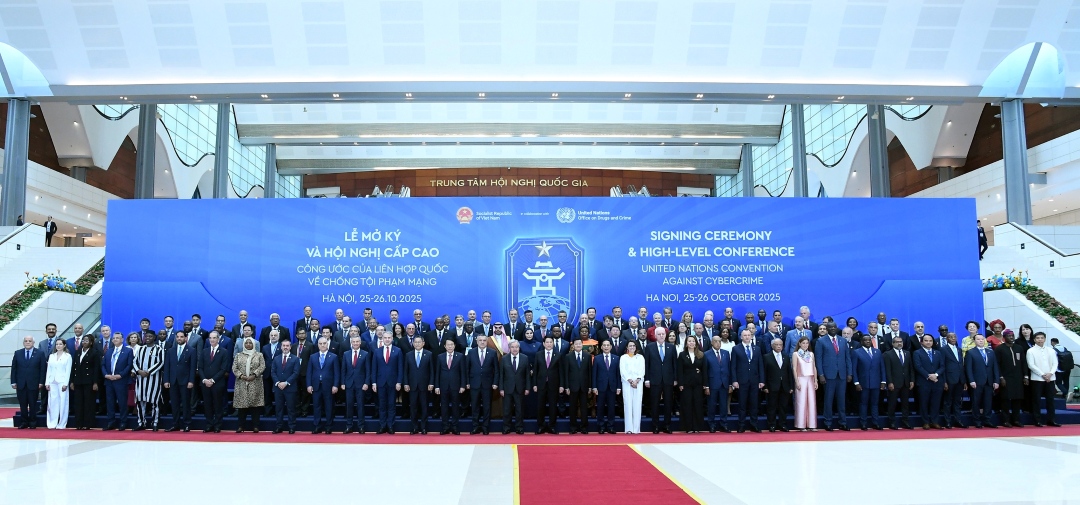
Vietnam stepped into the global spotlight on October 25-26, 2025 as world leaders, senior diplomats, and cybersecurity experts gathered in Hanoi for the official signing of a landmark United Nations treaty to combat cybercrime — the first global convention of its kind and the first UN convention ever opened for signature in Vietnam
Vietnam last week held the Signing Ceremony and the High-Level Conference of the United Nations Convention against Cybercrime, known as the Hanoi Convention, at the National Convention Center in Hanoi City. The convention seeks to establish a unified legal framework for preventing, investigating, and prosecuting crimes committed through digital technologies across borders.
The event marked a historic moment for Vietnam, signaling both its deepening international integration and its growing influence as a trusted partner in global governance.
Countering rising cyber threats
Cybercrime has become one of the defining threats of the 21st century, inflicting trillions of dollars in losses worldwide each year. According to the UN Office on Drugs and Crime (UNODC), online scams alone cost victims in East and Southeast Asia between US$18 billion and US$37 billion in 2023.
From the 2017 ransomware attack that paralyzed shipping giant Maersk to the 2022 assault on Costa Rica’s digital infrastructure, cyberattacks have evolved from isolated incidents to global crises that undermine economies, disrupt governments, and erode public trust. Increasingly, digital platforms are exploited for human trafficking, sexual exploitation, and child abuse — crimes that cross borders and outpace existing legal frameworks.
“The UN Cybercrime Convention is a powerful, legally binding instrument to strengthen our collective defences against cybercrime,” said UN Secretary-General António Guterres at the signing ceremony. “It is a testament to the continued power of multilateralism to deliver solutions. And it is a vow that no country, no matter their level of development, will be left defenceless against cybercrime.” The convention was adopted in December 2024 by the UN General Assembly. It will enter into force 90 days after being ratified by the 40th signatory. It includes nine chapters and 71 articles outlining provisions for law enforcement collaboration, extradition, mutual legal assistance, and technical support for developing nations.
Vietnam’s role and diplomatic recognition

Vietnam played an active role throughout the five-year negotiation process, which began in 2019 when the UN initiated discussions on drafting a comprehensive treaty on cybercrime. Over the following 30 months, representatives from 155 countries and more than 150 intergovernmental, non-governmental, and private-sector organizations took part in eight formal negotiation sessions and five intersessional meetings held in New York and Vienna.
Several Vietnamese proposals — including mechanisms to support developing countries and the integration of climate change considerations into cyber policy frameworks — were widely endorsed by member states, reflecting Hanoi’s pragmatic and inclusive approach.
Speaking at the signing ceremony, Vietnamese President Luong Cuong described the convention as “a milestone for global cybersecurity governance and a symbol of international solidarity in the digital era.”
UN Secretary-General António Guterres, in his remarks, praised Vietnam for its leadership in promoting dialogue and cooperation, saying the convention “embodies the shared determination of nations to secure our digital future.”
According to Deputy Minister of Public Security, Lieutenant General Pham The Tung, the two-day event drew more than 2,500 participants, including 110 national delegations, 150 international and regional organizations, and over 50 research institutions. More than 400 journalists from 189 domestic and foreign media outlets covered the event, which was broadcast live in six official UN languages via UN Web TV — the first time a Vietnam-hosted event had such global reach.
A total of 72 countries signed the convention during the summit, including 64 that joined the plenary signing session, making it one of the largest UN treaty signings in the past decade. It must be ratified by each State according to its own procedures. Deputy Foreign Minister Nguyen Minh Vu said the number of signatories far exceeded the 40 required for the treaty to take effect, paving the way for its early implementation.
The conference also featured 71 national and institutional statements, eight thematic panels, and 37 side events organized by international and private-sector partners. Discussions were described by participants as open, constructive, and collaborative.
Vietnamese leaders also held high-level meetings with visiting delegations. Party General Secretary To Lam met with heads of state and international organization representatives, while President Luong Cuong hosted a state banquet and Prime Minister Pham Minh Chinh chaired the closing press conference.
The signing of the Hanoi Convention underscored Vietnam’s rising stature as a venue for global dialogue and consensus-building. Once a developing nation largely focused on domestic growth, Vietnam has in recent years expanded its diplomatic footprint, hosting major international summits and peace talks while contributing to UN peacekeeping operations.
Deputy Minister of Public Security Pham The Tung credited the event’s success to close coordination among the Ministry of Public Security, the Ministry of Foreign Affairs, the Hanoi People’s Committee, and other agencies — a model, he said, of effective international event organization. “This achievement demonstrates Vietnam’s capacity, credibility, and commitment to global cooperation,” he added.
Experts say the Hanoi Convention will serve as a cornerstone for international efforts to tackle cybercrime, particularly in supporting nations that lack the capacity to respond to complex digital threats. Future programs are expected to focus on training, capacity building, and information sharing to enhance collective resilience.
As digital technologies become increasingly intertwined with global security and economic stability, the success of the convention will depend on sustained cooperation and political will among signatories. For Vietnam, the event marked both a diplomatic milestone and an affirmation of its growing role in shaping multilateral solutions.
“The Hanoi Convention is not only a treaty against cybercrime,” said Deputy Foreign Minister Vu. “It is also a message of unity — that nations, regardless of size or level of development, share responsibility for a safer, fairer, and more sustainable cyberspace.”