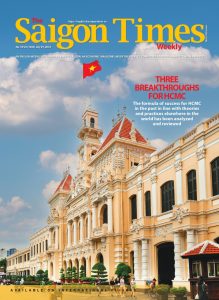
The formula of success for HCMC in the past in line with theories and practices elsewhere in the world has been analyzed and reviewed. The city can now single out strategic approaches to quickly implement Resolution 98.
HCMC is facing what are described as the toughest development challenges since 1975. At the mid-term review conference of the HCMC Party Committee on July 15, 2023, senior officials of the country pointed out the issues the city is coping with and what is expected from the city. HCMC authorities at the conference also admitted to obstacles, restrictions and challenges facing the country’s biggest economic hub, how it has fared comparatively poorer than other localities in the country and other regional rivals.
Resolution 98, which was just adopted by the National Assembly to offer more liberal mechanisms and policies for the city, is the leverage for the city to take strategic approaches to change the situation. The single choice for HCMC is to accomplish the mandate with concrete results.
The unsatisfactory outcome of the National Assembly’s Resolution 54 on special mechanisms for HCMC and that of action plans and strategic programs implemented in the past two decades show that working methods play a decisive role. Experiences from success stories in the past, external and internal, can hint at ways to implement Resolution 98.
International experiences
In 2002, Lee Myung-bak, former chairman of Hyundai Group, joined the race for the post of Seoul mayor when this metropolis of ten million people was facing challenges that set back the living quality and the competitiveness of the city. As traffic congestion was worsening, he raised the weird idea of demolishing the artery expressway crossing the city to restore the spring Cheonggyecheon, alongside renovating and upgrading the public transport system, especially bus routes. Worse still, such initiatives were not included in Seoul’s spacial development plan then.
Lee Myung-bak and his associates were able to accomplish a seemingly unattainable task within a tenure of four years. Building on this success, in 2007, he achieved an election victory to become the South Korean president. Adding green spaces, creating inner-city forests, and bringing nature to a metropolis of ten million people within an area of 605 square kilometers (equivalent to 30% of HCMC) are deemed his greatest heritage.
There are at least three key reasons behind the success of Lee Myung-bak as an enterprising person. First, issues of his choice were of strategic nature in addressing bottlenecks, and were feasible and concrete. Second, prudent preparation for an action plan, which took two out of his four years in office. Third, he successfully rallied support from other stakeholders, especially those with long-term benefits associated with the common benefits when success was achieved.
Prior to Lee Myung-bak, Seoul had seen several other mayors with bold thinking, especially Kim Hyun-ok. The retired army general as an associate of the then President Park Chung-hee had served as Seoul mayor for 4 years and 17 days (March 1966 to April 1970). It was he who commanded the fillup of the spring Cheonggyecheon to build an expressway. He created the platform for Seoul’s new facelift, especially in infrastructure, to become a top city in the region from the post-war ruins. A system of immense roads and numerous other infrastructure facilities were developed during his four-year tenure. Gangnam (smaller than Thu Duc City) was transformed from a cabbage-growing area with few residents south of the Han River into a major urban center with a population of five million after more than two decades, largely owing to action programs under Kim Hyun-ok.
Apart from Seoul, we can learn from the success stories or many other localities worldwide with enterprising leaders.
Shanghai Mayor Zhu Rongji took the job in 1987, and within just a few years had managed to put Shanghai on the springboard for the top position in China. His efforts paid off, evidenced by the success of Pudong, other infrastructure facilities, as well as other strategic policies. This is another example of aligning the local aspiration for development to the national aspiration for development.
Mitt Romney, governor of Massachusetts, the U.S., is another example. In the Democratic hotbed, this Republican politician had managed to provide enveloping insurance cover for all the people in the state (Romneycare), a practice later duplicated by U.S. President Barack Obama (Obamacare).
Reality in HCMC
HCMC itself has also seen moments of success. An approach that led to strategic breakthroughs prior to the renovation period and about one decade after that provides great food for thought. The enterprising spirit of the people, from the people and for the people had enabled the city’s State apparatus led by Vo Van Kiet, then Nguyen Van Linh, and Mai Chi Tho to apply trial policies that were in stark contrast with the Party’s policies at the time.
The city’s leadership earned praise for putting the right personnel in the right place. Who could better understand the hunger and know the way to convince farmers than Ms. Ba Thi, a farmer by nature but sensitive and profound? Vietnamese traders of Chinese origin keener in international trade were entrusted to engage in external transactions. And many others were assigned to the right tasks, helping the city’s population of over three million at the time to avoid hunger, production was restored, and most importantly, such daring changes became strategic breakthroughs that later resulted in the country’s renovation policy.
Renovation could be regarded as a “special mechanism” or new mechanism for Vietnam’s development. At the beginning, almost no one could imagine the specific steps or methods. The city’s pioneering role was brought into play. Learning from others and employing those people with expertise constituted the most efficient method. The then Secretary of the HCMC Party Committee, Vo Tran Chi, boldly assigned Phan Chanh Duong, a Vietnamese of Chinese descent, and members of the Friday Group (those who had worked for the Saigon Regime, so dubbed because they gathered together every Friday) to research and trially apply the models of export processing zones, industrial parks, and new urban areas. During this experimental process, Dr. Tran Du Lich was appointed head of the city’s Economics Institute and Giao Thi Yen as leader of HIFU, which was the predecessor of the HCMC Finance and Investment State Owned Company (HFIC), which proved such decisions to be right.
The establishment and development of the Saigon Hi-Tech Park led by the then vice chairman of HCMC Pham Chanh Truc and others also provided good experiences.
The formula for success stories or strategic breakthroughs in HCMC mentioned above is that initiatives or concrete actions were led or executed by enterprising people who knew how to maneuver the system to achieve results. They knew how to (i) flesh out national strategies or share concerns of national leaders and thus they gained support or orientations; (ii) employ the right people for the right place and psych up the spirit of their teams; and (iii) maintain the spirit of serving the people, and thus had the widespread support to make the impossible possible.
Recommended breakthroughs for Resolution 98
As a researcher with a focus on HCMC, I observed that the special mechanism allowed for HCMC under the National Assembly’s Resolution 54 and the establishment of Thu Duc City in 2020 are two sizeable shakeups in HCMC over the past two decades. However, the results to date have not been really impressive as expected, since such shakeups have not created strategic changes, as evaluated by the city’s authorities as well as central agencies when reviewing the execution of Resolution 54.
Resolution 54 is nearly 3,000 words long and Resolution 98 over 13,000 words. Resolution 98 prevails in that it covers all aspects that once properly executed will create radical changes for the city, helping it to realize its role as the economic locomotive. However, this all-inclusive feature also is the weakness since it is difficult to single out the focal point or the strategic breakthrough. In news reports about this Resolution, I have not found the list of strategic issues that can be put forth for public comprehension and supervision, which is of paramount importance.
With a desire to see success in implementing Resolution 98, I’d like to recommend three issues for the city to address in the next five years as follows: (1) changing the urban transport infrastructure; (2) successfully mapping out measures to tap the land bank to create resources for the city’s development; and (3) turning Thu Duc City into the most important growth momentum of HCMC. These three issues need to be associated with specific targets or criteria.
In short, the formula of success for HCMC in the past in line with theories and practices elsewhere in the world has been analyzed and reviewed. The city can now single out strategic approaches to quickly implement Resolution 98. It is hoped that HCMC will find the right approach to assert its role as the locomotive, contributing to the target for Vietnam to become a developed country by the year 2045.