Green transformation and sustainable development are no longer optional for businesses. True transformation must begin internally, with practical and meaningful steps that can gradually lead to larger impacts.
While some regulations may seem challenging to meet, adhering to them can open new opportunities and strengthen a company’s position in the global supply chain.
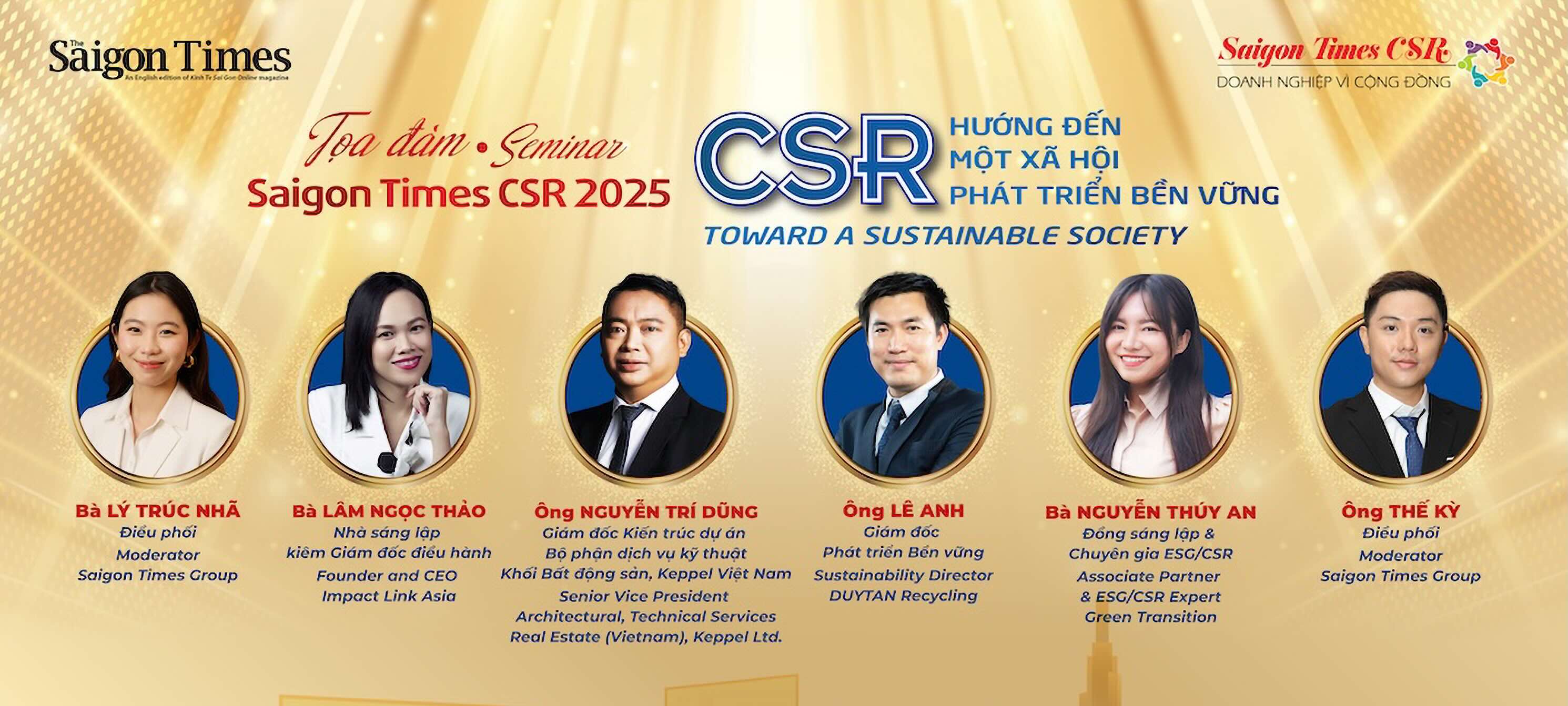
On November 5, The Saigon Times, an English news website of the Saigon Times Group, held its Saigon Times CSR 2025 Merit Ceremony to honor 40 businesses for their outstanding contributions to the community through corporate social responsibility (CSR) initiatives. Along with the ceremony, a panel discussion titled “Toward A Sustainable Society” brought together experts and business leaders to share practical perspectives and provide guidance for shaping CSR strategies in the years ahead.
When people hear “sustainable development,” they often default to thinking about broad actions like reducing electricity use, conserving water, or cutting emissions. However, sustainability is much more immediate and personal. It involves the design of our living spaces, the methods we use to produce goods, and how we consume responsibly. Ultimately, it makes sure that our daily choices and actions have a positive impact on both the environment and society.
During the discussion, real-world examples from pioneering companies and experts helped answer key questions: How can sustainability become a core part of business strategy? How can green values extend beyond the company to the broader community? Is green transformation simply a way to meet strict import regulations, or can it be a real growth opportunity?
Balancing economic benefits and social impacts
Many companies are starting to incorporate sustainability into their operations, but transitioning from simply “adding” sustainable initiatives to fully integrating them into the business model is a complex process. How can businesses generate economic value while also providing tangible benefits for communities and the environment?
Nguyen Tri Dung, senior vice president, architectural, technical services, real estate (Vietnam), Keppel Ltd., said that Keppel integrates sustainable development principles into real estate projects to generate economic value, protect the environment, and benefit communities. One approach is to incorporate nature into building designs from the planning stage. Buildings are positioned to maximize natural light and airflow, reducing reliance on air conditioning and artificial lighting. This method lowers energy consumption and costs while encouraging healthier, more sustainable living spaces.
Agreeing with Dung, Nguyen Thuy An, associate partner and ESG/CSR expert at Green Transition, added that green transformation should begin with small, practical steps like reducing waste and conserving electricity and water before moving on to developing green products and lowering emissions. For small- and medium-sized enterprises (SMEs), this approach helps optimize investment costs. Achieving small, tangible goals fosters motivation and confidence. For large corporations, the focus is on scaling initiatives from pilot projects to industry-wide transformation, allowing SMEs in the same sector to also benefit.
Le Anh, sustainability director at Duy Tan Recycling, shared how the company expanded cooperation with multiple manufacturers under the framework of Extended Producer Responsibility (EPR), which covers collection, treatment, recycling, or financial contributions. By aligning Government policies, corporate awareness, and modern technology, Duy Tan Recycling is able to recycle up to 200 tons of plastic waste daily from packaging used by partners such as Coca-Cola, La Vie, Sapuwa, and Unilever. Some plastic packaging is 100% recyclable, creating a “plastic reborn” lifecycle for products. These efforts make concepts of a green and circular economy tangible in everyday life.
To incorporate sustainability into business operations, companies need more than just technical investments and budgets—they must change their mindset and view sustainability as a fundamental part of their long-term strategy.
Lam Ngoc Thao, founder and CEO of Impact Link Asia, highlighted several sustainability trends for 2025. Companies are expected to cut emissions not only in production and consumption but also across entire supply chains. They must also follow regulations like the European Union’s Carbon Border Adjustment Mechanism (CBAM), which demands transparent reporting. Meanwhile, artificial intelligence and big data can help accelerate the shift toward a cleaner, greener, and more transparent economy.
Even with potential setbacks, such as policy changes in the United States or reductions in funding for major green transformation initiatives, the global trend toward sustainability remains unstoppable. Vietnamese businesses should focus not on whether to make changes, but on how to do so effectively and affordably. While awareness of sustainability has grown, SMEs still adopt it more slowly due to limited resources.
Transformation as a competitive necessity
Experts and business leaders emphasized that policies, mechanisms, and changing consumer behavior can drive green transformation, but they also pose challenges that companies need to overcome to succeed.
Green and low-emission practices are now mandatory, not optional. For exporters, the EU’s CBAM regulations, fully enforced in 2026, could impose high taxes—or even block market access—on products with high emissions.
Lam Ngoc Thao advised Vietnamese companies to develop strategies for the short, medium, and long term. In the short term, production lines should be upgraded to reduce emissions, and transition costs need to be included in budgets to keep cash flow steady. Companies using older, high-emission equipment should find ways to replace or retrofit machinery according to a long-term plan.
She also emphasized that green transformation must match consumer demand. Even environmentally conscious consumers expect affordable products. Green products need to stay competitively priced; otherwise, adoption will be limited, despite a shift toward more sustainable consumption habits.
From the perspective of a green transformation consultant, Nguyen Thuy An advised companies to prepare for product lifecycle traceability requirements. Businesses should begin with a greenhouse gas inventory to identify emissions “hotspots” and prioritize reduction efforts, such as investing in new technologies and renewable energy.
Failing to adapt to strict regulations like CBAM risks leaving companies behind compared to competitors who adopt green transformation. Timely adaptation turns challenges into opportunities. Successfully navigating the green transition enhances brand value and secures a firm position in the global supply chain.