HCMC has a robust sports infrastructure, fueled by growing social demand and an expanding network of facilities. Yet the sector remains underutilized, even as it begins to emerge as a dynamic driver within the city’s urban economy.
Following recent administrative boundary adjustments, HCMC has emerged as one of Vietnam’s leading sports hubs, anchored by one of the most robust development foundations in the southern region.
A super-urban foundation
HCMC’s population now exceeds 10 million, supported by a youthful workforce, rising expenditures on health and leisure, and a vast sports infrastructure comprising more than 15,600 facilities and clubs. As of 2025, approximately 36.7% of residents engage in regular physical activity—equivalent to 3.6 to 5 million people exercising daily. This base highlights substantial economic potential.
Assuming average monthly spending in the mass market segment—including gym and yoga fees, court rentals, and purchases of sportswear and footwear—ranges from VND300,000 to VND500,000 per person, total direct consumer expenditure would
reach VND1.5 trillion to VND2.5 trillion per month. On an annual basis, this translates into a market size of roughly VND18 trillion to VND30 trillion, a striking figure that underscores the opportunity for sports to evolve into a major economic sector if developed strategically.
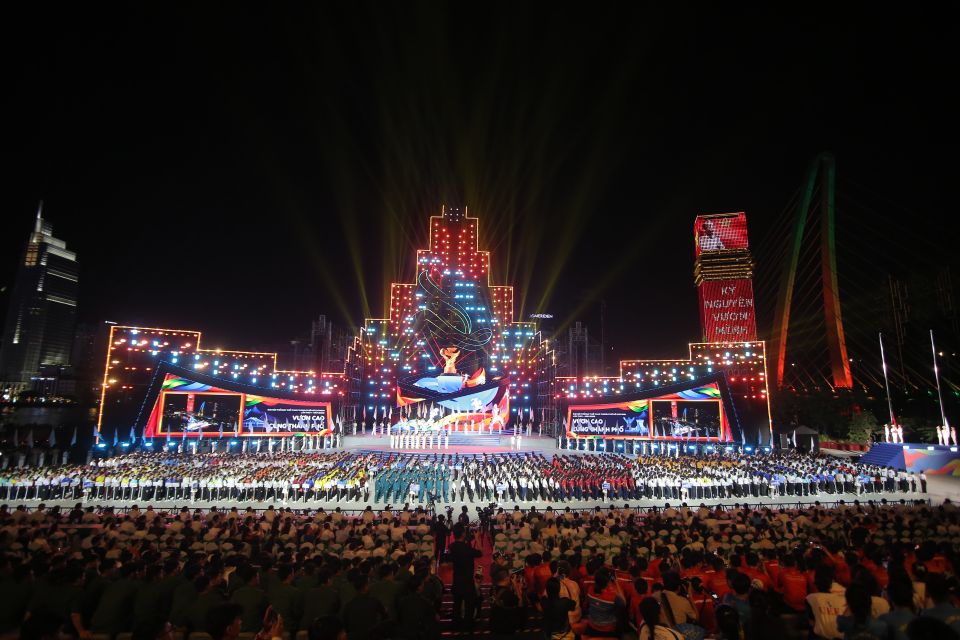
HCMC hosts hundreds of major sporting events each year, ranging from marathons that draw tens of thousands of participants to regularly organized football, tennis, and pickleball tournaments. Yet, compared with regional benchmarks, the city has not fully established itself as an economic magnet on par with urban centers such as Bangkok or Singapore, where sports have matured into integrated service industries. In those markets, competition, tourism, entertainment, and media are interwoven into multi-layered value chains that generate millions of dollars annually.
In other words, HCMC does not lack participants, tournaments, or events. What it lacks is a comprehensive strategy to capitalize on sports— transforming on-field excitement into measurable economic growth.
According to sports expert Ly Dai Nghia, director of the HCMC Sports Training and Competition Center, the city has a golden opportunity to develop its sports economy, driven by its large population, rising incomes, and growing demand for healthy lifestyles. Unlocking this potential, however, requires a focus on four key pillars.
The first is mass sports services—including gym, fitness, yoga, football, badminton, and pickleball— which have already become genuine consumer markets but now require standardization and professionalization rather than spontaneous growth.
The second is sports tourism and events, positioning HCMC as a hub for marathons, sports festivals, and international competitions, where each event generates tourism and media value alongside athletic competition.
The third pillar is digital sports and artificial intelligence, a strategic direction to modernize training, management, and organization through data and technology. The fourth is sports medicine and science, a rapidly expanding field that not only supports athletes but also extends to public health services.
“In short, HCMC does not lack demand—the challenge is turning that demand into a structured economic sector,” Nghia emphasized.
 Unlocking resources through infrastructure and policy
Recognizing this untapped gold mine, HCMC has set its sights not only on attracting new investment but also on unlocking the value of its existing infrastructure. This strategy is being advanced systematically by the city’s sports sector.
A centerpiece of this effort is the sports triangle model. In this framework, HCMC serves as the core, concentrating on elite training and technological innovation; Binh Duong functions as a production hub for youth training and sports manufacturing; while Ba Ria–Vung Tau (now merged into HCMC) leverages its coastal tourism strengths to host major sporting events. This clear division of roles maximizes the comparative advantages of each locality while fostering a synergistic ecosystem capable of staging international event series.
Nguyen Nam Nhan, deputy director of the HCMC Department of Culture and Sports, emphasized that the model delivers both economic and social benefits. It fosters a regional sports ecosystem, expands public access to athletic activities, and strengthens the southern region’s image as a “sports super-urban hub.”
According to Nhan, the city is pursuing three breakthrough strategies. The first is revitalizing existing infrastructure by upgrading and repositioning facilities at the intersection of sports, entertainment, and community activities, thereby optimizing utilization. The second is integrating sports with tourism and media, creating new value chains that extend beyond competition. The third is accelerating socialization, with the city acting as an enabler to attract private-sector participation in sponsorship, event organization, and infrastructure investment.
Notably, special policies and mechanisms under the National Assembly’s Resolution 260 give HCMC greater autonomy in licensing and attracting international events. This flexibility is a crucial factor in building a continuous event pipeline—an essential component of a sustainable sports economy.
Challenges and an enabling mindset
Despite its billion-dollar potential, HCMC’s sports sector still faces structural bottlenecks.
Nguyen Tu Anh, CEO of Nexus Sport Events, observed that viewing sports merely as a social movement generates more activities, but only by treating it as an economic sector can a true market be created. While HCMC has begun shifting from a management mindset to an economic development approach, he stressed that the pace must accelerate.
The industry, he noted, is expanding faster than its regulatory framework and supporting infrastructure. Event organization costs continue to rise as user expectations increase, while profit margins are squeezed by price-sensitive consumers. The most significant bottleneck lies in inter-agency coordination.
“A marathon involves transportation, healthcare, police, and local authorities. Without a clear coordinating body, businesses face significant delays,” he explained. “At the same time, the concept of sports as an economic sector remains new, leading to gaps in standards, data, and policy support—particularly in media rights, which remain underexploited.”
Vietnam still relies on purchasing rights to international events such as Ironman or UTMB, rather than developing its own exportable sports products, Nguyen Tu Anh added. Businesses have urged HCMC to formally recognize the sports economy as a sector contributing to GDP and to establish a strategic, city-level event calendar to prevent scheduling overlaps. Expanding transparent socialization mechanisms—where the state plays an enabling role while enterprises manage operations—would allow stadiums, parks, and riverside routes to generate new revenue streams.
Ly Dai Nghia emphasized that the challenge extends beyond physical infrastructure. The core issue is the absence of a strong ecosystem capable of retaining and monetizing participants. In addition to facility shortages, the sector suffers from gaps in service infrastructure, including inconsistent quality, lack of professional standards, and underutilized intellectual assets such as media rights and event branding. Weak linkages between sports, tourism, healthcare, and technology further prevent resources from converging into a cohesive system. As a result, despite abundant participation and demand, HCMC still lacks a fully functioning sports economy.
From a governance perspective, Nguyen Nam Nhan noted that Ho Chi Minh City is at a pivotal moment to accelerate the development of its sports economy—but doing so requires a fundamental shift in mindset. “The city’s position is clear: the state plays an enabling role, while businesses are the driving force,” he said. “We are studying institutional models that combine public investment with private management. Mechanisms are being refined to allow enterprises deeper participation, including sponsorship connectivity, commercial use of public facilities, and expanded event spaces in central areas.”
Experience shows that when the legal framework is supportive, private-sector participation can be strong. Major marathons and sporting events already carry the imprint of leading brands co-creating experiences. According to city officials, further improvements in policy transparency and administrative simplification will help transform HCMC’s sports sector into an attractive investment destination, moving closer to the “sports–entertainment” industry model seen in developed economies.
The sector now stands at a critical turning point. While the city possesses all the necessary foundations, it has yet to fully capitalize on its potential, particularly in comparison with regional peers. With a clearer strategic vision from policymakers, experts, and businesses, confidence is growing that once institutional bottlenecks are removed, sports in HCMC will evolve beyond recreational activity into a billion-dollar industry.