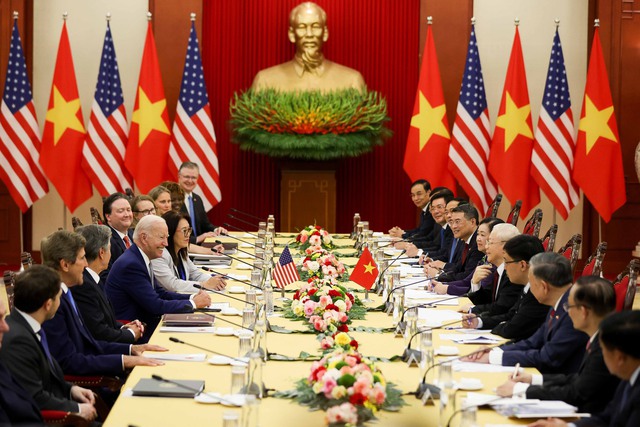
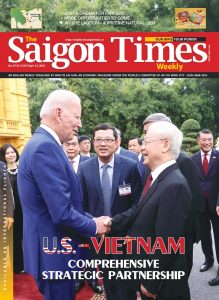
On September 10, during President Joe Biden’s State visit, Vietnam and the U.S. took their relationship to the next level by upgrading it from a comprehensive partnership to a comprehensive strategic partnership. This marks a significant milestone in their joint pursuit of peace, prosperity, and sustainable development.
“The unprecedented and momentous elevation of ties between the two countries was the result of intense efforts by both governments to establish and build mutual understanding and to chart a forward-looking path toward the opportunities and challenges in a rapidly-evolving world,” said a statement posted on the White House website.
Over the past decade, since Presidents Truong Tan Sang of Vietnam and Barack Obama of the United States established the Vietnam-U.S. comprehensive partnership, the two nations have made substantial progress in enhancing mutual understanding, building trust, and strengthening cooperation across various sectors. This new level of partnership will be firmly rooted in the achievements made so far, emphasizing their commitment to the United Nations Charter, international law, political systems, independence, sovereignty, and territorial integrity.
On September 11, Vietnam and the U.S. issued a joint communiqué detailing the elevation of their bilateral ties to a comprehensive strategic partnership, highlighting their deepening cooperation across various fields and dimensions:
Enhancing political and diplomatic relations
Vietnam and the U.S. are committed to further deepening their political and diplomatic ties. They aim to facilitate regular exchanges of delegations and engagement at all levels to reinforce mutual understanding and foster political trust.
Both nations’ leaders have proposed the establishment of an annual dialogue mechanism between Vietnam’s Minister of Foreign Affairs and the U.S. Secretary of State. This initiative is expected to enhance relations between the political parties and legislative bodies of the two countries.
Furthermore, they have agreed to maintain favorable conditions to facilitate the completion of their diplomatic and consular facilities. This commitment was communicated through a statement on the U.S. Embassy and Consulate website in Vietnam.
Advancing science, technology, and innovation
In recognition of the transformative impact of innovation on the global economy, the U.S. and Vietnam are intensifying their collaboration on critical and emerging technologies. This cooperation aims to enhance prosperity not only for their citizens but also for those across the Indo-Pacific region, as highlighted in the White House’s statement.
During his visit to Vietnam at the invitation of Party General Secretary Nguyen Phu Trong, President Biden participated in the Vietnam-U.S. Innovation and Investment Summit alongside Prime Minister Pham Minh Chinh. Their discussions centered on priorities for expanding technological and economic cooperation. Acknowledging Vietnam’s potential in the semiconductor industry, the U.S. has pledged support for its rapid growth and collaboration to bolster its position in the global semiconductor supply chain. This partnership was officially formalized through the signing of a Memorandum of Cooperation on Semiconductor Supply Chains, Workforce, and Ecosystem Development.
Additionally, both nations launched comprehensive initiatives for workforce development in Vietnam, focusing on the creation of practical teaching laboratories and training programs related to semiconductor assembly, testing, and packaging. To kickstart these initiatives, the U.S. Government will provide initial seed funding of US$2 million.
Vietnam and the U.S. are set to establish a Developing Electronics and Leading Technology Advancement Partnerships (DELTA) network. This network will facilitate close collaboration with like-minded partners to strengthen secure technology supply chains. Moreover, the two countries will identify potential areas of cooperation in artificial intelligence, research and development, governance, health and medical science, climate science, biotechnology, and conservation.
Education and training
People-to-people connections, particularly in the realm of education and training, hold significant importance in the U.S.-Vietnam partnership. The U.S. is planning various new programs to expand educational cooperation as part of the enhanced partnership. These initiatives include a STEM-focused education endeavor targeting all levels of the Vietnamese education sector and another initiative to foster digital growth.
Under these programs, the U.S. and Vietnam will promote cooperation by sharing best practices, scientific advancements, and educational opportunities among their universities and research laboratories. Both nations will create a conducive environment for student, scholar, and professor exchanges, as well as forge partnerships among educational institutions.
Boosting trade, investment, and economic cooperation
As the partnership between the United States and Vietnam is elevated, both nations reaffirm their shared commitment to regional prosperity through enhanced economic cooperation. This commitment is backed by a series of initiatives and measures designed to promote trade and investment, as outlined in the statement posted on the White House website.
The two countries commit to creating favorable conditions and facilitating increased market access for each other’s goods and services. Following recent announcements granting market access for U.S. grapefruit and Vietnamese pomelos, both countries expect more agricultural products to gain market access soon.
Moreover, the U.S. aims to improve capital access for underserved borrowers through new projects launched by the U.S. International Development Finance Corporation (DFC). These projects will expand lending opportunities, particularly for small and medium-sized enterprises led by women and those dedicated to climate initiatives.
Cooperation in climate, energy, environment and health
Recognizing the critical importance of climate, energy, environment, and health for societal well-being and innovation, Vietnam and the U.S. have chosen to expand their collaboration in these areas through a range of new projects and mechanisms.
A dedicated working group will be established to oversee climate projects and enhance adaptation and resilience efforts, including the Net Zero World Program. The U.S. Government will initiate a project to bolster climate resilience in traditional agriculture-based economies in the Mekong Delta, with an initial investment of US$11.41 million. Additionally, a pilot project will be launched to develop Vietnam’s first-ever battery energy storage system in Khanh Hoa Province.
Both nations are committed to securing critical mineral supply chains in Vietnam, assessing its Rare Earth Elements (REE) resources, and attracting high-quality investments for integrated REE sector development.
In the health sector, a comprehensive set of new activities will strengthen Vietnam’s core public health capacities, enhance surveillance systems, and improve infection prevention and control capabilities. The U.S. plans to expand partnerships with medical professionals to enhance palliative care for cancer patients.
Addressing war legacies
The United States and Vietnam, as trusted partners, share a commitment to addressing the legacies of war. The U.S. is dedicated to assisting Vietnam in the development of a technology-based system for identifying war remains. This involves conducting archival research, locating missing individuals, and employing advanced DNA technology.
Significant initiatives include the pledge to complete the Dioxin Remediation project at the Bien Hoa Air Base Area. Specifically, the U.S. and Vietnam have increased the project budget from US$183 million to US$300 million and extended its timeline to 2028. USAID will also expand its essential health and social service programs, supporting individuals with disabilities, into two additional provinces, Bac Lieu and Ca Mau, thereby increasing the number of supported provinces to 10. Furthermore, an additional US$25 million will be allocated for Unexploded Ordnance (UXO) clearance and tracking activities.
Bolstering security and protecting human rights
The United States is enhancing regional collective security by announcing new programs and equipment donations valued at US$8.9 million to enhance Vietnam’s capacity to combat regional and international transnational crime. Bilateral engagement between the U.S. and Vietnam on Trafficking in Persons (TIP) has been intensified to address new and emerging trafficking trends. This includes support to combat TIP, child sexual exploitation, and the growing issue of cyber scam operations in Southeast Asia.
Both countries reaffirm their commitment to promoting and protecting human rights. This commitment is realized through open and constructive dialogues, including the annual Vietnam-U.S. Human Rights Dialogue and Vietnam-U.S. Labor Dialogue, aimed at enhancing mutual understanding and bridging differences. They also emphasize the need for increased cooperation to ensure that all individuals, including vulnerable groups, regardless of gender, race, religion, or sexual orientation, as well as persons with disabilities, can fully exercise their human rights.
Reinforcing business-to-business ties
Both nations are poised to expand their collaboration across various sectors. They will strengthen their partnership in the aviation sector, fortify semiconductor supply chains, deepen technology partnerships, ease travel and transportation, promote tourism, upgrade strategic port and energy infrastructure, and enhance financial services and capital markets. These efforts are designed to increase trade and pave the way for new initiatives.
For example, Boeing and Vietnam Airlines have signed a US$7.8 billion deal for the purchase of 50 Boeing 737 Max jets from the U.S. planemaker. Amkor Technology, based in Arizona, is set to commence operations at its advanced factory in Bac Ninh Province, while NVIDIA is partnering with FPT, Viettel, and Vingroup to deploy AI in the cloud, automotive, and healthcare industries.
Other noteworthy projects include the US$6.7 billion Cai Mep Ha Logistics Center, VNG’s anticipated Initial Public Offering on the Nasdaq, Vinfast’s US$4 billion EV manufacturing facility in North Carolina, and Nobu Hospitality’s hotel and restaurant project in Vietnam.