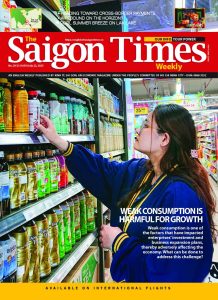
Weak consumption is one of the factors that have impacted enterprises’ investment and business expansion plans, thereby adversely affecting the economy. What can be done to address this challenge?
Sluggish consumption hampers economic growth
According to a report from the General Statistics Office (GSO), the total revenue from retail goods and services in the first half of 2023 was estimated at VND3,016,800 billion, a 10.9% increase compared to the same period last year. However, it is still lower than the year-on-year growth of 12.2% recorded in the first half of 2022. With inflation taken into account, the growth rate for the first half of 2023 stood at 8.4%, equivalent to the growth rate in the same period last year.
Notably, in terms of GDP utilization, final consumption in the first half of this year only increased by 2.68% compared to the same period last year, contributing 30.27% to the overall growth. Meanwhile, asset accumulation saw a slight increase of 1.15% year-on-year, contributing 6.28% to the overall growth. On the other hand, despite a 10% decline in goods and services exports and a 13.2% drop in goods and services imports, the balance in imports and exports contributed as much as 63.45% to the overall growth.
When comparing these figures to the GDP growth rate of 6.42% in the first half of 2022, with final consumption increasing by 6.06% year-on-year, nearly triple the growth rate of 2.68% in the first half of 2023, it becomes clear how falling consumption is affecting economic growth. However, it is not just the export sector that has been affected by declining global demand, especially from major trading partners. Domestic consumption has also been negatively impacted.
A survey on the business trends of processing and manufacturing enterprises in Q2 2023 found that low domestic demand was the primary factor affecting these businesses, as cited by 55.5% of the surveyed enterprises. This was followed by concerns about the competitiveness of domestic goods (47.2%) and low global market demand (34%).
The challenging business environment has resulted in job losses and a decline in income, leading to reduced spending. GSO figures indicate that up to 100,000 enterprises exited the market in the first half of this year.
The number of workers in the industrial sector decreased by 4.2%, with non-State enterprises and foreign-invested enterprises experiencing declines of 3.5% and 4.2% respectively. In Q2, 217,800 workers were laid off, predominantly in industries facing order difficulties such as apparel, footwear, and component production.
The difficult situation is further reflected in the decline of personal income tax revenue in the first half, which fell by 7% year-on-year to VND86,900 billion, marking the largest drop in 10 years.
According to a report by S&P Global, the Purchasing Managers Index (PMI) in June remained below the 50-point level for the fourth consecutive month, as weak demand forced firms to reduce staff and purchasing activities, with prices also decreasing. This decline in demand is the primary reason for the decrease in new orders, particularly in the export sector, as global demand continues to decline.
Demand stimulus with multiple solutions
According to a survey conducted by the General Statistics Office, 24.9% of enterprises reported an increase in orders in Q2 compared to Q1, while 38.9% experienced stable orders, and 36.2% witnessed a decline. Looking ahead to Q3, 32.2% of enterprises anticipate an increase in orders, 41.5% expect stable orders, and 26.3% foresee a decrease. These figures indicate that enterprises are more optimistic about the future prospects.
The International Monetary Fund recently forecasted that Vietnam’s economy will recover in the second half of 2023, with a projected full-year growth of around 4.7%. This recovery is attributed to export re-bound and relaxed domestic policies.
However, import activities have significantly declined since the beginning of the year, with a year-on-year decrease of 18.2% in the first half. This decline suggests a potential reduction in future investments for new machinery or production materials, reflecting sluggish domestic demand.
The global market remains weak, particularly as Vietnam’s major trade partners face economic recessions due to their pursuit of monetary tightening and declining consumption. This is evident through the fall in Vietnam’s exports. Therefore, it is crucial to stimulate domestic demand as a partial offset to the decline in consumption by major trade partners. This solution lies in the hands of management agencies, rather than relying solely on the recovery of trade partners.
In addition to recent policy rate reductions and efforts to lower lending rates to stimulate demand, fiscal policy should prioritize supporting the economy, especially benefiting the poorest and most vulnerable individuals. With fiscal space available while monetary policy has certain limitations, increasing budget spending as planned, including salary raises, boosting public investment, and reducing taxes, can effectively stimulate domestic demand.
Experts from the World Bank have emphasized that boosting investment is the key to economic growth this year and in the coming years.
Export, consumption, and investment are the three pillars of demand, both domestically and globally. The growth of each pillar in relation to overall demand directly impacts Vietnam’s economic growth.
Public investment projects not only create more jobs and compensate for declines in private and foreign investments, but they also have ripple effects that boost various sectors and businesses, stimulating consumer demand. In light of this, the Prime Minister has urged relevant ministries and sectors to expedite the progress of public investment projects, ensuring the disbursement of all capital for national target programs.
Effective solutions to enhance domestic consumption and stimulate domestic demand, improve the quality and competitiveness of domestic goods, and issue a decree on reducing the registration fee for locally assembled and manufactured cars have also been prioritized.
Recently, the National Assembly approved a 2% reduction in value-added tax from July 1 to the end of this year. The legislature has also passed a resolution for the pilot implementation of special mechanisms and policies for HCMC, the economic engine of the country. HCMC has shown signs of slowdown in recent years due to restrictions in the investment budget, resulting in infrastructure bottlenecks that fail to keep up with the development demands.