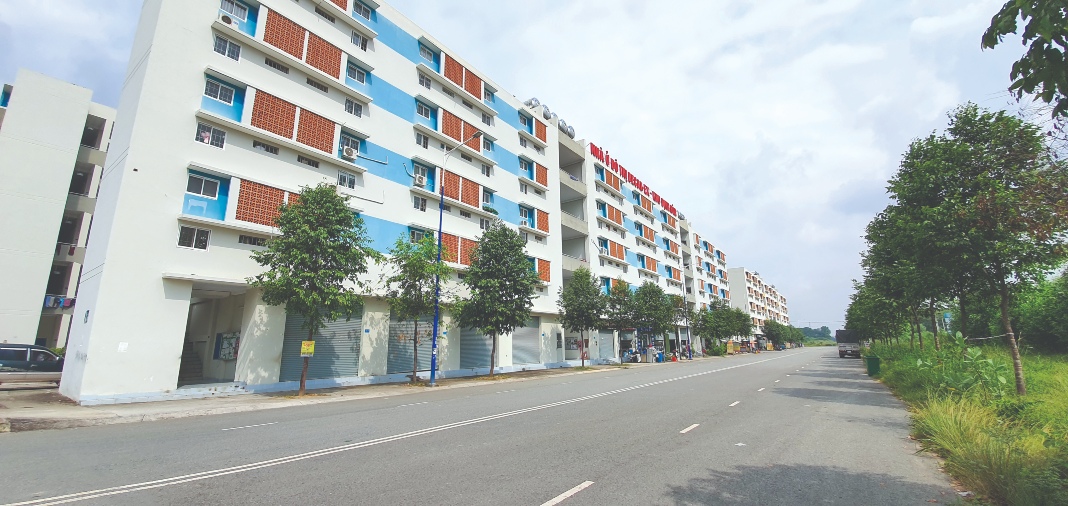
Three decisive factors for the successful development of social homes are low-cost funding, conducive policy, and simple and transparent paperwork. Will the National Assembly’s (NA) supreme review on social housing development in 2024 bring on these three factors?
NA set to work with eight ministries and 12 localities
“The implementation of policies and laws on real estate market management and social housing development from 2015 to the end of 2023” is one of the two supreme topics which the National Assembly will review in 2024.
Regarding social housing, the review aims to objectively and comprehensively evaluate the situation and results of policy and law implementation on social housing development from 2015 to late 2023. This includes identifying achievements, limitations and causes, learning from experiences gained, and proposing solutions to improve policies and laws on social housing.
The NA team will focus on issues such as social housing development programs and plans, target groups and eligibility conditions, land availability, funding sources for social housing construction, project implementation (including investment procedures), types and standards of social homes, pricing and principles for renting, rent-to-own, and selling social homes, and management and operation of social homes.
Between the end of April and the end of July 2024, the NA team is scheduled to work with eight ministries and ministerial-level agencies: Ministry of Construction, Ministry of Finance, Ministry of Planning and Investment, Ministry of Natural Resources and Environment, Ministry of Justice, State Bank of Vietnam, Government Inspectorate, and State Audit Office of Vietnam. They will also visit 12 localities, including Ho Chi Minh, Hanoi, Danang, Haiphong and Can Tho cities, and Binh Duong, Binh Thuan, Dong Nai, Khanh Hoa, Quang Ninh, Bac Ninh, and Hung Yen provinces. In these localities, the team will look into actual social housing projects.
In early August 2024, the team will work with the Government to finalize the content of the review report. The draft report will be presented to the NA Standing Committee at its August 2024 session and will be fine-tuned before it goes before the NA at its October 2024 sitting.
Extending to the 2023 Housing Law
Immediately after the ongoing seventh sitting of the National Assembly (slated to conclude on June 29), the working groups of the review team will start working with the agencies and localities in question. Group 3, in particular, made use of the June 9-16 interval between the two sessions of the National Assembly’s current sitting to work with HCMC, Dong Nai, Binh Duong, and Can Tho. Reports from these localities indicate that social housing supply does not meet demand. Difficulties in social housing development can be divided into three main groups: lack of funding, overlapping and inappropriate policies, and complicated and time-consuming procedures.
For example, to be exempt from land use fees, social housing investors still have to determine land use fees before proceeding to the procedures for land use fee exemption, resulting in additional administrative paperwork and taking 1-2 years to get it done. The regulations on selecting social housing investors are overlapping and inconsistent with laws on investment, bidding, and land, making the investor selection process complicated and time-consuming.
Not only enterprises but also social housing policy beneficiaries face a heavy paperwork burden. They must meet three conditions: owning no house, residing in the province with social housing, and having income lower than the taxable threshold. These conditions must be verified by competent authorities. These regulations require many procedures and documents to be handled, making life difficult for people in need and authorities.
Moreover, preferential policy measures for social housing project investors exist but are not substantial enough to attract businesses. For instance, they include a land use fee exemption, a 50% tax reduction, 20% of the total residential land area set aside for commercial housing development, and access to low-interest loans. However, these incentives benefit home buyers, not investors, as current regulations do not allow state incentives to be included in the sale, rental, or rent-to-own prices of social homes. Another issue is that legitimate costs such as sales and business management expenses cannot be factored into social home prices, and the profit margin is capped at 10%, making it unattractive for companies.
Like other real estate businesses, social housing investors have difficulty accessing funding sources. The VND120-trillion credit package for social housing has disbursed a little more than VND1.14 trillion so far, with over VND1.13 trillion disbursed to investors in 11 projects and VND11 billion to home buyers in four projects.
The 2023 Housing Law has somewhat resolved policy, procedure, and incentive obstacles for social housing development. For example, the law exempts land use fees and land rents for the entire project area of social housing and eliminates the need to determine land prices, land use fees, or land rents exempted under land law. Social housing investors can earn a maximum profit of 10% on the social housing construction area and receive a maximum 20% of the total residential land area (or 20% of the total project floor area) for commercial service or commercial housing construction according to the approved project investment policy. Commercial housing project investors are not required to allocate part of the residential land area for social housing; instead, provincial authorities will decide their obligations based on local conditions.
The 2023 Housing Law also removes the residency condition for purchasing or renting social homes, retaining only conditions on having no house and income below the taxable threshold to facilitate access for people in need of a home. For social home rental, meeting housing and income conditions is not mandatory, and the only condition on target groups applies. The law also improves the social housing investor selection process to align with laws on investment, land, and bidding, and specifies methods and timing for determining social house sale, rental, and rent-to-own prices.
The 2023 Housing Law is expected to take effect on August 1, 2024, instead of January 1, 2025, as previously stipulated. Consequently, implementation guidelines, including guiding government decrees on social housing development and management, must be issued and effective simultaneously. However, the National Assembly’s review covers the period from 2015 to 2023 only. Therefore, the review team should expand their evaluation to include social housing policy in the 2023 Housing Law and its implementation guidelines. This is to ensure two things: First, favorable policies and procedures for social housing investors and beneficiaries are effectively implemented, avoiding a situation where the law is open and transparent but the decrees and circulars that guide the execution of the law set unnecessary conditions. Second, to provide accurate, targeted proposals for improving social housing policies and laws in the future.
Regarding funding, besides proposing solutions to unlock current preferential funding for social housing, the review team should also make proposals related to new directions outlined in Directive No. 34-CT/TW issued on May 24, 2024 by the Party Central Committee’s Secretariat on social housing development. Specifically, these include focusing on developing social homes for rent in urban areas using public investment funds, weighing the establishment of a Social Housing Development Fund or an appropriate financial institution model for long-term, sustainable social housing development. These will serve as a basis for the National Assembly to make accurate, impactful, and strong decisions to realize people’s dream of owning a home and stabilizing their livelihoods.