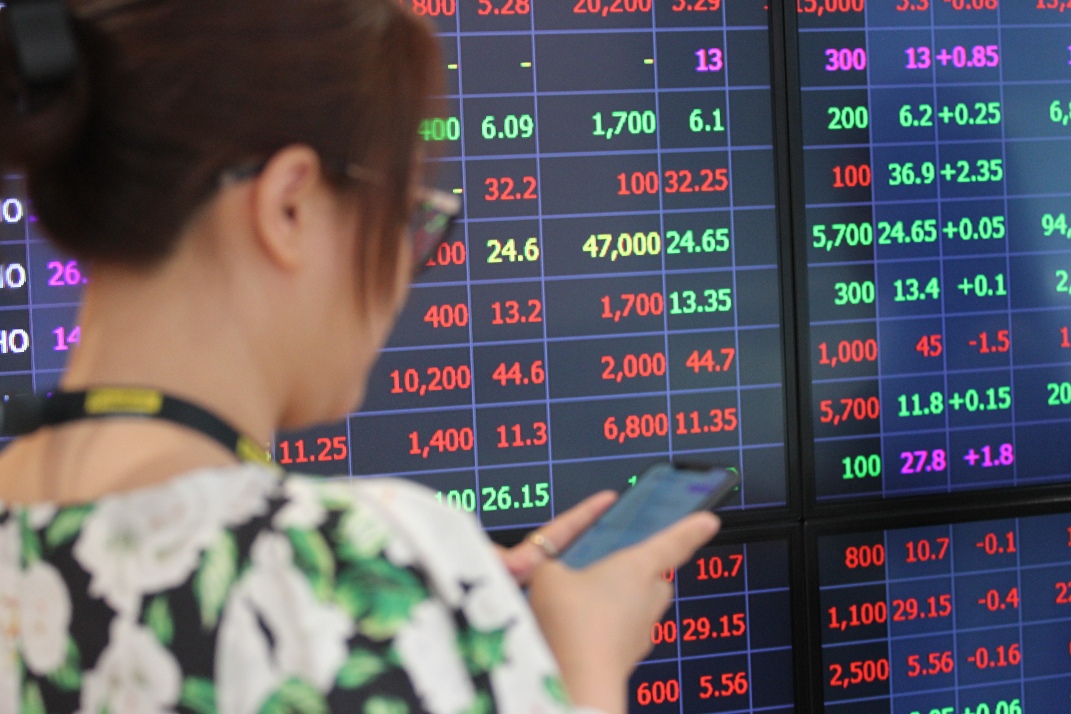
After a strong wave of net buying in early July, foreign investors have shifted back to net selling as the stock market continues to reach new highs. Beyond profit-taking, this reversal reflects growing concerns over the short-term nature of capital flows, foreign exchange risks, and lingering uncertainties in the global economic outlook.
From record net buying to massive selling sessions
In the first half of July, foreign investors played a pivotal role in driving the sharp rally in the stock market. On the HOSE, they recorded net purchases exceeding VND8.1 trillion, including an uninterrupted streak of 11 consecutive net buying sessions from July 2 to 16. Notably, on July 3 alone, net buying surged past VND2.2 trillion. The most actively accumulated stocks during this period included SSI (over VND3.4 trillion), VPB (VND1.4 trillion), and SHB (VND1.4 trillion), alongside Dragon Capital’s fund certificate FUEVFVND (VND1.3 trillion).
This buying momentum was driven by the expectation that FTSE Russell would upgrade the local market in September, along with the positive response to the tariff agreement between Vietnam and the U.S.—one of the earliest agreements with competitive rates in the region.
However, things have flipped since mid-July. Foreign investors have been net selling as the market continues to rise sharply and hit new highs.
In the second half of July, foreigners net sold over VND4.66 trillion across all three exchanges, with selling dominating nine out of 12 trading sessions during this period. The last trading day of the month (July 31) alone saw net sales of more than VND2.24 trillion across all three exchanges.
Foreign investors resumed net selling on August 1, offloading approximately VND2.48 trillion—their largest single-day net sell since late April. The trend continued on August 4, with an additional VND292 billion in net sales. Remarkably, when negotiated transactions are included, the total net selling value would have reached a record-breaking VND10.1 trillion, primarily driven by the sale of nearly 90 million VIC shares, valued at around VND9.94 trillion.
On August 11, the first trading session of the week, foreign investors extended their selling streak, net selling over VND650 billion across all three exchanges. This occurred despite the VN-Index climbing further and briefly touching the 1,600-point mark. Overall, from August 1 to 11, foreign investors net sold nearly VND2.9 trillion—excluding the negotiated VIC transactions. This reversal in trading behavior has, to some extent, dampened domestic investor sentiment.
Why the reversal?
From a market perspective, the sharp rally that has pushed the VN-Index closer to its previous peak makes profit-taking by both domestic and foreign investors an understandable move. In an environment of sustained rapid growth, a market correction is widely anticipated as a necessary pause to preserve long-term upward momentum. This expectation has led many investors to adopt short-term swing trading strategies in an effort to capitalize on volatility and lock in gains.
Still, there are more underlying reasons.
One key factor lies in the nature of capital flows. A portion of the foreign inflows in July originated from Participatory Notes (P-Notes), as many investment funds have yet to fully commit and remain in a phase of cautious exploration. P-Notes are inherently speculative instruments, characterized by their transient nature—capital can enter and exit swiftly—often contributing to heightened market volatility.
Another significant concern is the rising foreign exchange risk, which has disrupted the trading strategies of foreign investors. In the final four trading sessions of July alone, the central exchange rate between the U.S. dollar and the Vietnamese dong climbed by VND76. Over the course of the month, it rose by a total of VND197, or approximately 0.8%—a notably sharp increase compared to previous months. This upward movement in the central rate was mirrored by rising buying and selling prices at both commercial banks and in the informal market.
At the same time, the U.S. dollar surged on the international stage. The U.S. Dollar Index (DXY)—which gauges the greenback’s strength against a basket of major currencies—briefly touched the 100-point mark in late July, its highest level in several weeks. This rally was fueled by a series of trade agreements reached between the U.S. and key global partners, which boosted investor confidence. Additionally, the Federal Reserve’s decision to maintain its monetary policy stance for the fifth consecutive meeting—despite mounting pressure from President Donald Trump—further reinforced the dollar’s strength.
For foreign investors, exchange rate fluctuations can offset their financial gains. Therefore, reducing their holdings is a sensible safeguard.
Pressure from the future economy
The exchange rate, a crucial factor influencing the strategies of foreign investors, will continue to come under pressure in the near future, according to MB Securities Joint Stock Company (MBS).
First, export activities are projected to decelerate in the coming months, as many firms front-loaded shipments ahead of the July 9 tariff deferral deadline—dampening international demand moving forward. According to the S&P Global Vietnam Manufacturing PMI, export orders have declined for eight consecutive months, marking the steepest drop in two years. Simultaneously, Vietnam has ramped up imports from the U.S. under a near-zero tariff regime in an effort to reduce its trade surplus, placing additional strain on the foreign exchange balance.

Secondly, the interest rate differential between the U.S. dollar and the Vietnamese dong is expected to widen further. Domestic deposit rates still have room to decline in the third quarter, while the U.S. Federal Reserve is unlikely to cut the federal funds rate before September due to a resilient labor market and persistent inflationary pressures. Taking these factors into account, MBS forecasts that the USD/VND exchange rate will fluctuate between VND26,600 and VND26,750 by late 2025—representing a 4.5–5% increase compared to the beginning of the year..
Moreover, the exchange rate remains sensitive to geopolitical tensions and new tariff measures introduced by the Trump administration, which are disrupting global supply chains and redirecting investment flows. If pressure on the exchange rate persists, domestic interest rates may be forced upward—potentially prompting foreign investors to shift toward net selling and reduce their equity exposure.
However, this trend does not reflect a wholesale exit from the Vietnamese market. Instead, foreign investors appear to be actively restructuring their portfolios. Specifically, they are cashing in on stocks that have recently surged, whose valuations are no longer compelling, and whose profit targets have already been met. At the same time, they continue to accumulate shares in companies with strong growth potential.