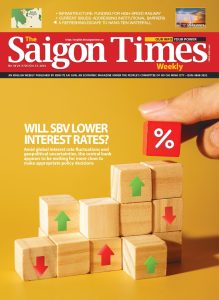
A source from the State Bank of Vietnam (SBV) recently said that the central bank had not ruled out the possibility of reviewing policy interest rates. Amid global interest rate fluctuations and geopolitical uncertainties, the central bank appears to be waiting for more clues to make appropriate policy decisions.
Bolder steps by central banks worldwide
On October 16, 2024, the Bank of Thailand (BoT) lowered its benchmark interest rate by 0.25 percentage point to 2.25% per year, its first cut in four years, to support the Thai economy affected by an export decline and regional geopolitical instability. On the same day, the Central Bank of the Philippines (BSP) made its second interest rate cut in two months by 0.25 percentage point to 6% per year, with expectations for a third cut by the end of the year.
In recent months, central banks in Asia and Europe have revised down interest rates to boost economic growth and respond to external factors, such as weakened demand and rising energy prices. Indonesia cut its benchmark rate by 0.25 percentage point to 6% per year on September 18 to stimulate investment and consumption amid slowing economic growth. Meanwhile, the European Central Bank (ECB) has made three rate cuts this year, bringing its prime rate to 3.25% annually by October 17.
On October 21, the People’s Bank of China (PBoC) lowered its prime lending rate by 25 basis points and announced further cuts for one- and five-year loan prime rates to 3.1% and 3.6% per year, respectively, having earlier stunned the market by cutting short- and long-term loan rates in July. The PBoC adjusted down the reserve requirement ratio (RRR) by 50 basis points at the end of September and recently announced plans for a further RRR reduction of 25-50 basis points by the end of the year, depending on liquidity conditions.
The U.S. Federal Reserve’s recent move to enter a monetary easing cycle with a substantial 0.5-point rate cut in September has prompted other countries in the region to lower their interest rates aggressively, especially as global risks exert pressure on economies. However, compared to other countries, Vietnam faces unique factors that currently limit its ability to cut policy rates.
Why Vietnam cannot lower rates immediately
Since early August, the SBV has reduced Treasury bill and open market operations (OMO) rates, providing liquidity to the banking system at lower costs to support the economy in the aftermath of recent storms and floods. However, lowering core policy rates, such as refinancing, rediscount rates, or deposit interest rate caps of less than six months, remains a tough choice at this time.
While inflation has been under control, with the consumer price index averaging a 3.88% increase over the first nine months of 2024, inflation risks remain unpredictable. Geopolitical tensions, particularly in the Middle East, continue to impact global supply chains, potentially driving up energy prices. Additionally, recent storms and floods in Vietnam have put pressure on domestic food prices.
Foreign exchange rate pressure has resurfaced recently. The buying and selling prices of the U.S. dollar at banks rose continuously last week as the dollar strengthened globally. Notably, the dollar selling prices at banks have approached informal market levels, indicating a strain on supply in the banking system. A reduction in policy rates could further intensify the foreign exchange rate pressure, risking foreign investment outflows from Vietnam.
Furthermore, credit growth is still outpacing deposit growth, keeping system liquidity tight, especially with rising loan demand toward year-end. Latest data from SBV showed credit growth at 9% through September, totaling VND14.7 quadrillion, while deposits grew by about 5.28%, reaching VND14.5 quadrillion.
According to international institutions, the likelihood of the SBV cutting policy rates this year remains low. UOB Bank expects the SBV to maintain its main policy rates through the year’s end, while HSBC forecasts that the SBV will keep the refinancing rate at 4.5% until the end of 2025.
Waiting for more clues?
An SBV representative recently said that the central bank has not ruled out the possibility of reviewing policy rates, with options to maintain or lower it, depending on macroeconomic indicators such as inflation, exchange rates, and economic growth. At a time when global interest rates are volatile and geopolitical situations in many parts of the world are tense, the SBV appears to be awaiting further clues before making a decision.
The first signal may come from additional rate cuts by the Fed, which is anticipated to make two more cuts by the end of the year. Fed decisions directly impact exchange rates, foreign investment flows, and dollar-denominated borrowing costs for businesses. If the Fed reduces rates, the rate differential between Vietnam and the U.S. will narrow, easing the pressure on the exchange rate between the Vietnam dong and the U.S. dollar.
This would give the SBV more flexibility to consider cutting policy rates without risking foreign capital outflows. In 2023 and through the first nine months of 2024, high U.S. rates prompted international investors to pull funds from emerging markets to seek high-yield U.S. assets.
Banking system liquidity is a crucial factor in monetary policy decisions, and the SBV will closely monitor this before deciding on a rate cut. One potential measure to improve liquidity could be the central bank’s resumption of foreign currency purchases. With the peak inflow of remittances and foreign direct investment disbursements expected in late 2024 and early 2025, the SBV will choose an appropriate time to act.
Frederic Neumann, chief Asia economist at HSBC, recently said that China’s economic stimulus efforts could benefit Vietnam’s economy, giving the SBV little impetus to lower rates. However, if the U.S. economy falls into a recession and China’s stimulus measures prove ineffective, the SBV may resort to rate cuts.
Lastly, ongoing military conflicts in the Middle East, which are causing global economic instability, will influence the monetary policy choices of many countries. One significant concern is the potential for direct conflict between Israel and Iran, which could cause severe disruptions in oil markets and global supply chains. If geopolitical instability worsens, international capital flows may once again be affected, compelling the SBV to proceed cautiously with rate adjustments to ensure financial system stability.