


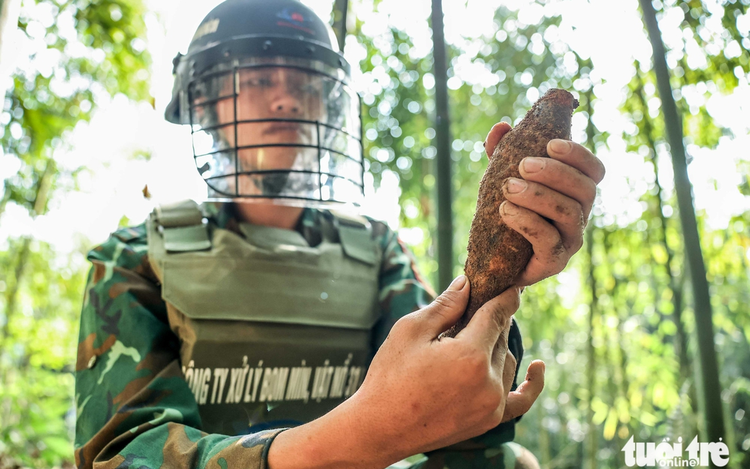
A soldier holds a B60 mortar round newly found in a bamboo forest in Tuyen Quang Province, northern Vietnam. Photo: Nguyen Khanh / Tuoi Tre
The dangerous work is a crucial first step in ensuring the safety of teams searching for the remains of fallen soldiers and protecting local residents from deadly wartime explosives.
Facing death every day
More than 200 officers and workers from Mine and Explosive Ordnance Clearance Company 319, under Corporation 319 of Vietnam's Ministry of National Defense, spend their days soaked in sweat inside heavy protective gear while meticulously examining every patch of ground.
On the former Vi Xuyen battlefield, unexploded ordnance remains buried in multiple layers beneath the surface.
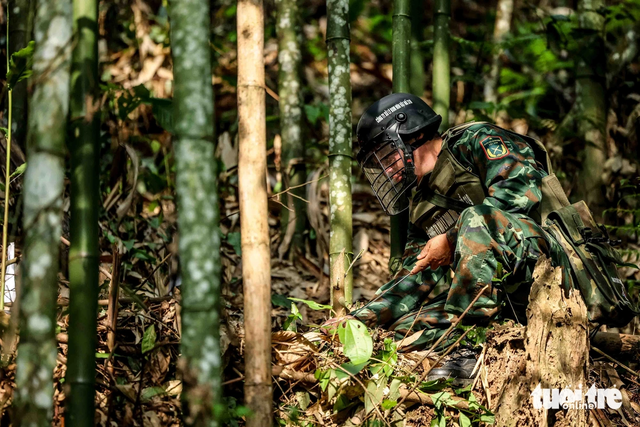
A soldier carefully inserts a metal probe into the ground while searching for suspected landmines and unexploded ordnance in Tuyen Quang Province, northern Vietnam. Photo: Nguyen Khanh / Tuoi Tre
The first team digs small footholds and clears vegetation. Behind them, soldiers wearing protective suits weighing more than 10 kilograms patiently insert metal probes, little thicker than incense sticks, into the ground.
Whenever the probe stops against a rock, a tree root, or another hard object, they calmly mark the location with a red flag before further inspection.
The buried objects can be live grenades, mortar shells, artillery fragments, or, most commonly, Type 652A anti-personnel mines. These plastic-cased mines contain only a small metal detonator, making them extremely difficult to detect with conventional mine detectors.
The Type 652A is considered especially dangerous because it was widely scattered on the ground as a defensive weapon.
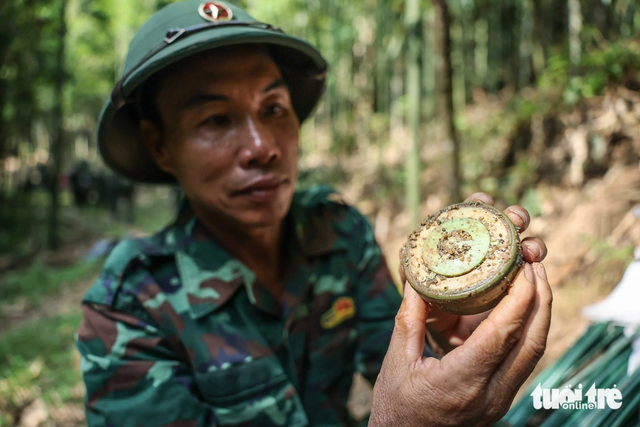
Type 652A anti-personnel mines remain among the most common explosives left behind after the war in Vietnam. Their plastic casing makes them difficult to detect with specialized equipment. Photo: Nguyen Khanh / Tuoi Tre
It can detonate under pressure of only about 2.5 kilograms and has continued to claim lives and cause severe injuries long after the war ended.
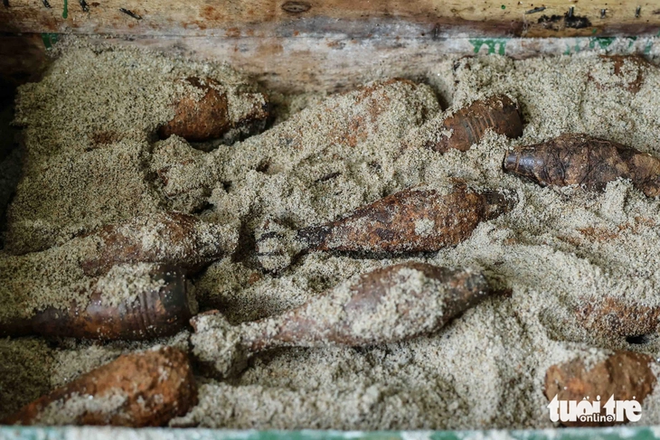
In a single morning, the clearance team recovered more than a dozen landmines and grenades, removed their detonators, and carefully placed them in sand-filled wooden boxes.
Clearing way for search for fallen soldiers
Before teams can search for and recover the remains of fallen soldiers, mine clearance must be completed.
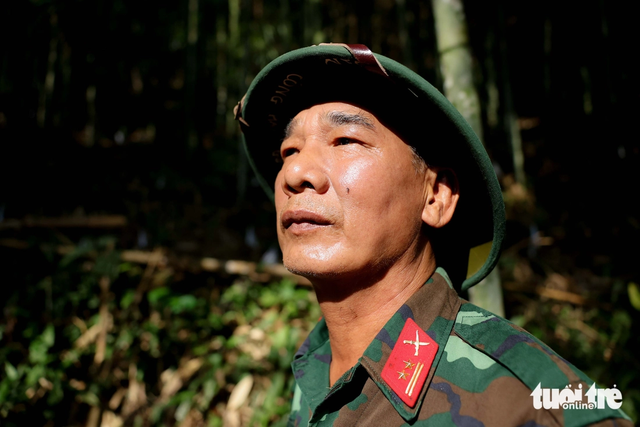
Lieutenant Colonel Nguyen Van Trieu says his unit is clearing 500 hectares in Tuyen Quang Province under a 2025-27 post-war mine clearance project. Photo: Nguyen Khanh / Tuoi Tre
More than 20 units are currently carrying out mine clearance missions across Tuyen Quang.
Since 2015, Mine and Explosive Ordnance Clearance Company 319, together with engineering units from Division 316 under Military Region 2 and the former Ha Giang Provincial Military Command, has cleared explosives along the former Ha Giang border area.
Lieutenant Colonel Nguyen Van Trieu, the field commander, has spent 37 years clearing landmines and unexploded ordnance, from Mong Cai in Quang Ninh Province to Vi Xuyen and other sections of the former Ha Giang border.
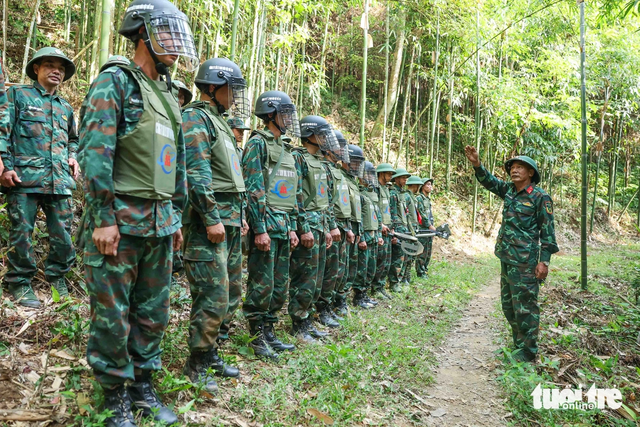
Lieutenant Colonel Nguyen Van Trieu assigns tasks before teams head into the field. Photo: Nguyen Khanh / Tuoi Tre
Although he has worked in many former war zones, Trieu said he has never encountered a battlefield with as many layers of buried explosives as Vi Xuyen.
"This is an extremely dangerous job, but we understand that the more explosives we remove, the safer it will be for teams searching for the remains of fallen soldiers and for local people," he said.
Under Vietnam's ongoing 500-day campaign to search for, recover, and identify fallen soldiers, mine clearance is being prioritized at former battlefields where many soldiers are believed to remain.
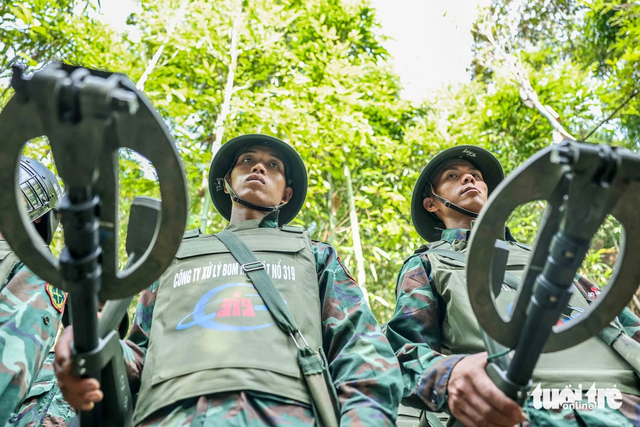
Modern mine detection equipment is used to locate unexploded ordnance left behind after the war. Photo: Nguyen Khanh / Tuoi Tre
Mine and Explosive Ordnance Clearance Company 319 has expanded its workforce from 60 to 242 personnel for the campaign. Equipped with modern technology and extensive experience, the unit has been assigned to clear areas with the highest concentration of unexploded ordnance.
Tuyen Quang still has about 70,000 hectares of land contaminated by mines and unexploded ordnance, most of it along the northern border.
During the 500-day campaign, authorities aim to clear 4,000 hectares in priority areas to support the search and recovery of fallen soldiers.
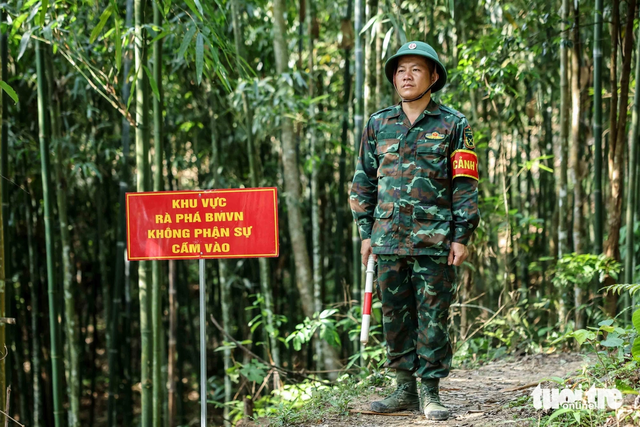
Warning signs mark the trail leading to the mine clearance area, where soldiers remain on guard at all times. Photo: Nguyen Khanh / Tuoi Tre
Trieu said his unit is responsible for clearing 500 hectares under a post-war mine and unexploded ordnance clearance project running from 2025 to 2027.
The project includes 230 hectares requiring clearance to a depth of one meter, 200 hectares requiring clearance to three meters, and another 70 hectares with extremely dense mine contamination.
"So far, we have completed 250 hectares, or 50 percent of the assigned area. We aim to finish the entire project by the end of 2026 to provide safe ground for the search and recovery of fallen soldiers' remains," he said.
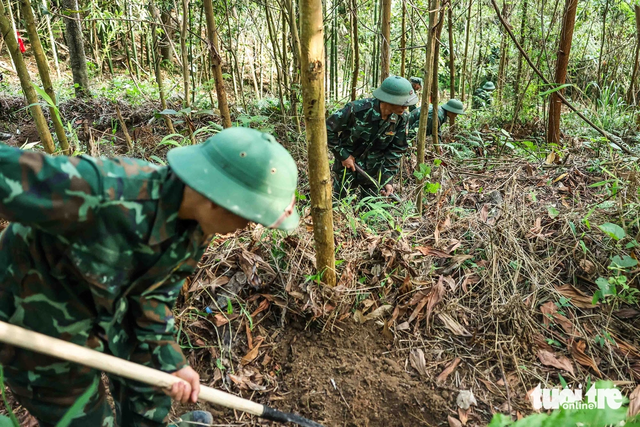
Soldiers clear vegetation before using specialized equipment to detect buried explosives. Photo: Nguyen Khanh / Tuoi Tre
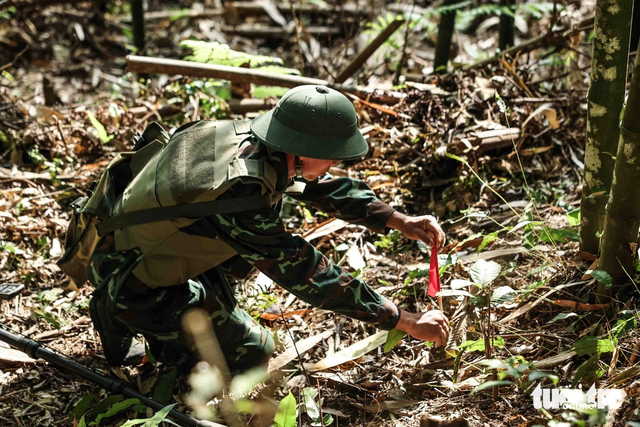
A soldier places a red flag to mark the location of suspected unexploded ordnance. Photo: Nguyen Khanh / Tuoi Tre
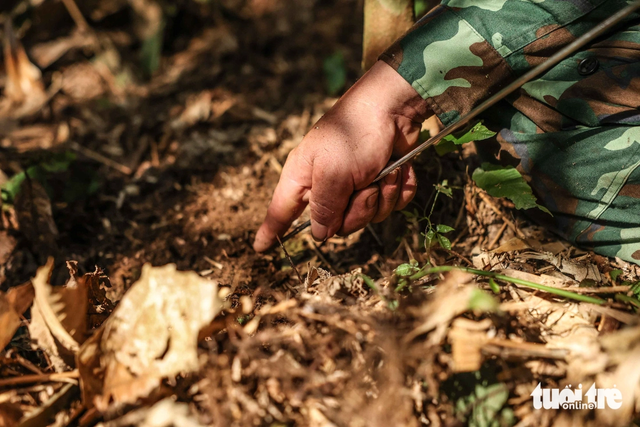
Whenever a metal probe strikes a hard object underground, soldiers mark the location with a red flag for further inspection. Photo: Nguyen Khanh / Tuoi Tre
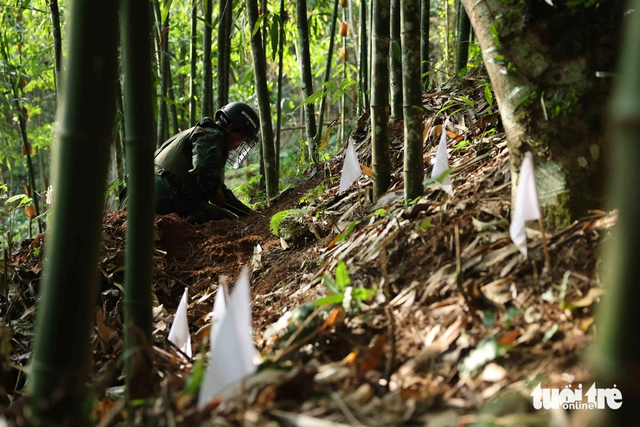
White flags are used to establish safe movement corridors through contaminated areas. Tuyen Quang still has about 70,000 hectares of land affected by mines and unexploded ordnance, mostly along the northern border. Photo: Nguyen Khanh / Tuoi Tre
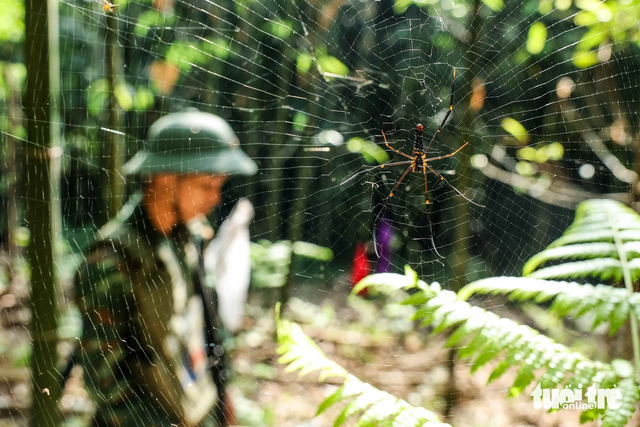
Mine clearance teams face constant danger from hidden explosives as well as insects and venomous animals. Photo: Nguyen Khanh / Tuoi Tre
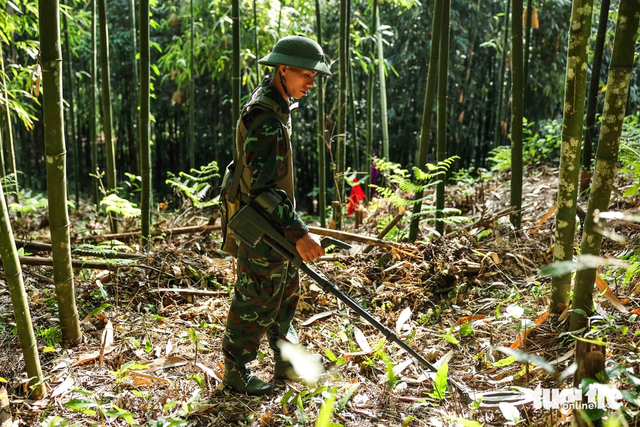
A soldier uses a MinNex 4600 mine detector to locate explosives left behind after the war. Photo: Nguyen Khanh / Tuoi Tre
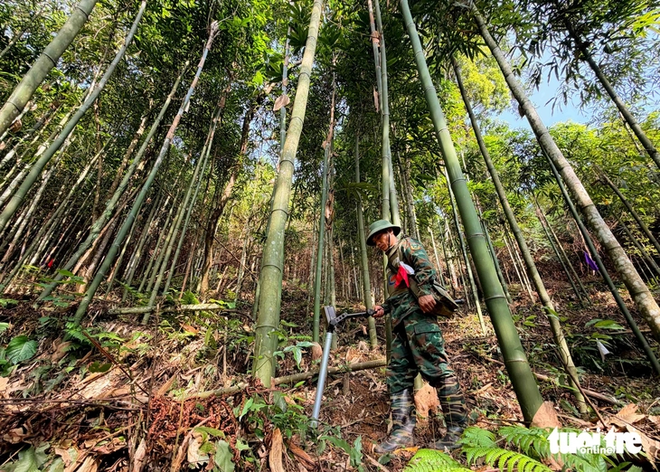
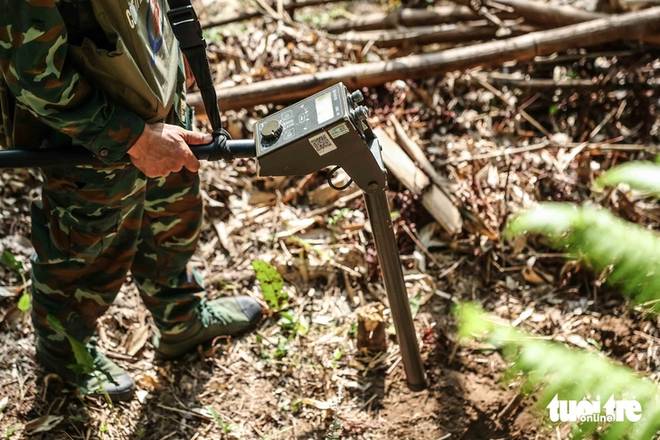
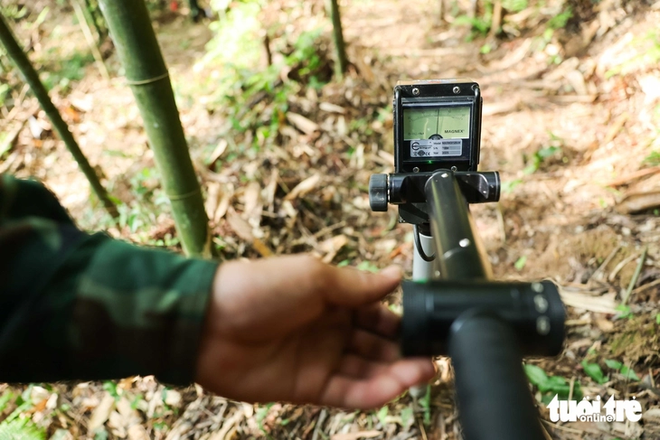
For bombs buried deep underground, soldiers use specialized detectors capable of scanning to depths of up to seven meters. Photo: Nguyen Khanh / Tuoi Tre
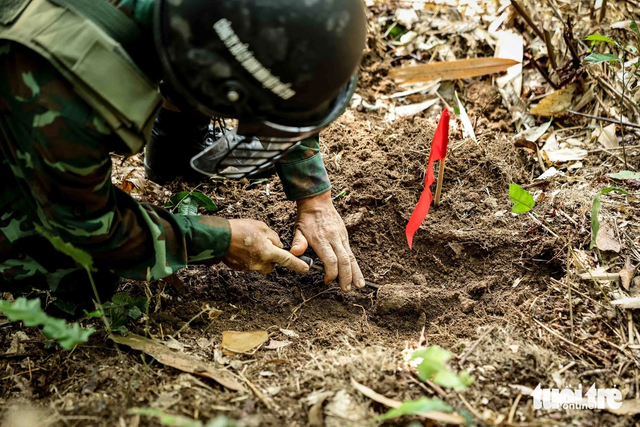
A grenade buried deep underground is about to be recovered. Each working day brings constant danger as soldiers search layer by layer beneath the ground. They first mark off the area and clear the surface vegetation. The first team searches the top 30 centimeters of soil, followed by other teams using advanced equipment to scan deeper layers. In some locations, they have to search as deep as three meters. Photo: Nguyen Khanh / Tuoi Tre
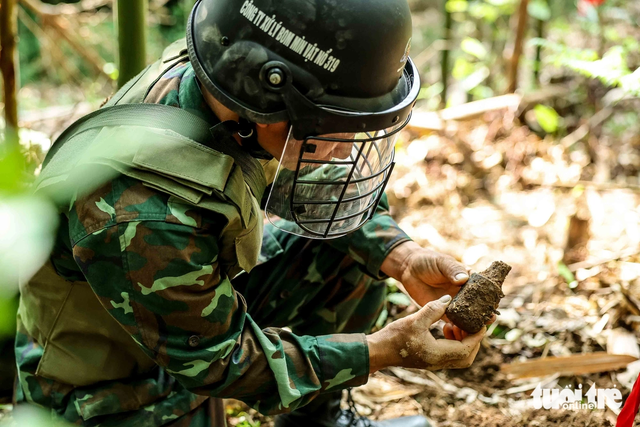
Soldier Bon Van Giau holds a grenade newly recovered from the ground. Photo: Nguyen Khanh / Tuoi Tre
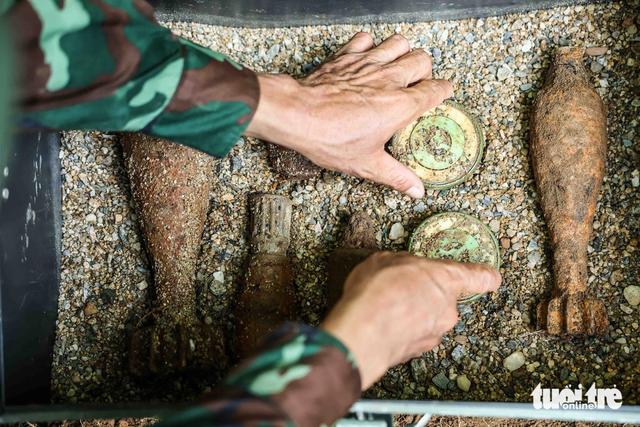
Within just one hour, the clearance team recovered several Type 652A anti-personnel mines, B60 mortar rounds, and grenades. Photo: Nguyen Khanh / Tuoi Tre
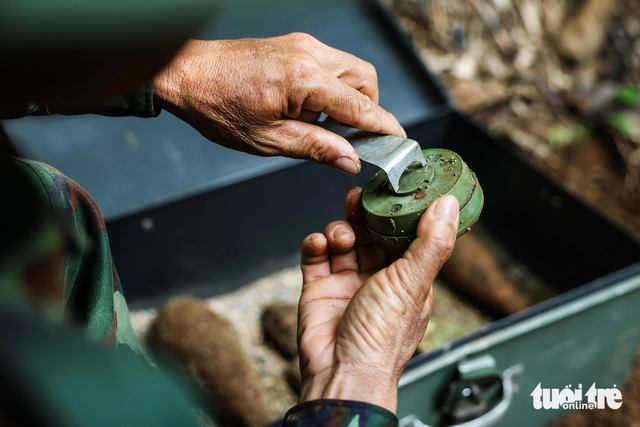
A Type 652A anti-personnel mine is being defused before being placed in a storage container. Photo: Nguyen Khanh / Tuoi Tre
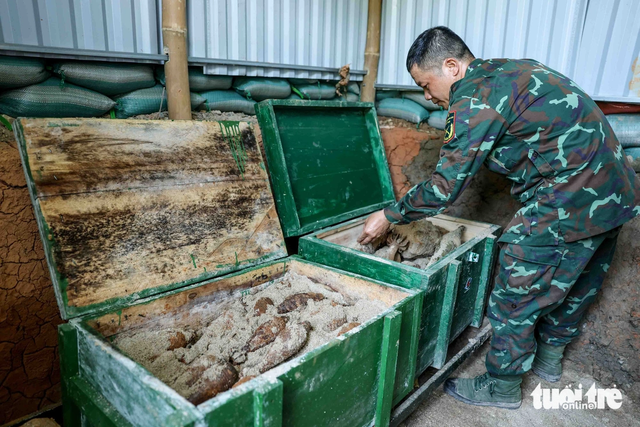
Pa Van Bich, leader of the machinery team, sorts recovered explosives into wooden crates. Most recovered explosives are destroyed, while a small number are retained for training purposes. Photo: Nguyen Khanh / Tuoi Tre
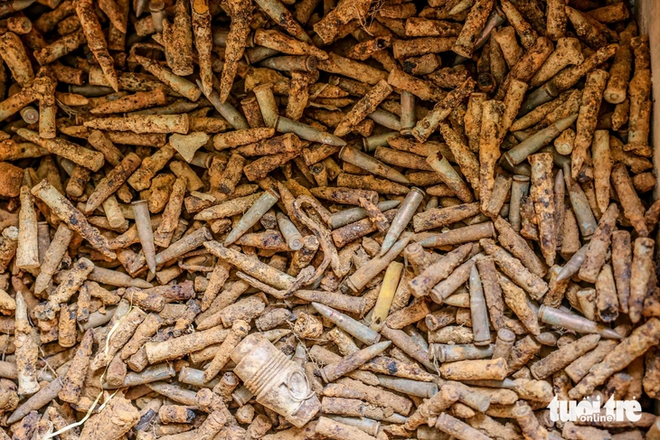
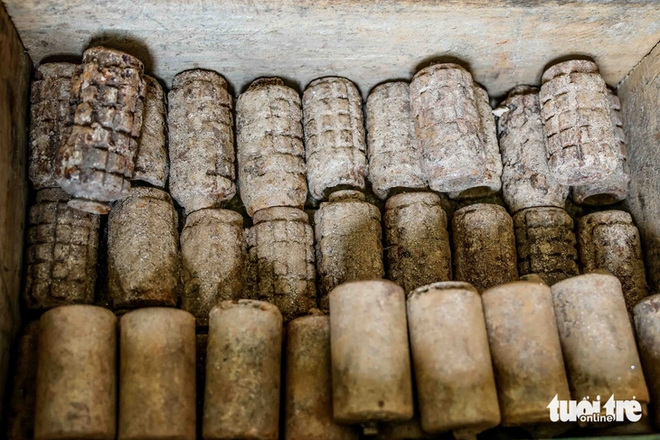
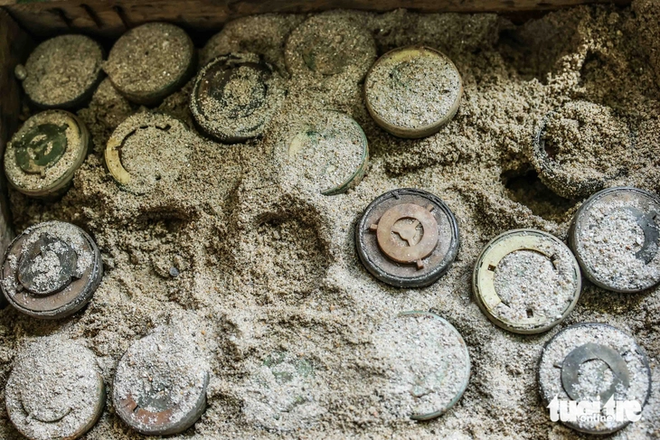
Ammunition, Type 652A anti-personnel mines, POMZ-2 mines, and B40 rocket rounds await disposal. Recovered bombs, mines, and unexploded ordnance are sorted and stored before destruction. Photo: Nguyen Khanh / Tuoi Tre








Max: 1500 characters
There are no comments yet. Be the first to comment.