


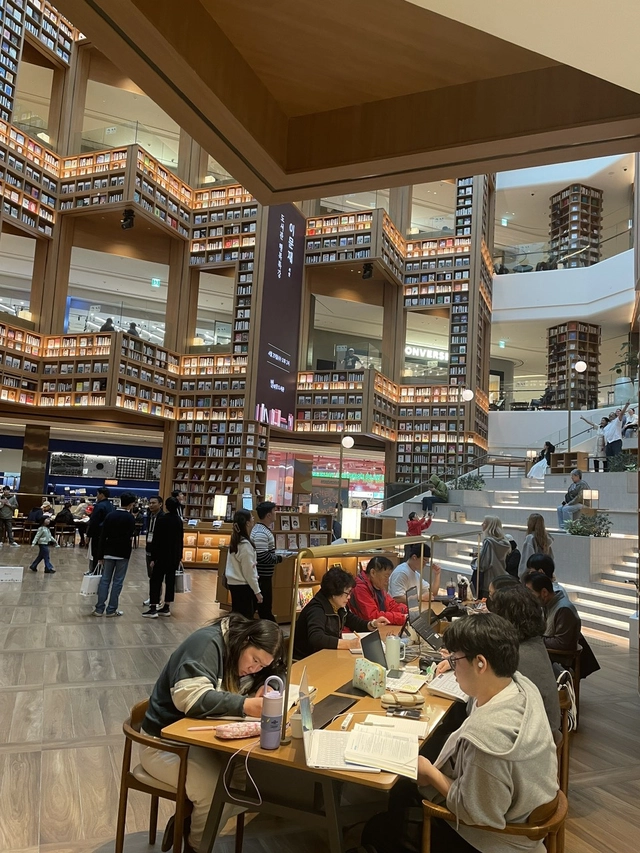
Visitors sit reading beside the 22-meter-high bookshelves spanning from the fourth to seventh floors at Starfield Suwon shopping center. Photo: XUAN TRUNG
Immidiately after an international journalists' conference in Seoul, Park Jong Hyun, president of the Journalists Association of Korea, led journalists directly to a nearby Kyobo Bookstore.
A retail centerpiece built on books
Kyobo, the country’s largest bookstore chain, is often described as a 'people’s bookstore,' serving as a beloved gathering place for book lovers.
Visitors come to read, browse, attend events, and interact with authors.
While reminiscent of Ho Chi Minh City’s Book Street, Kyobo is uniquely situated in the basement of a central commercial complex in Seoul.
Shelves packed with Korean and English-language books stretch throughout the spacious store, complemented by some 11 million titles available across Kyobo’s online platforms.
Hyunlim Kim, who oversees foreign-language books, explained that the store prioritizes fostering a reading culture over profit, particularly among young people increasingly drawn to digital devices.
Key features of the bookstore include comfortable seating for on-site reading, art exhibition areas, and a notable wall displaying portraits of Nobel Prize-winning authors.
Visitors will find prominent South Korean writer Han Kang displayed alongside renowned global authors.
For those unable to fully explore the store, a QR code allows them to learn more on their phones, displaying the message: “People make books, books make people.”
The same message in Korean appears at the main entrance of the Kyobo complex.

Beyond Seoul, in Suwon, home to Samsung’s headquarters, our journey continued into another realm of books at the Starfield shopping center.
Its library serves as the centerpiece, with towering bookshelves spanning from the fourth to seventh floors.
The fourth floor features a stage for speakers, audience seating for discussions about books and cultural topics, and ample comfortable areas for visitors to relax and read.
Prime retail space that would typically be used for commercial purposes is instead devoted to books.
Youngsun Won, general manager of Starfield Suwon, described its four-story bookshelves - approximately 22 meters tall - as the ‘heart’ of the complex.
As a result, visitors cannot overlook this ‘heart of books.’
The model is now being replicated at other Starfield centers across the country.
On the day of our visit, the mall had recently begun allowing pets to accompany their owners.
The rationale: recognizing that many young people find it difficult to part with their pets, Starfield Suwon opted to welcome them rather than maintain its previous ban, aiming to attract this demographic.
Cultural industry elevates South Korea’s global image
South Korea is investing in culture on a scale commensurate with its economic development.
The nation takes pride in this, viewing it as a means to enhance its global image and solidify its position as a well-rounded, developed nation, rather than one solely defined by economic growth.
Complementing the Hangeul Museum in Seoul, authorities have recently invested in a large, modern national museum in Incheon dedicated to the world’s writing systems.
The museum aims to enable Koreans not only to understand their own heritage but also to appreciate the broader tapestry of human civilizations.
As highlighted by the exhibits, writing systems across the world are among humanity’s greatest inventions, connecting the past, present, and future. South Korea positions itself within that continuum of development.
The museum is designed like an unfurling scroll, guiding visitors back to the earliest forms of writing before moving through the evolution of scripts across different cultures.
Vietnamese visitors may find the experience particularly engaging, given that Vietnamese is featured alongside major languages such as English, French, Chinese, Japanese, and Korean in the displays.
Notably, the East Asian section features a version of Truyen Kieu ‘The Tale of Kieu’ written in Nom script by the renowned Vietnamese poet Nguyen Du.
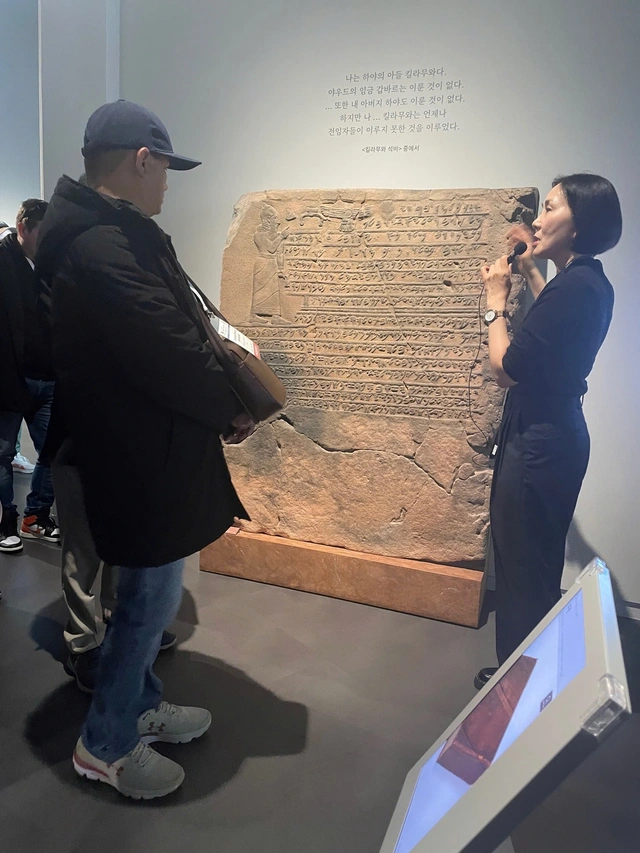
Visitors listen to a presentation on the origins of writing systems at the National Museum of World Writing Systems. Photo: XUAN TRUNG
The museum attracts young audiences through its modern design and the application of cutting-edge technologies in sound, lighting, and artifact presentation.
Due to time constraints, however, we were unable to learn about the acquisition process for these globally sourced artifacts.
Leaving the museum with some regret, we were compensated with a visit to the nearby Dae Jang Geum Park.
This 250-hectare film studio, operated by MBC (one of South Korea’s leading broadcasters), gained fame following the immense success of the historical television series Dae Jang Geum.
The MBC Dramia set has since been transformed into a park named after the hugely popular series in South Korea, Vietnam, and beyond.
MBC executives admitted they had not anticipated the scale of the show’s success.
Built 20 years ago, the set continues to attract domestic and international visitors eager to experience scenes of historical Korea.
The kitchen of Dae Jang Geum, complete with real pots and pans, continues to evoke nostalgia, particularly among female visitors who eagerly take photographs as if stepping directly into the series.
Despite the patriarchal norms of Korea’s feudal era, the story honors Dae Jang Geum, an orphan who rose to become the King's first female physician in the Joseon Dynasty (1392–1910).
Today, South Korea celebrates actress Lee Young Ae, who portrayed the character, as a national beauty icon.
The park also includes camping areas for visitors, particularly young people, seeking to spend more time immersed in the historical setting.
The enduring success of the series has clearly generated a lasting legacy of cultural and commercial achievements.
The success of film studios, bookstores, and writing museums in attracting the public is not easily achieved.
It requires carefully executed, dedicated projects commensurate with their intrinsic economic and cultural value.
Today, South Korea’s cultural industries now rival its traditional manufacturing sectors - processing, machinery, and electronics - which initially propelled the country into the ranks of developed nations within decades after World War II.
Where history stands still: The DMZ
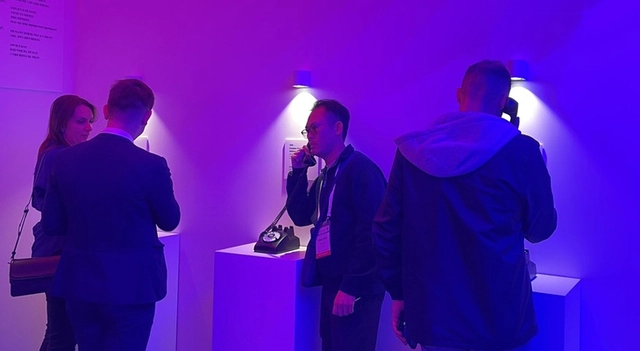
International journalists listen to recorded audio of family reunions between North and South Korea through a rotary telephone at the DMZ. Photo: XUAN TRUNG
At the Demilitarized Zone (DMZ), which separates North and South Korea, we were struck by the description of it as "where history stands still."
The area has remained off-limits to both sides since the armistice agreement was signed in 1953.
Lifting the receiver of a rotary telephone, we listened to recorded sounds—sobs, laughter, and cries—from reunions of families separated between the two Koreas.
These emotional sounds were captured during brief reunions from periods of warmer relations.
Images and footage of tearful meetings and partings played on screens, rendering the DMZ's story profoundly moving, not only for those directly affected but also for visitors.
Even without further explanation, visitors can grasp the value of peace.
The DMZ thus becomes not merely a story of war or politics, but a deeply human cultural narrative.
South Korea's comprehensive approach to cultural development offers valuable lessons for Vietnam, which is also seeking to expand its own cultural industry and promote its national image abroad.









Max: 1500 characters
There are no comments yet. Be the first to comment.