


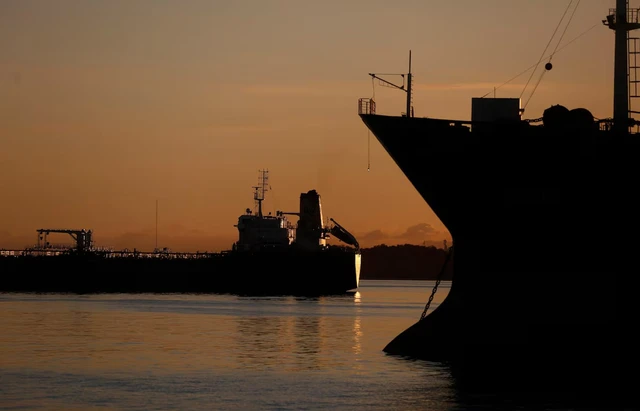
Oil tankers are pictured docked at the Guanabara Bay in the state of Rio de Janeiro, November 19, 2014. REUTERS/Pilar Olivares/ File Photo
Southeast Asia's fuel oil imports from Brazil more than doubled last month compared to February, data from analytics firms Kpler and Vortexa showed, mostly heading to the world's top ship refuelling hub of Singapore and Malaysia.
The volume is at an all-time high near 1 million metric tons (about 205,000 barrels per day) based on Kpler data, while Vortexa puts it at the highest in a year at close to 800,000 tons.
A widening fuel oil price spread between the East and West is driving more South American fuel oil towards Asia, traders and analysts said.
The East-West VLSFO swap - the price difference for Asia versus supply from the United States and Europe - widened to a record of more than $160 a ton on March 31, over 170% higher than end-February, LSEG data showed.
"Favourable East-West VLSFO arbitrage economics, along with strong refinery runs in the Atlantic Basin, could continue to pull fuel oil towards Asia," said Xavier Tang, senior market analyst at Vortexa.
Robust Brazilian supply caps premiums
Concerns of tighter oil supply emerged after the U.S.-Iran conflict curtailed traffic through the crucial Strait of Hormuz, which typically handles about a fifth of daily global energy shipments.
This drove up refuelling costs for all marine fuels including VLSFO, high-sulphur fuel oil (HSFO) and marine gasoil.
The Brazilian fuel oil influx, which mainly consists of very-low-sulphur fuel oil used in bunkering, has capped spot premiums for fuel oil and marine fuel in Asia's oil trading hub, Singapore.
Spot premiums for VLSFO dropped to about $50 a ton on Tuesday, after spiking to a record of nearly $140 on March 18, up from single-digit premiums before the war started, LSEG data showed.
However, the region's VLSFO imports for March were relatively flat month-on-month despite heavy inflows from Brazil, Vortexa's Tang said.
"Supplies from Kuwait's al-Zour refinery have fallen significantly as the Strait of Hormuz remains mostly shut, while Dangote's RFCC (residue fluid catalytic cracking) unit is running at full capacity in March, reducing low-sulphur straight-run inflows into Singapore," Tang said.
While spot premiums for bunker fuel in Singapore have eased back to pre-war levels on higher supply from Brazil and Russia, traders said the supply outlook remained tight due to a shortage of heavy crude oil that produces HSFO and gasoil blending stocks used in the making of VLSFO.









Max: 1500 characters
There are no comments yet. Be the first to comment.