



An investor checks her phone in front of a stock market display board at a securities company in Vietnam. Photo: Quang Dinh / Tuoi Tre
In an interview with Tuoi Tre (Youth) online newspaper, Wang, who has nearly 20 years of management experience at Yuanta Financial Holdings in Shanghai, Taiwan, and Thailand, shared his views on the reforms Vietnam should prioritize to attract long-term foreign capital.
Drawing on his experience following the market upgrade journeys of several countries, Wang said Morgan Stanley Capital International (MSCI) has become increasingly stringent in its assessments, with some markets having been downgraded after failing to implement meaningful reforms.
He said Vietnam should recognize that MSCI serves as a global benchmark provider that helps investment funds measure performance and allocate international capital, placing greater emphasis on sustained implementation than on policy commitments.
Although MSCI has acknowledged Vietnam's reform efforts, eight of its 18 market accessibility criteria remain rated as "requires improvement," he noted.
According to Wang, Vietnam should prioritize three key reforms.
The first is completing the implementation of a central counterparty clearing (CCP) mechanism.
Vietnam's State Securities Commission has announced a roadmap to implement the CCP mechanism in the first quarter of 2027.
Wang said the system would eliminate the pre-funding requirement, which MSCI has identified as Vietnam's biggest technical hurdle.
Second, Vietnam should fully address foreign ownership limits and ensure equal treatment for all investors.
Third, the country should introduce omnibus trading accounts (OTA) and expand English-language corporate disclosures to improve access for institutional investors.
He added that meeting MSCI's standards will require high-level coordination by authorities with a deep understanding of how global index providers evaluate markets.
Foreign investors continue net-selling
Asked about the recent wave of foreign net selling despite Vietnam's solid economic outlook, Wang cited several factors.
He said global capital has been flowing into AI- and semiconductor-related markets such as the United States, South Korea, and Taiwan, reducing the relative appeal of frontier and emerging markets, including Vietnam.
He also pointed to a shortage of high-quality new listings.
Unlike the 2017-18 period, when companies such as Sabeco, Vinhomes, and Techcombank attracted strong foreign interest, the market has seen fewer major listings in recent years.
However, Wang said a third wave of initial public offerings led by major private companies, including Thaco Auto, Bach Hoa Xanh, Golden Gate, and Highlands Coffee, could bring more high-quality stocks to the market and help attract foreign capital.
Another factor was exchange rate pressure and interest rate differentials between Vietnam and the United States, which encouraged some investment funds to shift capital elsewhere.
He noted that the situation has improved as the exchange rate has become more stable.
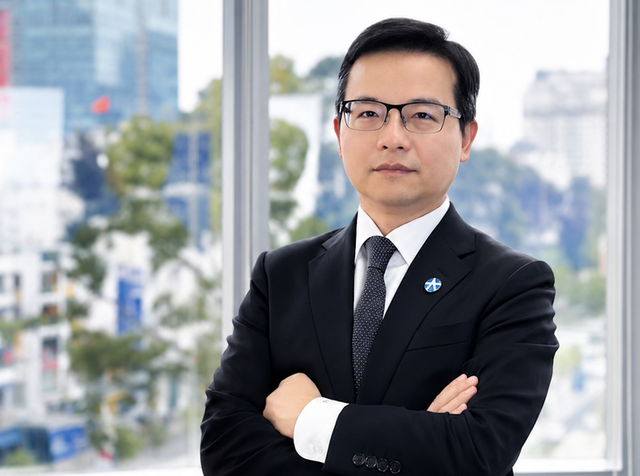
Wang Chung Shan, chairman and legal representative of Yuanta Securities Vietnam. Photo: Yuanta Securities Vietnam.
To attract more long-term foreign investment, Wang proposed three broader strategies.
The first is upgrading Vietnam's sovereign credit rating to investment grade.
He said doing so would enable the country to attract capital from pension funds, insurance companies, and sovereign wealth funds.
Vietnam's sovereign credit ratings from both S&P and Fitch are currently one notch below investment grade, making an upgrade an important step toward increasing the country's attractiveness while lowering financing costs across the economy, he said.
His second recommendation is to develop international financial centers in Ho Chi Minh City and Da Nang, giving investors better access to foreign exchange services and international hedge funds.
Third, he called for expanding the derivatives market and developing more effective foreign exchange hedging instruments to reduce investment risks for overseas investors.
Looking ahead, Wang said Vietnam's macroeconomic fundamentals remain strong, citing GDP growth of 8.02 percent in 2025 and the government's target of annual growth of 10 percent during the 2026-30 period.
"The question is no longer whether Vietnam is attractive," he said.
"The real question is whether it is convenient and safe enough for foreign investors to access."
Speaking about Yuanta Securities Vietnam, Wang said the company's greatest strength lies not only in the scale of Yuanta Financial Holdings but also in its operational experience across multiple developed markets.
The company plans to continue introducing investment models that have proven successful in other markets, including YSsaving, a regular stock and exchange-traded fund (ETF) investment solution designed to help investors build wealth over time.
Yuanta Securities Vietnam also serves as a bridge between Vietnam's capital market and international investors.
In cooperation with Yuanta Thailand, it has launched depositary receipt products linked to several leading Vietnamese listed companies.
Wang said risk management and regulatory compliance remain central to Yuanta's long-term strategy across the Asia-Pacific region.
In Vietnam, the company applies strict governance standards to protect client assets while maintaining balanced and sustainable growth.
He added that the securities industry is shifting from competing primarily on trading services to competing on customer experience, data, and long-term value creation.
While technology plays an increasingly important role, Wang said the ultimate goal is to help clients invest more effectively and build stronger financial futures.
Yuanta Securities Vietnam aims to become not only a brokerage or financial technology company but also a trusted financial partner for investors and one of Vietnam's top 10 securities firms in the future.
He said the Vietnamese government's efforts to improve market transparency and operational quality create significant opportunities for financial institutions, but companies must also manage growing challenges, including rising competition, cybersecurity threats, online fraud, and financial scams, while balancing innovation, business growth, and risk management.








Max: 1500 characters
There are no comments yet. Be the first to comment.