


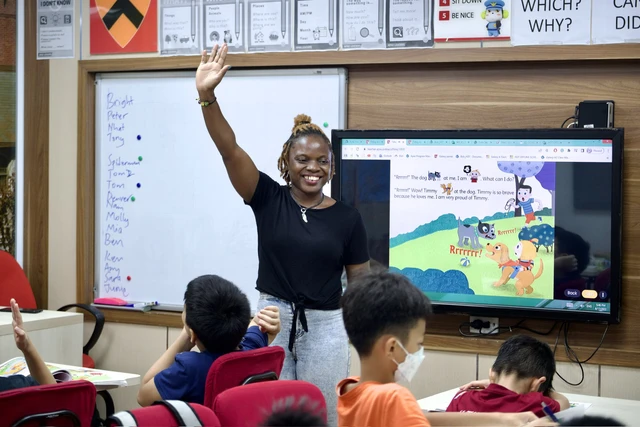
An English teacher at a language center in Hanoi, Vietnam. Photo: Nam Tran / Tuoi Tre
Making English a second language in Vietnam’s schools requires a roadmap tailored to each school, taking into account factors such as the teaching workforce, language-use environments, and regional disparities, experts said at the 17th International Conference on TESOL in Ho Chi Minh City on Monday and Tuesday.
The event was co-organized by Southeast Asian Ministers of Education Organization, Regional Training Center in Vietnam (SEAMEO RETRAC) and Curtin University, Australia.
It brought together more than 150 speakers, researchers, lecturers, teachers, postgraduate students, education managers, and pundits from Vietnam and many other countries.
The conference, themed 'Shaping the Future of English Language Teaching in the Digital Era,' focused on topics including English as a second language in the digital era, digital transformation in English language education, and innovations in teaching methodology and assessment.
Gradually expanding English use in schools
Dr. Nguyen Thi Mai Huu, director of the National Foreign Languages Project under the Vietnamese Ministry of Education and Training, said the first step is to properly understand the goal of making English a second language in schools.
Vietnam is currently not yet an environment where English is used as a second language in the community. The goal is to gradually expand the use of the language within the educational environment.
“This does not mean that 100 percent of activities at schools must be conducted in English,” Huu stressed.
According to her, the process should be carried out simultaneously in three directions.
First, the quality of English teaching and learning should continue to be improved.
Second, English should gradually be used as a medium of instruction for subjects and content, as well as at educational institutions, where conditions permit.
The third direction is to expand the use of English in communication, educational materials, academic activities, and other educational activities.
Huu said that making English a second language in schools should be implemented at different levels.
Schools with favorable conditions can develop bilingual programs, adopt content and language integrated learning, or teach certain subjects in English.
Schools that do not yet have sufficient resources should start by improving the quality of English teaching and learning and gradually expanding the environment in which English is used.
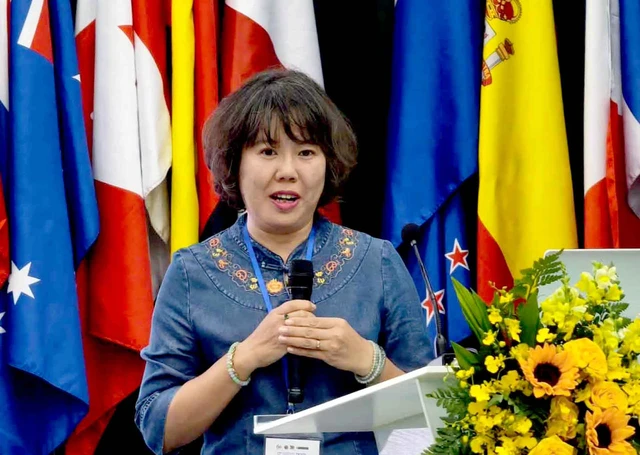
Dr. Nguyen Thi Mai Huu, director of the National Foreign Languages Project under the Vietnamese Ministry of Education and Training, speaks at 17th International Conference on TESOL in Ho Chi Minh City in August 2026. Photo: Trong Nhan / Tuoi Tre
Teachers, technology matter
The teaching workforce is also crucial to making English a second language in Vietnam’s schools.
Besides continuing to improve their English proficiency, English teachers need to further develop their teaching methods and ability to apply technology.
The next challenge is to prepare teachers of other subjects to use English in their professional fields.
“In some remote and isolated areas, the demand for English teachers remains very high, let alone teachers of other subjects who are capable of teaching in English,” Huu said.
She said testing and assessment should also continue to be reformed to support learners’ progress.
Teachers can use assessment information to adjust their teaching, while students can use it to tailor their learning strategies.
“We need to promote assessment for learners’ progress, rather than simply assess learning outcomes,” Huu said.
Technology is another foundation.
Huu noted that English teachers have already gained experience applying information technology to teaching, particularly during the COVID-19 pandemic, when education shifted significantly to online platforms.
“Today, digital technology and AI are continuing to open up new possibilities for supporting English language teaching and teacher development,” she said.
Le Thi Thuy Duong, director of SEAMEO RETRAC, said AI, digital technology, and new learning environments are changing the way foreign languages are taught and learned.
These changes require a rethinking of teaching and learning practices, assessment of learning outcomes, and teacher development.
However, Duong stressed that education is ultimately about people.
Technology can support teaching, but it cannot replace the dedication, creativity, and inspiration that teachers bring to the classroom.
AI can provide information, while teachers play a key role in helping learners develop critical thinking, communicate with confidence, and achieve personal growth.











Max: 1500 characters
There are no comments yet. Be the first to comment.