


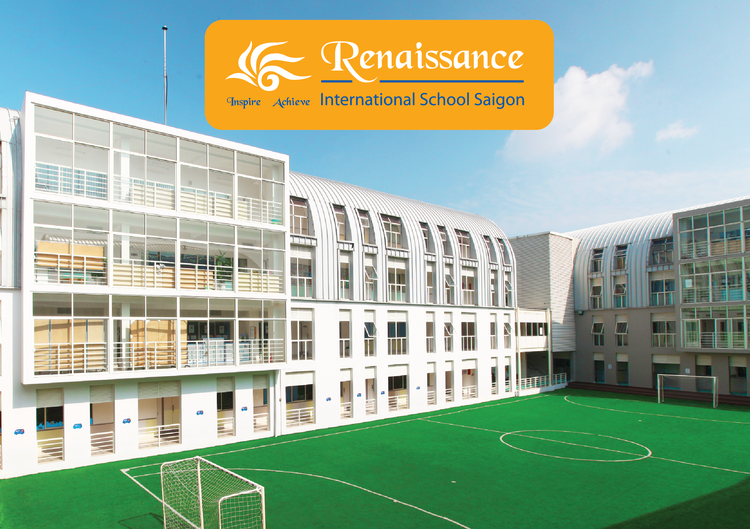
Advertorial – Head of Renaissance International School Saigon, Mr. David Cole talks about the importance of education investment at an early age and how child-centred education can influence development.
Why early childhood education matters?
A child’s performance in school and later life is largely dependent on how much they have learnt prior to primary school. Evidence shows that children receiving a quality early years programme have a considerable advantage over others of the same age.
Research indicates that quality early education can promote children’s short term cognitive, social and emotional development along with their long-term success. UNICEF also states that the early childhood years – from birth through to eight – are the most formative in terms of intelligence, personality and social behaviour. Therefore, a child-centred education in an international school can help children to achieve logical thinking, effective communication skills, the ability to integrate with society and independent living skills.
The legacy of adult direction and teaching through rote learning unfortunately persists in many approaches to learning. Play and activity schemas have been developed by teachers with a child having little control over his or her learning. Children may be allowed to explore and make minor choices within fixed parameters, but they are not truly able to explore the potential of being a genuine decision maker, collaborator, mentor, teacher, advisor and representative of their own critical thinking. This is why quality early childhood education is imperative in making a difference to a child’s life. It gives them the basis from which hopes, dreams and opportunities can be realised.
We believe that striving to do things right, from the very beginning of a child’s education, is an investment in the future.
What are the characteristics of child-centred education?
It is essential that the child is at the centre of everything the school does. All decisions made are only taken after considering the impact upon the child’s needs and learning and the child’s best interests are paramount.
With a child-centred education children are respected as partners in learning.
Teachers and children engage in the learning processes together through collective investigations of ideas and concept development. Children can take a lead role in the focus of learning, sharing openly their ideas, interests and skills and they become the source of teaching motivation and learning input.
A quality and child-friendly learning environment is an essential element in a child-centred approach where children are able to access materials and resources as needed and where they have ownership of the creation and maintenance of the space in which they work.
Such an approach is a core value at Renaissance International School Saigon. We offer our pupils specific learning strategies to meet their individual needs, through attention to active engagement with hands-on learning activities, collaborating opportunities and critical thinking skills development.
Which programmes are offered by Renaissance International School Saigon?
Renaissance is an international British school providing an education that has similar characteristics to an education in an independent school in the UK and incorporating a strong international dimension. The British character of the school is embodied in its ethos, curriculum, teaching, and care for pupils and their achievements.
Our school promotes a vibrant and creative curriculum, designed to inspire achievement at all levels.
Our programmes are based on the British system (the National Curriculum for England), modified to meet the international profile of our pupils. The pre-school 'Future Kids' program is based on the UK's Early Years Foundation Stage Curriculum. At the Primary level, the curriculum taught incorporates the International Primary Curriculum (IPC). At the Secondary level, the school again follows the British framework until the final two years, when pupils are prepared for the International Baccalaureate Diploma Programme. The curriculum covers the following key subjects: English, Mathematics, Science, History, Geography, Music, Drama, Information and Communication Technology, Health and Physical Education, Art and Design and selected Modern Foreign Languages including Vietnamese, Korean and Mandarin. Vietnamese Language, Culture and Social Studies are provided for Vietnamese pupils.
Working in partnership, pupils, parents and teachers will help inspire and develop in our young people a love for learning and the ability to celebrate, respect and appreciate diversity. A balanced, child-centred Renaissance approach enables them to explore the creativity possible within both the arts and sciences.
|
Renaissance is an international British school, offering the National Curriculum for England complemented by the International Primary Curriculum (IPC), Cambridge IGCSE and the International Baccalaureate. Established in 2007 and opened by HRH Prince Andrew, Duke of York with the presence of the government, industry and corporate sectors, Renaissance is now one of the leading international schools in Vietnam that is committed to long-term development and investment. Please contact Admission for details: Tel: (+84-8) 3773 3171 – Ext. 120/121/122 Fax: (+84-8) 3773 3176 74 Nguyen Thi Thap Street, Binh Thuan Ward District 7, Ho Chi Minh City, Vietnam Web: www.renaissance.edu.vn Facebook: Renaissance International School Saigon - Official |









Max: 1500 characters
There are no comments yet. Be the first to comment.