


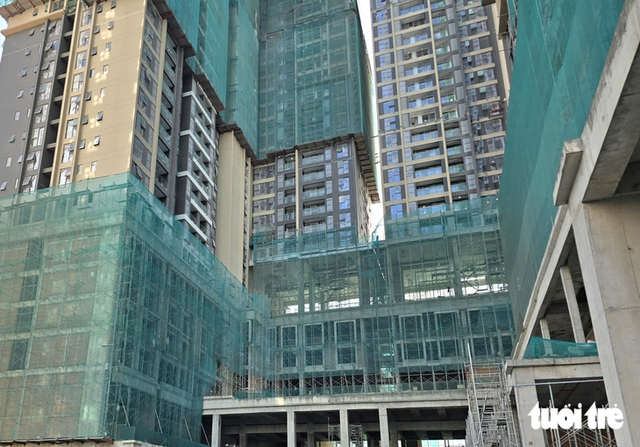
The state would acquire commercial housing projects from developers that are no longer capable of completing or transferring them to create a stock of state-owned housing in Vietnam. Photo: Cong Trieu / Tuoi Tre
Resolution No. 21-NQ/TW, adopted at the third plenum of the 14th Party Central Committee on July 28, sets out major viewpoints and directions for amending the Land Law and related legislation.
One of its most notable proposals is to study and pilot a mechanism under which the sate could acquire commercial housing projects from developers that are no longer capable of completing them or are unable to transfer them to other investors.
The acquired developments would be converted into state-owned housing assets, helping expand the public housing stock and meet residents’ housing needs.
Reviving projects, not rescuing developers
The proposed mechanism is primarily aimed at resolving bottlenecks in the property market, bringing idle land and long-stalled projects back into use, and creating additional housing resources for the public.
Speaking with Tuoi Tre (Youth) online newspaper, Hoang Ha, a lawyer of the Ho Chi Minh City Bar Association, welcomed the proposed mechanism, saying it could unlock land, unfinished buildings, and other social resources that have been frozen for years.
Instead of merely reclaiming land, imposing penalties, or leaving projects abandoned, the state could facilitate their completion, restore urban functions, reduce land waste, and expand the public housing stock.
The approach is consistent with Resolution 21’s objectives of improving land-use efficiency, preventing resource waste, and better meeting residents’ housing needs.
However, Ha stressed that it is essential to clearly distinguish between 'rescuing a project' and 'rescuing its developer.'
The state should not compensate developers for expected profits, losses caused by poor management, or increases in land value that the businesses did not generate.
“Its role is to resolve a deadlock so that people can receive their homes and urban areas can develop sustainably,” he asserted.
Clear eligibility criteria should therefore be established for projects subject to acquisition, while all cash flows and obligations toward homebuyers, banks, contractors, and the state must be independently audited.
The acquisition should also not absolve the former developer of civil, administrative, or criminal liability for any violations.
A transparent valuation and settlement process would also be essential.
Safeguarding homebuyers' rights
Protecting homebuyers’ legitimate rights should be a central consideration in any mechanism designed to revive stalled housing projects, particularly where off-plan units have already been sold.
Lawyer Ha said homebuyers’ interests must be placed at the center of the process, particularly in projects where off-plan homes have already been sold.
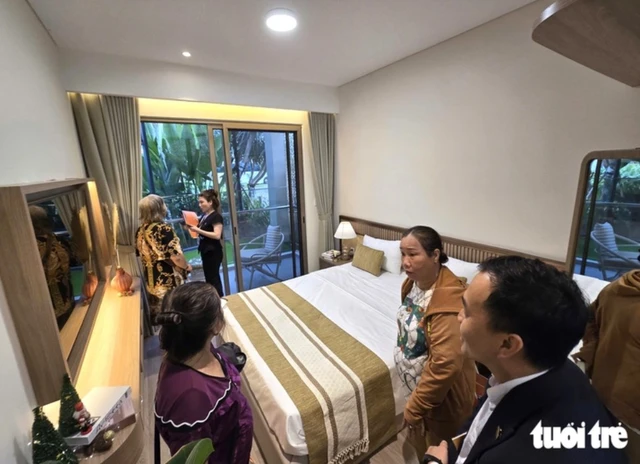
Experts say that if a stalled project can still be completed, homebuyers should be allowed to continue their contracts and receive their homes instead of being offered refunds only. Photo: Cong Trieu / Tuoi Tre
The current guarantee framework protects buyers financially but does not necessarily ensure that they receive the homes they have contracted to purchase.
Under the 2023 Law on Real Estate Business, if a developer fails to hand over a property, the guarantor bank is required to fulfill the developer’s financial obligations, including refunding advance payments and other amounts owed to buyers.
The bank, however, is not responsible for completing the project.
This means that when a development fails, buyers may recover their money but still lose the home they have expected to receive.
After years of waiting, even a full refund may no longer be enough to purchase an equivalent apartment if housing prices have risen.
Buyers may also have to continue bearing rental expenses, loan interest, and the loss of an opportunity to secure stable housing.
For projects that remain capable of completion, the proposed mechanism should therefore prioritize allowing buyers to retain their contracts and receive their homes, rather than limiting them to refunds.
Possible arrangements could include maintaining existing contracts under a capped additional payment mechanism, introducing a revised completion schedule backed by a new guarantee, or offering buyers equivalent units.
For projects involving large numbers of buyers, collective voting procedures, independent oversight, and safeguards for those who disagree with the proposed plan would also be necessary.
The goal should be to distribute unavoidable recovery costs fairly so that buyers can receive their homes, instead of forcing them to effectively purchase the same property twice.
Any unavoidable recovery costs should be allocated fairly, with the aim of enabling buyers to receive the homes they have contracted for without effectively requiring them to pay for the same property twice.
“Homebuyers should only be asked to share objective and necessary additional costs required to complete the project,” Ha said.
“They should not bear losses caused by poor management, misuse of funds, penalties, interest arising from the former developer’s violations, or increases in land value.”








Max: 1500 characters
There are no comments yet. Be the first to comment.