


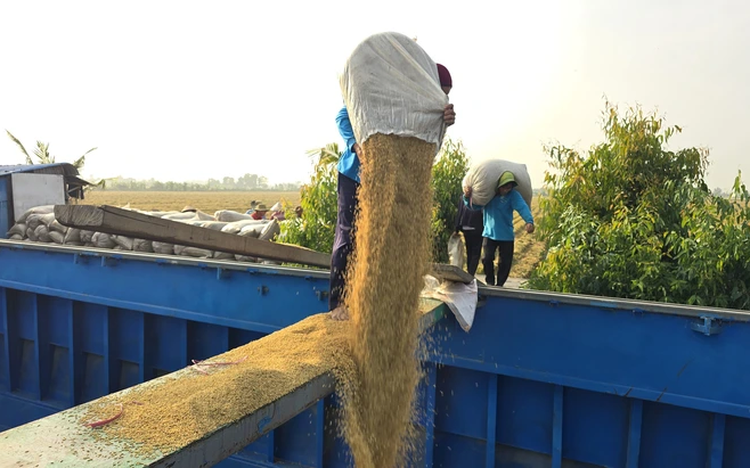
Farmers harvest rice in the Mekong Delta, Vietnam. The Philippines plans to tighten controls on pesticide residues in rice imported from Vietnam. Photo: Trung Chanh / Tuoi Tre
Local experts said the Philippines’ move could pose a short-term challenge but also present an opportunity for the Vietnamese rice industry to accelerate standardization and move toward safer and more sustainable production.
Vietnam exported around 5.3 million metric tons of rice worth US$2.52 billion from the beginning of the year through July 15, 2026, according to the Vietnam Food Association.
The Philippines remained the largest buyer of Vietnamese rice, accounting for about 45 percent of the country's total rice exports, or nearly 2.4 million metric tons.
The Philippines' tighter controls on pesticide residues are putting greater pressure on Vietnamese businesses and farmers to improve quality control from the production stage.
Signal from Philippines
The Philippines has been Vietnam's largest rice import market for years. As a result, any changes in the country's import policies have a significant impact on Vietnam's rice exports and the industry's development strategy.
An expert who monitors Vietnam's rice industry told Tuoi Tre (Youth) online newspaper that Vietnamese rice accounts for around 90 percent of the Philippines' annual rice imports.
The expert added that it was also possible that the move was intended to strengthen the Philippines' position in price negotiations with Vietnamese exporters.
Nevertheless, the move has a basis.
The Philippines' Bureau of Plant Industry, under the Department of Agriculture, recently said it was promoting measures to ensure food safety for consumers, including setting up an analytical laboratory to monitor chemical residues and ensure compliance with domestic and international food safety standards.
Nguyen Chi Thanh, rice industry director at An Giang Import-Export Joint Stock Company, said the Philippines' move is in line with a global trend toward phasing out harmful chemicals that persist in the environment and pose health risks to consumers.
"In the past, such requirements mainly came from demanding markets such as Europe and the U.S. However, middle-tier markets are also gradually moving toward standardization," Thanh said.
He predicted that the Bureau of Plant Industry would introduce the new controls gradually rather than impose strict measures immediately, as developed markets have done in the past.
"At first, they will strengthen inspections, but they are unlikely to be too stringent," he said.
Over the past few years, more markets have paid greater attention to residue controls.
In the case of the Philippines, negotiations have traditionally focused mainly on prices and rice varieties rather than technical standards.
"Rice shipments exported to the Philippines have hardly encountered any residue-related problems," Thanh said.
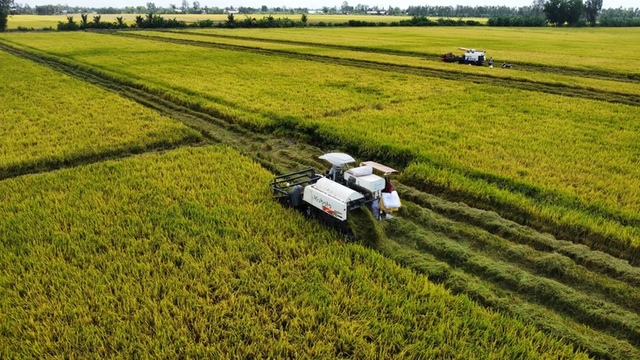
A Vietnamese company's rice-growing area in the Mekong Delta. Tighter controls in the Philippine market could become a catalyst for Vietnam’s rice industry to accelerate standardization. Photo: Trung Chanh / Tuoi Tre
Catalyst for standardization
The Philippines' new move could become a short-term barrier for Vietnamese rice.
However, it could also provide an opportunity for the rice industry to accelerate standardization across the entire production and supply chain.
Le Thanh Tung, secretary-general of the Vietnam Rice Industry Association and former deputy head of the Plant Production and Protection Department under the Ministry of Agriculture and Environment, said the ministry has long set high food safety requirements for agricultural products, including rice, through various technical programs and regulations.
In practice, however, some agricultural products have continued to face warnings from import markets, including durians contaminated with cadmium or the industrial dye Auramine O.
Although authorities have set out a clear direction, implementation has not received sufficient attention.
Therefore, tighter quality controls by Vietnam's largest rice import market could become a catalyst for the industry to reorganize production in a safer and more responsible manner.
Some Vietnamese simply act as intermediaries, moving agricultural products from producers to consumers, Tung said.
Businesses seeking sustainable growth must control their raw material production areas and eliminate harmful chemicals from the outset, rather than simply purchasing agricultural products and exporting them, according to Tung.
Thanh of An Giang Import-Export Joint Stock Company also said the Philippines' new requirements were a positive signal for the rice industry to reorganize production.
However, the extent of the change would depend on how the importing country implements the new measures.
"There needs to be a 'shock' to drive change. If a shipment is returned, businesses will change very quickly.
Conversely, if authorities say they will tighten controls but shipments continue to be exported in large volumes, it will be difficult to create momentum for change," Thanh said.
Phan Hoang Lam, chairman of Lam Rice Group Inc., shared the view that the Philippines' new policy would force Vietnam’s rice industry to accelerate standardization.
“Businesses must change their mindset and practices by standardizing inputs, standardizing raw material areas and making the entire production chain transparent. Those that fail to meet the requirements will be left out of the game,” he said.








Max: 1500 characters
There are no comments yet. Be the first to comment.