


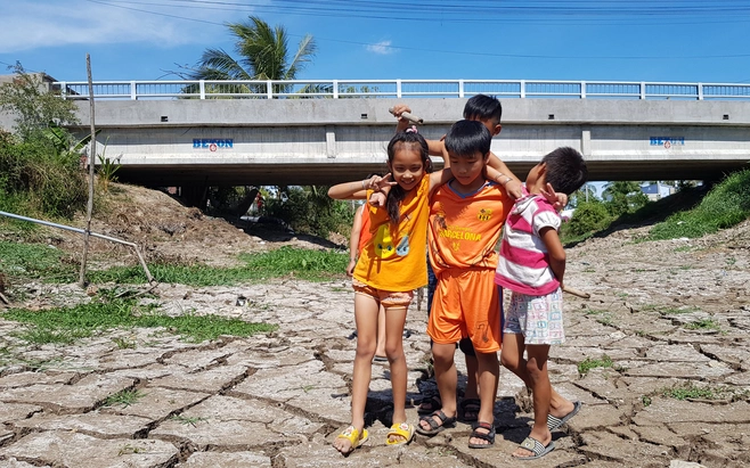
Children walk across cracked, parched ground in an area of the Mekong Delta in southern Vietnam, amid prolonged dry weather conditions. Photo: Trung Chanh
El Nino is a natural climate phenomenon characterized by the abnormal warming of sea surface temperatures in the central and eastern tropical Pacific Ocean.
In 2015, as the Mekong Delta was heading into a harsh dry season, international weather agencies, including the World Meteorological Organization (WMO) and the U.S. National Oceanic and Atmospheric Administration, confirmed that El Nino had formed and repeatedly upgraded their forecasts for its intensity.
The WMO at the time classified the event as one of the strongest since 1950, comparable to the historic episodes of 1982-1983 and 1997-1998.
At the peak of the 2015-16 dry season, residents in former Ben Tre Province, now part of Vinh Long Province following a national administrative restructuring effective July 1, 2025, faced severe freshwater shortages and had to buy fresh water transported by barge from the upper reaches of the Tien River at VND150,000-200,000 ($5.70-7.60) per cubic meter.
At present, the Australian Bureau of Meteorology has confirmed that the Nino 3.4 index, a measure used to monitor and assess El Nino, stood at +1.94 degrees Celsius in the week ending July 26, 2026, well above the +0.8 degrees Celsius threshold the agency uses as a reference for El Nino conditions.
The reading indicates a very strong El Nino signal, raising concerns for the Mekong Delta as the phenomenon could increase the risk of drought, water shortages, and saltwater intrusion during the upcoming dry season.
The situation is particularly concerning because, if unfavorable conditions develop, the Mekong Delta could face severe drought and saltwater intrusion, significantly affecting agricultural production, domestic water supplies, and the livelihoods of millions of people, especially those living in coastal areas.
The region, however, now has more experience in dealing with drought and saltwater intrusion following the crises of 2015-16 and 2019-20, and has invested in a number of adaptation projects.
Still, proactive preparations for another potentially severe drought remain essential.
Dr. Le Anh Tuan, former deputy director of the Research Institute for Climate Change, now the Mekong Institute, under Can Tho University, recommended that the Mekong Delta use the remaining time before the dry season to prepare for possible drought and saltwater intrusion.
The immediate priority, he said, should be to increase water storage capacity.
"From now until the end of the rainy season, we must find ways to store as much water as possible," Tuan emphasized, adding that water should be stored at multiple levels, from local infrastructure systems to individual households, using ponds, tanks, water storage bags, and concrete reservoirs.
The rainy season in southern Vietnam typically begins in May and lasts through the end of November. The dry season covers the remaining months.
At the local level, Nguyen Thi My Hung, head of the Rural Development Division under the Dong Thap Province Department of Agriculture and Environment, said the province plans to invest in a project to transfer fresh water through the Cho Gao Canal to supply the Go Cong freshwater zone.
The project is expected to help address water shortages for domestic use and agricultural production caused by extreme weather in the area.
Once completed, it will ensure a stable and continuous water supply for daily use and farming in the Go Cong freshwater zone, Hung said.
"This will provide a solid foundation for the long-term stability and socioeconomic development of the entire region in the future," she said.
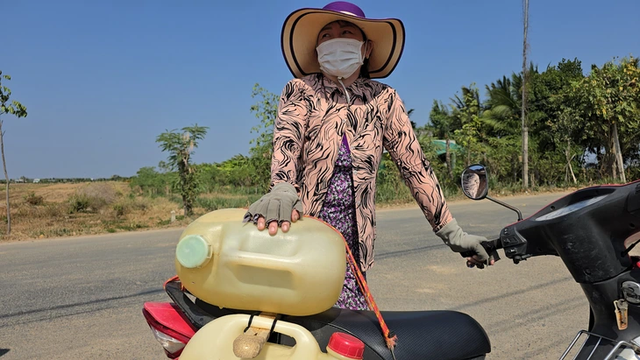
A resident stands beside a motorbike loaded with fresh water amid prolonged dry weather conditions in an area of the Mekong Delta in southern Vietnam. Photo: Trung Chanh
Regarding agricultural production, Tuan suggested reconsidering plans to expand rice cultivation in areas that frequently face drought and saltwater intrusion.
"Rice cultivation should not be expanded because it requires a large amount of water while generating relatively low value," Dr. Tuan said.
With water supplies at risk of becoming scarce, he said domestic water use should be prioritized over agricultural production.
Water treatment plants in coastal areas should prepare plans to transport raw water from upstream areas for treatment and distribution to residents, he said.
Solutions for treating brackish water to produce fresh water should also be prepared to respond to severe water shortages.
"People must be given priority first, followed by livestock farming and other production needs," Tuan said.
For residents in coastal areas, production plans should be adjusted from now on.
Water-intensive crops should be reduced or replaced with production models better suited to available water supplies, he said.
"Sowing rice now without having enough water could result in even greater losses. It is better not to farm than to do it halfway, affecting yields and potentially losing the entire crop," he warned.
In addition to water management and agricultural solutions, local authorities should strengthen public awareness campaigns on water conservation, support residents in shifting to livelihoods suited to drought and saltwater intrusion conditions, and proactively develop plans to prevent and fight forest fires in melaleuca forests and nature reserves.
Given the current El Nino conditions and the potential risks ahead, specific recommendations and guidance are needed to help the Mekong Delta prepare for the impacts of a severe dry season, he said.








Max: 1500 characters
There are no comments yet. Be the first to comment.