


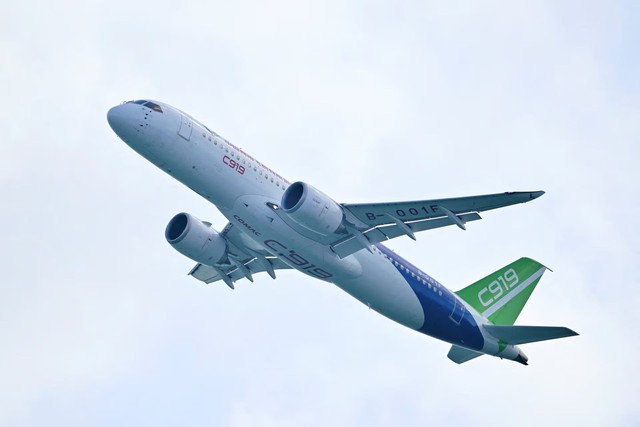
A Comac C919 flies during an aerial flying display ahead of the Singapore Airshow at Changi Exhibition Centre in Singapore February 1, 2026. REUTERS/Caroline Chia
Supply chain problems are hurting global airlines and will remain for some time to come, the head of the International Air Transport Association warned industry leaders and regulators.
"This disruption continues to have a major impact," IATA Director General Willie Walsh said at the Changi Aviation Summit, ahead of Asia's largest air show.
Planemakers Airbus and Boeing have faced supply chain problems since the COVID-19 pandemic, while engine makers like GE Aerospace and Pratt & Whitney are having to juggle competing demands from new plane assembly and maintenance for existing fleets.
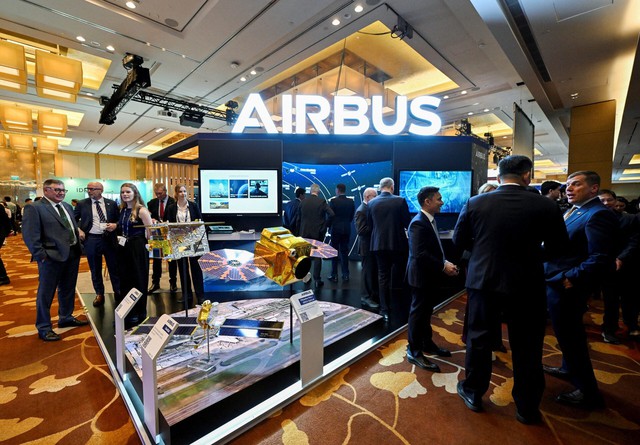
An Airbus booth at the Space Summit at Sands Expo and Convention Centre in Singapore February 2, 2026. REUTERS/Caroline Chia
Aviation is also navigating geopolitical changes including U.S. import tariffs that have upended flows of air freight.
"I think the impact of geopolitical change was much more obvious on the air cargo side of the business than on the passenger side," Walsh said.
Air cargo shipments between Asia and North America slipped 0.8% last year in the first such decline for some time, while volumes between Europe and Asia increased by 10.3%, he added.
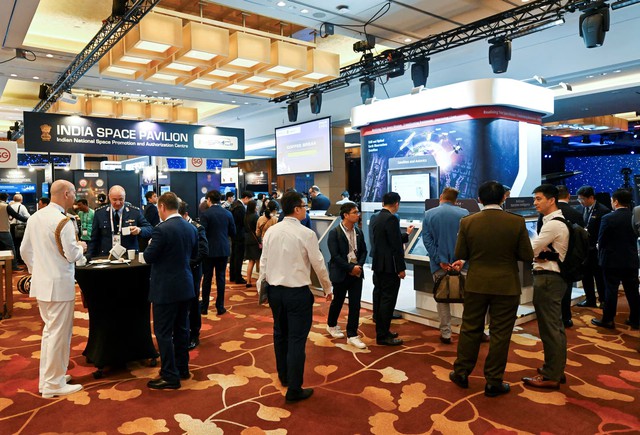
A general view of the Space Summit at Sands Expo and Convention Centre in Singapore February 2, 2026. REUTERS/Caroline Chia
The Asia-Pacific region is the world's fastest-growing region for air travel, propelled by China and India, with passenger traffic growth of 7.3% projected for 2026.
Toshiyuki Onuma, newly elected president of the governing council of the International Civil Aviation Organization, the United Nations' aviation body, warned aviation would struggle to keep up with projected growth without coordinated action.
"A system built for 4 billion passengers cannot support three times that number without transformation," he said. "We must also accelerate progress to achieve net-zero carbon emissions by 2050."
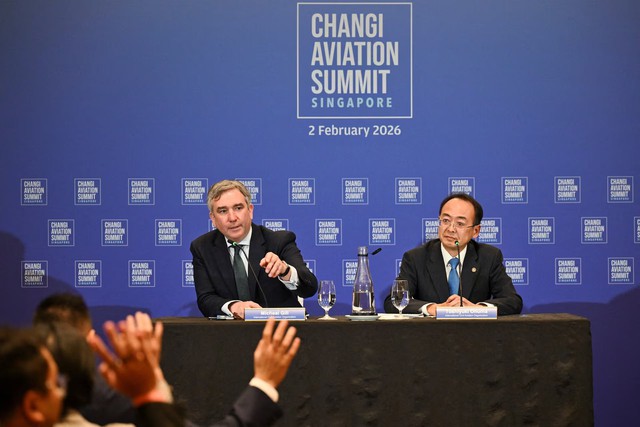
Toshiyuki Onuma (right), International Civil Aviation (ICAO) Council president, attends a press conference at the Changi Aviation Summit at Sands Expo and Convention Centre in Singapore, February 2, 2026. REUTERS/Caroline Chia
Supply chain 'weaponisation'
The gathering comes as tensions over aircraft certification threaten to disrupt a decades-old system of global aviation norms known as the Chicago Convention.
Onuma avoided being drawn into the dispute over U.S. President Donald Trump's demands last week for Canada to certify certain U.S.-designed Gulfstream business jets or face tariffs, telling reporters that ICAO would remain "technically neutral".
"If it is obvious that some member states are violating the Chicago Convention, then firstly ICAO's function is (to) ask such a country to rectify the situation," he said, without specifying whether this would apply to Trump's intervention.
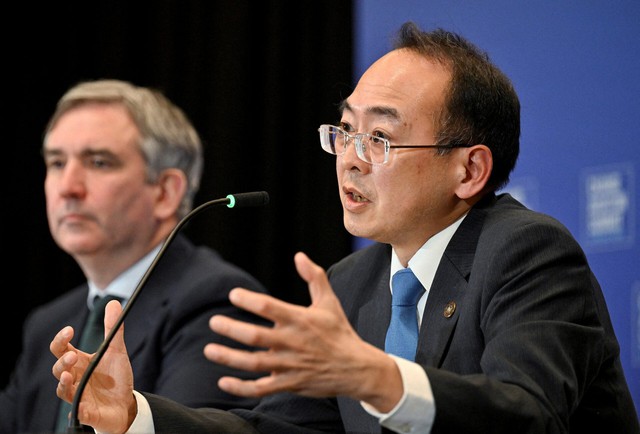
Toshiyuki Onuma (right), International Civil Aviation (ICAO) Council president, speaks at a press conference at the Changi Aviation Summit at Sands Expo and Convention Centre in Singapore, February 2, 2026. REUTERS/Caroline Chia
Speaking to the 350-strong audience of aviation leaders, he stressed the importance of global cooperation.
"Only together can we achieve a sector that is safer, more sustainable and more competitive," Onuma said.
Trump's comments have raised alarm among airlines and certification specialists who questioned whether aircraft certification should become entangled in politics.
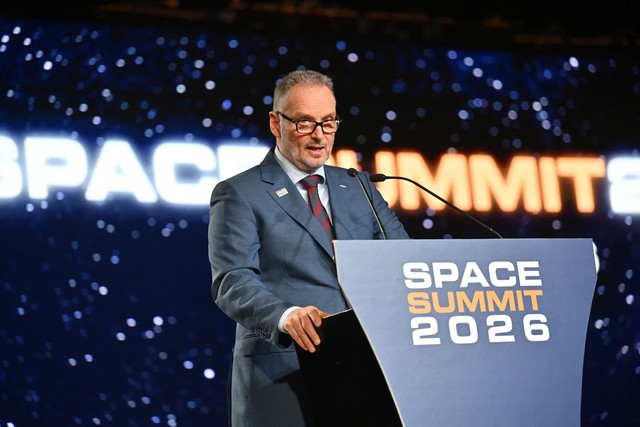
Dr Michael Schoellhorn, CEO of Airbus Defence and Space, delivers a keynote address at the Space Summit at Sands Expo and Convention Centre in Singapore February 2, 2026. REUTERS/Caroline Chia
"There can be no bargaining over certification," a senior regulatory official told Reuters.
EU Transport Commissioner Apostolos Tzitzikostas became the latest senior figure to warn of the "weaponisation" of supply chains as major powers pursue their geopolitical agendas.
"Today, (there are) real issues in developing the growth of aviation in the years to come...issues of weaponisation of dependencies in supply chains," he told the conference.
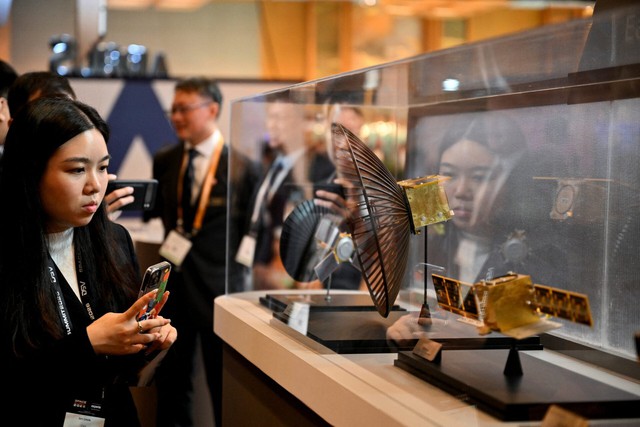
A visitor looks at earth observation satellite models at the ST Engineering booth at the Space Summit at Sands Expo and Convention Centre in Singapore February 2, 2026. REUTERS/Caroline Chia
His comments echoed a warning last month by France's aerospace industry over the fate of cross-border supply chains that were built under globalisation policies now in retreat.
Aerospace executives say rare earths - a component in jet engines - remain a particular pressure point despite a U.S.-China trade truce. China dominates the global supply of the metals.








Max: 1500 characters
There are no comments yet. Be the first to comment.