


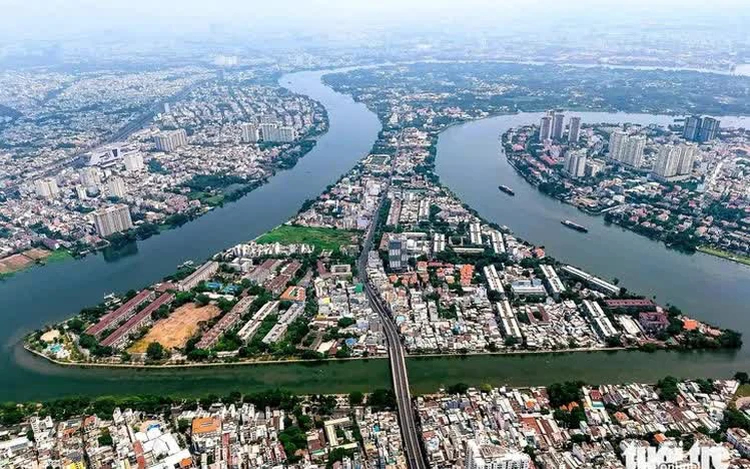
The site for the Binh Quoi-Thanh Da new urban area project in Ho Chi Minh City is expected to be handed over before October 31, 2026. Photo: Chau Tuan / Tuoi Tre
Editor’s Note: This commentary by Associate Professor Ho Quoc Tuan from the UK's University of Bristol offers a personal and analytical perspective on Ho Chi Minh City’s evolution through the lens of economic knowledge transfer. Drawing from his own journey as a finance student and practitioner in the early 2000s, the author argues that the city’s true strength lies not merely in its GDP or trade turnover, but in its unique role as an intellectual gateway, a living policy laboratory whose rapid absorption of global ideas and informal business standards has continually reshaped Vietnam's human capital for over half a century.
The piece has been edited by Tuoi Tre News for clarity, consistency, and coherence.
When economists examine cities that transformed their countries' trajectories, Shanghai, Singapore, or Seoul, they often focus on trade, investment, and industrial output. Yet a more fundamental question lies beneath those familiar metrics: when an economy opens to the world, what actually crosses its borders? Is it only goods and capital, or does something more enduring take root?
For Ho Chi Minh City, the answer extends beyond GDP and export statistics. Over the past half-century, the city has become Vietnam's primary conduit for global knowledge, professional standards, and institutional learning. Long before the country could fully absorb international capital, it had to learn the language of global markets. Ho Chi Minh City became the place where that learning happened first.
Where global ideas entered Vietnam
To many observers, Ho Chi Minh City's distinctive role stems from the latitude successive Vietnamese governments have granted it. Over the decades, Hanoi has repeatedly entrusted the city with greater economic autonomy, allowing it to pilot reforms before they were adopted nationally.
The labels have evolved, from 'economic hub' to 'special municipality,' from industrial engine to aspiring international financial center, but the underlying function has remained remarkably consistent. Much like Shenzhen in China, albeit through a different institutional path, Ho Chi Minh City has often served as a testing ground for new market-oriented policies.
Its advantage, however, did not begin with government policy alone.
Before the Doi Moi reforms of the late 1980s, the city already possessed an entrepreneurial culture shaped by decades of international commerce. Its business community retained commercial instincts, overseas relationships, and diaspora connections that proved invaluable once Vietnam reopened to the world. The infrastructure for exchanging ideas already existed; economic liberalization simply allowed those connections to expand.
My own experience reflects this environment.
As a finance student in the early 2000s, accessing World Bank or IMF publications was anything but routine. Internet access remained limited, and online databases were still beyond the reach of most Vietnamese universities.
A small group of us regularly visited the library of the Fulbright Economics Teaching Program in Ho Chi Minh City, borrowing economic reports stored on CDs and reading research that was difficult to obtain elsewhere. Those resources offered more than information. They introduced analytical frameworks, policy debates, and ways of thinking that differed markedly from traditional university curricula.
A few years later, during my internship at Vietnam's Eximbank, I encountered another dimension of this knowledge transfer. Instead of relying solely on domestic textbooks, we studied market reports prepared by international banking partners. We learned not only financial techniques but also professional norms, analytical methods, and risk management practices used in global financial centers.
This is an often-overlooked dimension of globalization. Trade integration is not merely about containers moving through ports or foreign direct investment flowing into factories. It is also about the movement of ideas, managerial practices, and institutional knowledge.
By the early 2000s, multinational accounting firms, international banks, development organizations, and educational partnerships were introducing global standards in auditing, finance, corporate governance, and public policy. Institutions such as the Fulbright Economics Teaching Program helped train generations of economists and policymakers, while the Big Four accounting firms raised professional standards across Vietnam's corporate sector. These changes were gradual but transformative.
From knowledge consumer to knowledge creator
This environment produced a generation of professionals who became unusually adept at translating between Vietnam and the global economy.
Many learned through necessity rather than formal instruction. They adapted quickly, absorbed international practices, and continuously upgraded their skills as foreign companies entered Vietnam. Over time, they became professionals who understood local institutions while communicating comfortably with international investors, regulators, and business partners.
Years later, conversations with former colleagues now working in Washington, London, and Singapore often return to the same starting point. For many of us, Ho Chi Minh City provided our first sustained exposure to international business standards. That early experience did not guarantee global careers, but it gave us a foundation that proved valuable in increasingly international workplaces.
This may be one of the city's most important contributions to Vietnam's development.
Economic openness should not be measured solely by export volumes or investment inflows. Equally important is a society's capacity to absorb, adapt, and eventually generate knowledge. Cities that cultivate this capability create professionals who become bridges between domestic institutions and global markets.
Over the past three decades, each phase of Ho Chi Minh City's development has demanded a new form of literacy. During the 1990s, the challenge was understanding the fundamentals of a market economy. The 2000s required mastery of modern banking, finance, and corporate governance as multinational firms expanded their presence. Today, attention has shifted toward artificial intelligence, semiconductor manufacturing, blockchain applications, green technology, and digital transformation.
The next stage presents a more difficult challenge.
Ho Chi Minh City's traditional growth model—built on manufacturing, trade, logistics, and real estate—is approaching structural limits. Rising labor costs, constrained urban land, and stronger regional competition mean that future growth will depend less on physical expansion and more on innovation and productivity.
In other words, the city can no longer rely solely on importing global knowledge. It must increasingly contribute to creating it.
Recent policy initiatives reflect this ambition. Resolution 260/2025/QH15 grants Ho Chi Minh City greater flexibility in several areas of economic governance, while local authorities continue to pursue digital transformation, innovation districts, and financial-sector reforms. Yet experience from many emerging economies suggests that institutional execution often matters more than legislative intent. In rapidly evolving industries, regulatory delays can quickly erode competitive advantages.
The principle itself has not changed.
Two decades ago, openness meant allowing foreign universities, banks, and multinational firms to establish a stronger presence in the city. Today, it means creating regulatory environments that allow entrepreneurs, researchers, investors, and technology companies to experiment, innovate, and scale without unnecessary barriers.
Knowledge and capital remain highly mobile. Cities that enable both to circulate efficiently are more likely to remain competitive.
Ho Chi Minh City's economic scale remains formidable, accounting for a significant share of Vietnam's trade, investment, and innovation activity. Yet its greatest contribution may be less visible than its skyline or export statistics. It is the accumulation of human capital, the steady transfer of knowledge, professional norms, and institutional capability, that has shaped generations of Vietnamese professionals.
Over 50 years after its post-war reconstruction, Ho Chi Minh City once again stands at an important transition. Its future will not be defined solely by how much capital it attracts, but by whether it can evolve from Vietnam's principal gateway for global knowledge into one of the places where that knowledge is created.
If it succeeds, the city's next chapter will be measured not only by economic growth, but by the ideas it contributes to the world.








Max: 1500 characters
There are no comments yet. Be the first to comment.