


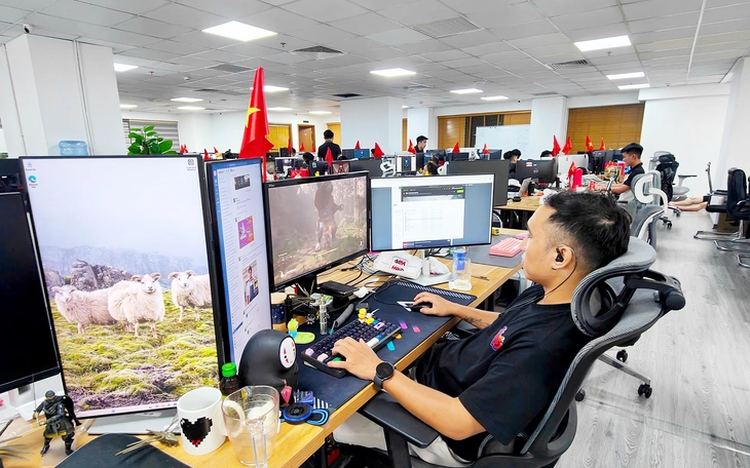
For decades, the nine-to-five norm carried the promise of stability, implying predictability, legal protection, and a boundary between work and the rest of life. Photo: Duc Thien / Tuoi Tre
On TikTok, Gen Z users began posting videos of themselves standing beside a cake, sometimes alone, sometimes with friends hovering just out of frame.
One by one, they placed candles on top. Each flame stood for something they had managed to do in the past year: sticking to a pilates routine, finishing a book, and returning to a hobby they once abandoned.
One candle was for quitting a job.
What an achievement cake can hold
The 'achievement cakes' were modest and almost ceremonial. Confessional without spectacle. Smiles lingered between pride and relief.
In a season devoted to gratitude and reflection, resignation appeared alongside self-improvement and perseverance, framed not as failure but as something earned.
At first glance, the videos were pure celebrations and did not announce a critique of work. But the presence of quitting among these year-end milestones hinted at something harder to name, a response to a working life that feels increasingly difficult to sustain.
These small celebrations do not convey a rejection of work, but a recalibration. As the gap widens between what modern jobs promise and what they actually demand, staying and leaving have become personal judgements rather than institutional guarantees.
Pressure rarely reveals itself all at once. It gathers quietly in the ordinary rhythms of work: days that stretch past their official end, flexibility that expands responsibility instead of easing it, and the subtle pressure to endure without complaint.
Leaving, then, is not framed as escape, but as a decision reached after endurance has already been tested.
What endurance adds up to
T., a junior analyst at a Big Four firm, does not describe her relationship with work in terms of balance so much as trade-offs.
When she entered full-time employment, she expected predictable hours and clearer boundaries. Instead, her experience has been more fluid.
Her role allows her to work from home several days a week, but the workday often ends only when the work is complete, often stretching well beyond standard hours.
"There isn't a strict rule requiring me to stay past five or work weekends," she says. "It's more a sense of responsibility, not wanting to log off while others are still carrying the workload."
Nothing about this pressure is explicit. There are neither penalties for leaving on time nor formal rules demanding overtime.
Still, the shared understanding that everyone is pushing through together makes logging off feel less like a right and more like a choice with social and professional consequences.
But for now, T. stays. She treats the long hours as a calculated investment in experience, exposure, and momentum.
In her case, well-being is not guaranteed by structure alone but something she actively weighs against ambition.
B., a young marketing professional, reached a different conclusion. She describes her decision to resign from her previous corporate role as gradual rather than impulsive.
Over time, she came to recognize a workplace culture shaped by hierarchy and unspoken expectations, where tolerance was treated as professionalism and insecurity did much of the disciplining.
"For a long time, certain leaders believed they were indispensable," she says. "Previous generations tolerated unfair practices because they were afraid of losing their jobs. Younger workers now see employment as a two-way relationship. When our contributions aren't recognized or respected, we're more willing to leave."
Eventually, she found herself arriving at work in a constant state of emotional fatigue, a version of herself she no longer recognized. Leaving, for her, was not rebellion but a boundary.
What separates their decisions was not resilience or work ethic, but assessment.
Both understood what their roles demanded and weighed those demands against what they believed work would give back.
Their stories reflect a reality that even though the nine-to-five norm has not vanished, its meaning has changed.
Staying is no longer assumed and leaving is no longer unthinkable.
What the nine-to-five no longer guarantees
For decades, the nine-to-five carried the promise of stability, implying predictability, legal protection, and a boundary between work and the rest of life.
For earlier generations, it marked progress, a move away from informal labor, endless hours, and economic uncertainty.
But for many young workers today, that promise wears like an old coat that no longer keeps out the cold.
What people are responding to is not work itself, but a mismatch between what the nine-to-five is meant to guarantee and what it now asks in return.
Official hours may end, but expectations continue, and flexibility often brings more responsibility rather than relief.
In this environment, staying afloat can begin to feel like an achievement. Leaving can too.
In early 2025, Vietnam strengthened overtime regulations, setting clearer limits and raising compensation for extra hours worked.
The change signaled growing concern for employee welfare at the policy level.
Yet the candles revealed a different narrative. Young workers were not celebrating balance or ease. They were marking survival.
The question was no longer whether people were tired, but why work still felt too difficult even as protections improved.
When care becomes a coping strategy
That gap often surfaces in conversations about well-being. Framed as a humane response to modern pressures, it has long functioned as a way of managing people rather than reshaping work itself.
Responsibility is passed inward, leaving individuals to adapt to systems that remain largely unchanged around them.
Today, well-being is discussed as a measurable asset, linked to engagement, performance, and mental health.
In practice, it frequently arrives as an add-on, in the form of programs or reminders to cope, rather than changes to workload, pace or expectation.
For young workers, this can feel like a quiet transfer of responsibility.
When exhaustion is treated as a personal failure to manage stress rather than a predictable outcome of how work is structured, the remedies offered follow the same logic.
Be more resilient. Manage better. Adjust yourself. The structure of work stays where it is.
If staying or leaving has become a personal calculation, what matters is not whether people are choosing correctly, but why they are choosing alone.
The solitude is not accidental. Rather, it is the space institutions leave behind when limits go unnamed.
How organizations decide what to hold
A., an HR assistant at a large automotive franchise in Vietnam, works within a system shaped by recent overtime reforms where extra hours are no longer assumed by default and employees must opt in instead of complying automatically.
Tasks are assigned by project, and once responsibilities are met, people are not required to remain in the office.
On paper, the arrangement seems ideal. In practice, A. is careful to note, compliance does not always translate into comfort.
Culture matters as much as policy, so employees remain cautious about how freely they can exercise the boundaries available to them.
Some organizations invest in structured well-being initiatives while others rely on symbolic gestures like company trips, small rewards or occasional events framed as appreciation.
These efforts are not meaningless. But when they sit alongside unchanged workloads and expectations, they function more as symbols than support.
For him, the most meaningful difference is flexibility, not as a perk but as a practical adjustment to how people live.
In Vietnam, where Saturday work remains common, a required morning in the office can consume much of a weekend in transit, leaving little space to visit family.
Hybrid arrangements do not eliminate pressure, he argues, but they can soften its impact by returning some responsibility to the organization.
P., a senior HR manager at a consumer goods multinational, sees the same tension from another angle. Early in his career, he associated well-being with balance and disconnection. Over time, that definition began to feel incomplete.
"Well-being isn't just balance," he says. "It's physical, mental, financial, and work-life well-being. At different stages of life, people prioritize different things."
What matters most, in his view, is alignment. Employees may know their limits, but without systems that support them, that knowledge offers little protection.
Even generous support can fall flat if people do not feel safe invoking them. Leadership behavior, he argues, carries more weight than policy because it sets the tone for what is actually permissible.
For him, misalignment often shows up as uncertainty about direction. Many young workers, he observes, are searching for a 'dream company,' when the more pressing question is whether the work itself leads anywhere beyond the role.
In his organization, this understanding shapes how well-being is practiced. Managers and staff hold regular conversations about pressure and difficulty, not as personal disclosure but as a way of understanding capacity.
These discussions make it easier to anticipate strain and adjust expectations around the reality that energy and attention fluctuate.
Training supports these conversations, focusing on how to invite and respond, not for extracting information.
"Young employees want to know what they're doing actually leads somewhere," he explains. "Not just for the company, but for themselves. When people understand how their work contributes to a larger goal, they're more willing to push through difficult periods."
When that link weakens, endurance becomes harder to justify. Staying begins to feel arbitrary. Leaving, by contrast, starts to feel more like a rational response than a risk.
What work owes its people
What continues to undermine many initiatives is emphasis. Refusing to change how work moves, companies often respond by offering better ways to sit with it, like adjusting the chair rather than the hours, and leaving employees to manage the discomfort on their own.
This is where the achievement cakes come back into view. Less like irony than as record. A small, deliberate act that says this mattered, even if no one else noticed. The candle is not a symbol of chaos or instability. It holds a limit.
The flame does not burn forever. It burns just long enough to be seen. When organizations fail to name limits, people still do. They mark them quietly in resignation letters, in candles pressed into frosting, and in the decision not to endure one more year.
Candles are being lit because decisions still have to be made. The question left behind is whether institutions will recognize them, or continue letting individuals carry them.









Max: 1500 characters
There are no comments yet. Be the first to comment.