


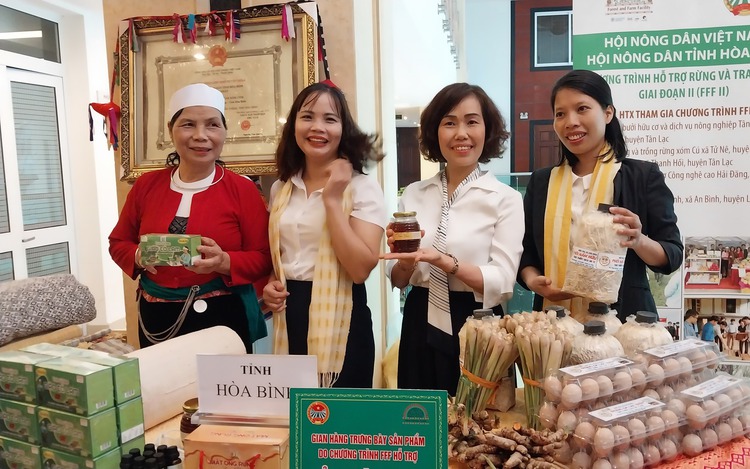
Products from the Dong Lai Traditional Brocade Weaving and Comprehensive Services Cooperative are on display organized by the FFF at a national level event. Photo: Pham Thang/FAO
For a stretch of years, the looms had been sitting quiet. The wooden frames that had clattered through generations of Muong households in Phu Tho Province were beginning to resemble relics from the past, and a craft passed down through generations looked as though it might not survive the twenty-first century.
Today the sound is back. In a modest storeroom in Com Hamlet, Tan Lac Commune, mostly middle-aged and elderly women of Muong ethnicity – the third-largest minority group in Vietnam – weave textiles and sew handcrafted garments that now sell online as well as in local markets and boutiques.
The revival is real. The question is what it will take to make sure it lasts.
History preserved in cloth
The craft these women of the Dong Lai Traditional Brocade Weaving and Comprehensive Services Cooperative produce are no cheap mass-market souvenirs.
Muong brocade is a written record in cloth. Its roughly 50 motifs – lozenges, flowers, duck eggs, mountain peaks – are drawn directly from nature. Historically, these patterns encoded the community's social order, with the most elaborate designs of sacred animals woven in silk reserved strictly for nobility.
The skill behind it, most notably the art of the patterned waistband, is recognized by the Vietnamese government as national intangible cultural heritage.
It is painstaking work where a single misplaced thread distorts the entire design. The process remains entirely traditional: the women grow cotton and mulberry, raise silkworms, spin thread, dye it with natural indigo and turmeric, and weave every inch by hand.
Nothing about it is fast or cheap. Yet that has always been the fundamental paradox: its craftsmanship was never in doubt; its market viability was.
Weaving together
The decline of Muong weaving craft was never a story of forgotten technique and lost tradition; it was a story of exquisite craft with no viable market.
As early as 2008, master artisans began teaching the trade once more, and by 2017, local authorities officially designated the hamlet a traditional craft village, supplying it with new looms and sewing machines.
Still, the struggle persisted, as weaving cloth and finding buyers are two entirely different battles. The artisans could produce, but they could not connect with the market.
Income remained negligible. One seasoned weaver recalled earning just a few million dong a year, barely US$100 to $200. Unsurprisingly, the younger generation chose modern jobs over a heritage that could not feed them.
Refusing to yield, the women banded together in 2023 to establish the weaving cooperative, which now counts 54 members.
Moving away from isolated farming, where each woman cultivated her own small plot of cotton and mulberry for personal use, they began pooling their land, sharing expertise, and building a unified brand.
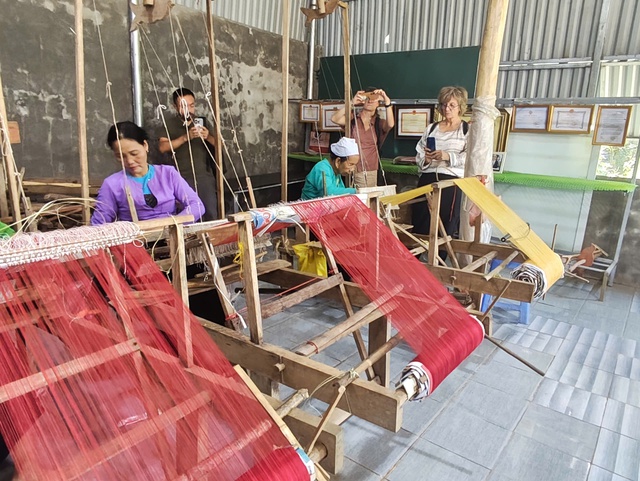
Members of the Dong Lai Traditional Brocade Weaving and Comprehensive Services Cooperative are at work on their looms. Photo: Pham Thang/FAO
Yet grit alone could only take them so far. What truly closed the gap between traditional craft and modern commerce was an infusion of global expertise. Meet the Forest and Farm Facility (FFF), a joint initiative of the Food and Agriculture Organization of the United Nations (FAO), IIED, IUCN, and AgriCord designed to empower rural producer groups.
FFF stepped in to provide the very element that had eluded the women for decades: the art of staying in business.
Under FFF's guidance, the members of Dong Lai transformed from local artisans into savvy entrepreneurs. They mastered climate-smart agroforestry, built digital marketing skills, and learned to sell directly to consumers via social messaging apps and regional trade fairs.
Knowledge-exchange tours broadened their horizons, while access to a green credit fund provided the capital needed to scale sustainably.
The turning point came in 2025, when their textiles earned Vietnam's prestigious 3-star 'One Commune, One Product' (OCOP) certification, a national mark of quality that put the cooperative on the map.
The financial impact was immediate and profound. Today, each member earns a steady VND4-5 million ($160–$200) a month just from cultivating mulberry, silkworms, and cotton, plus an additional VND2.5 million from weaving itself.
On top of individual wages, the cooperative generates hundreds of millions of dong in annual revenue through its diversified line of brocade goods.
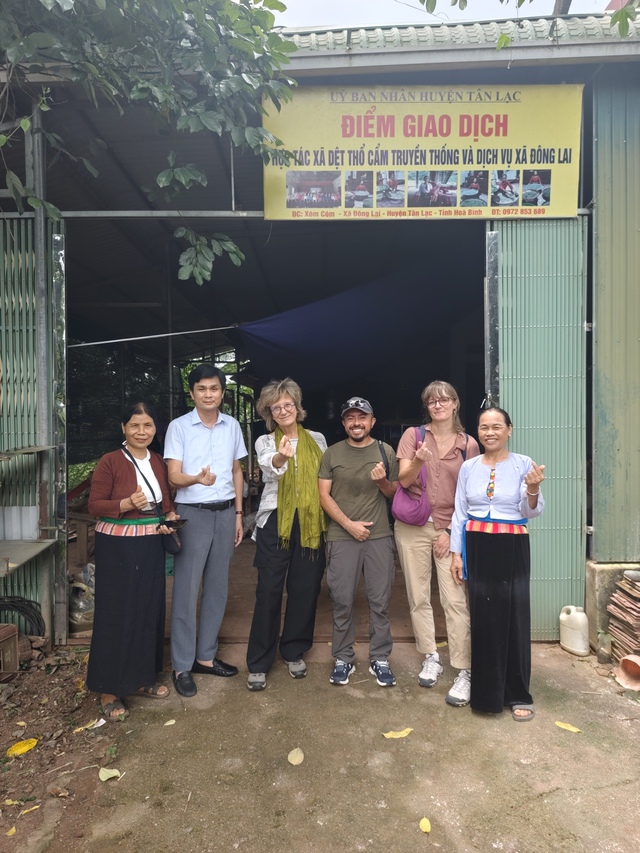
The FFF headquarters team visits one of the co-op members. Photo: Pham Thang/FAO
The road ahead
The results speak for themselves. By pooling their resources, the women grow more, produce more, and, crucially, sell more under a shared identity.
Looking ahead, the cooperative is eyeing cultural tourism and pop-up boutiques in nearby highland resorts as the next frontier for expansion.
Most telling of all, younger women are actively seeking to join. A craft that was once slipping into obscurity is, for the first time in a generation, attracting the very hands needed to carry it forward.
Yet the artisans themselves are under no illusions. They know that sustained success requires deeper investment in modern workshops, secure supply chains for raw materials, and wider distribution networks.
A 3-star OCOP rating and social media traction are a promising beginning, not a permanent guarantee. Remove the supporting scaffolding too soon, and this hard-won momentum could easily stall.
Still, the Dong Lai model proves that ancient crafts can not only survive but flourish in remote communities when backed by the right economic framework. By making tradition financially viable, it advances women's livelihoods, environmental stewardship, and rural independence all at once.
In the quiet hills of Phu Tho, the wooden looms are clattering once more, no longer as an echo of a dying past, but as the steady, unbroken rhythm of a future taking shape.








Max: 1500 characters
There are no comments yet. Be the first to comment.