


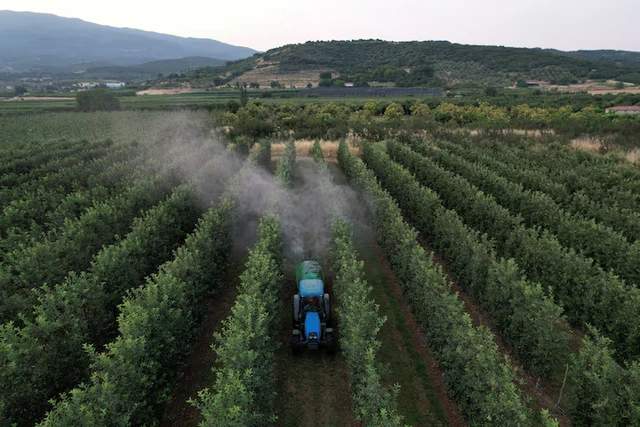
A drone view shows a local farmer Alberto spraying an apple orchard with pesticides, in the village of Agia in Thessaly region, Greece, June 12, 2025. Photo: REUTERS/Alexandros Avramidis
In her book Silent Spring, published in 1962, Carson exposed how chemical use after the Second World War had raced ahead of scientific knowledge and regulation.
Pesticides designed to kill insects were sprayed across farms, forests, waterways and towns with little understanding of their wider effects on nature or human health.
At the time, around 500 compounds were registered for pesticide use in the United States.
Today, Carson’s warning looks restrained.
The production and diversity of synthetic chemicals has increased dramatically.
In 2025, an estimated 350,000 chemicals and mixtures were registered for use worldwide, with only a fraction having undergone systematic hazard assessment, and fewer still restricted or phased out.
Invisible ingredients
Toxic chemicals are an invisible but pervasive feature of modern life.
They are embedded throughout the global food system; in pesticides, in processing equipment, in packaging and coatings, and as contaminants that migrate from soil, water and air into what we eat.
Perhaps because they are largely unseen, they continue to be underestimated.
Their impacts, however, are anything but abstract.
Drawing on nearly a year of academic and sector collaboration, a recent report by Systemiq and the Grantham Foundation links toxic chemical exposure to rising rates of noncommunicable diseases, fertility loss and developmental harm.
It also links them to accelerating damage to the ecosystems that underpin global food security.
The report, Invisible Ingredients, notes that the scale and speed of industrial chemical development has made it difficult for the institutions that govern them to keep pace.
While manufacturers of new drugs must prove their safety and efficacy before they can enter the market, industrial chemicals are permitted until harm is demonstrated.
This reactive model – designed for a smaller and slower chemical economy – has struggled to cope with today’s volumes and complexity.
The result has been repeated “regrettable substitutions”, where one hazardous compound is replaced by another with a similar structure and effect.
For example, when chlorofluorocarbons (CFCs) were removed from refrigerants to protect the ozone layer, they were replaced with hydrochlorofluorocarbons (HCFCs) and hydrofluorocarbons (HFCs), which later proved to be powerful greenhouse gases, requiring further costly rounds of regulation to replace.
Conservative estimates place the annual global burden of health, fertility and ecological damage from just four major groups of food-system chemicals at between $1.4–$2.2 trillion annually – roughly 2−3% of global GDP.
Yet decades of experience show that when exposure to hazardous chemicals is reduced, health outcomes improve and costs fall.
The challenge is not a lack of tools, but applying proven approaches, earlier and more systematically, before damage is locked in.

Toxic chemical exposure has been linked to rising rates of noncommunicable diseases, fertility loss and developmental harm. Photo: REUTERS/Callaghan O'Hare
Creating a solutions hierarchy
Reducing toxic exposure across our food systems and beyond will require more than incremental measures.
The transition will demand combined action from regulators, industry, and investors, as well as citizens and environmental groups.
To turn this shared responsibility for reducing toxic chemicals use into practical decision-making, our working group has developed a hierarchy of solutions:
- Top of the list is elimination: preventing unnecessary use of hazardous chemicals altogether. This typically delivers the greatest benefit at the lowest cost.
- Where chemicals are genuinely needed, the next priority is system redesign — changing materials, processes or business models to reduce reliance on hazardous substances.
- Substitution with safer alternatives can play a role, but only when guided by robust hazard assessment.
- Remediation of legacy pollution remains essential, particularly for drinking water and high-exposure pathways, but it is inefficient and expensive, and no substitute for prevention.
When governments and industry act together across these levers, toxic exposure can fall dramatically, improving health, fertility, and ecosystem resilience.
Real-world experience supports this.
In the EU clear regulatory timelines drove a roughly 90% reduction in the use of the most hazardous phthalates within a decade, with sharp declines in human exposure and minimal economic disruption.
Similar progress is now under way to tackle the use of bisphenols in food contact materials, following stronger evidence review and market-ready alternatives.

Photo: REUTERS/Lisi Niesner/Illustration
In agriculture, farmers in countries including Brazil, the United States and the European Union, are using precision application, integrated pest management and biological controls to sharply reduce pesticide toxicity and volumes without sacrificing yields.
For persistent chemicals such as PFAS ("forever chemicals"), only a phased elimination, with narrow essential-use exemptions, can prevent further irreversible contamination.
We estimate that 42% of PFAS volumes could be phased out by 2030, with alternatives able to replace around 95% by 2040, representing a market of at least $15 billion in the EU alone.
These transitions also make sound economic sense.
When external costs are accounted for, benefit-cost ratios for reducing toxic chemical use are overwhelmingly positive.
Clear, binding timelines provide the certainty industry needs to invest, innovate and scale safer solutions.
Markets for safe-by-design chemicals, materials and services are already emerging, with innovative businesses such as California-based InnerPlant choosing to forge ahead rather than wait for regulation.
They see safer chemistry as a strategic and financial opportunity, and that the market will continue to grow as regulation catches up with science.
In contrast, failure to act increases risk through future liabilities, remediation costs and supply-chain disruption.
More than half a century since Rachel Carson first sounded the alarm about synthetic chemicals, human exposure continues to grow astonishingly fast.
Yet governments, businesses and investors now have the tools and economic rationale to move decisively from reactive clean-up to preventative design.
The question is no longer whether action is possible, but how much longer we can afford the consequences of delay.








Max: 1500 characters
There are no comments yet. Be the first to comment.