


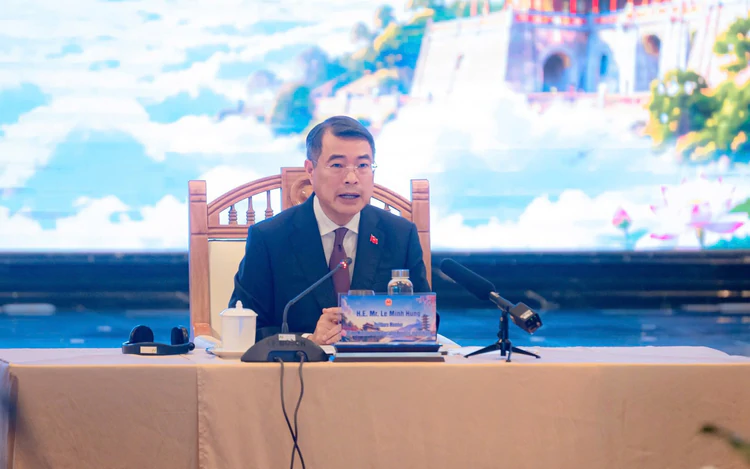
Vietnamese Prime Minister Le Minh Hung speaks at a meeting with representatives of Japanese businesses in Hue City, central Vietnam, September 6, 2026. Photo: Nhat Linh / Tuoi Tre
Hirata made the proposal at a meeting between Prime Minister Le Minh Hung and representatives of Japanese businesses operating in Vietnam in Hue City on Sunday, as part of the second Vietnam-Japan Local Cooperation Forum.
The proposal comes as the city plans to designate several central areas with poor air quality, heavy traffic, and high population density as LEZs from mid-2027, where gasoline- and diesel-powered vehicles will face restrictions.
Hirata said self-charging hybrids could significantly reduce fuel consumption and CO2 emissions without requiring charging infrastructure or substantially changing motorists' driving habits.
He also said HEVs could continue operating during natural disasters or power supply disruptions, which he considers an advantage given Vietnam's conditions.
For the draft LEZs in Ho Chi Minh City, he proposed that self-charging HEVs be recognized as vehicles prioritized for circulation alongside BEVs.
Toyota also called for low-emission-zone policies in major cities to be introduced through a practical, phased roadmap, giving residents and businesses time to prepare and adapt.
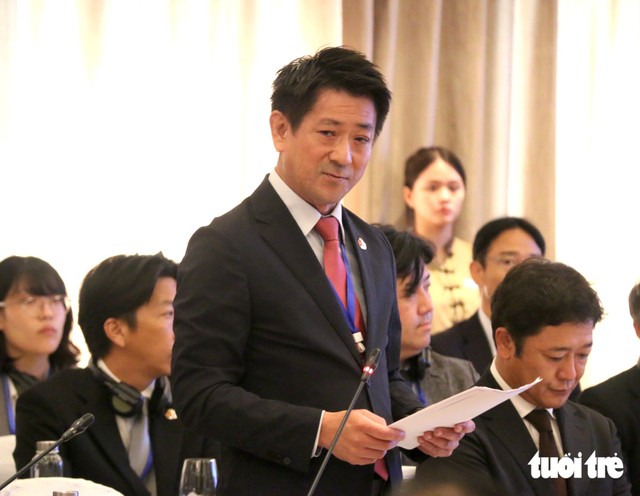
Toyota Vietnam general director Hirata Osamu speaks at a meeting between Vietnamese Prime Minister Le Minh Hung and representatives of Japanese businesses operating in Vietnam in Hue City, central Vietnam, September 6, 2026. Photo: Nhat Linh / Tuoi Tre
The company proposed that the environmental performance of different vehicle technologies be assessed over their entire life cycles, from energy production to vehicle operation, rather than based solely on emissions produced while vehicles are being driven.
Regarding special consumption tax, Hirata proposed that Vietnam gradually shift from calculating the tax based on engine displacement to a system based on CO2 emissions.
He said such a system would more accurately reflect the emissions levels of different vehicle technologies and encourage the development of low-emission vehicles.
Hirata said Toyota had invested in Vietnam for more than 30 years and remained committed to long-term investment in the market.
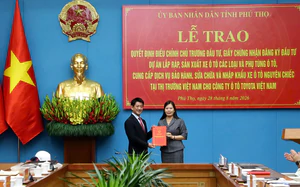
The company has decided to invest US$360 million in Vietnam to expand its production capacity and prepare for mass production of self-charging hybrid vehicles and other electric vehicle models, he said.
Toyota asked the government to recognize the role of self-charging hybrids in Vietnam's automotive industry development strategy.
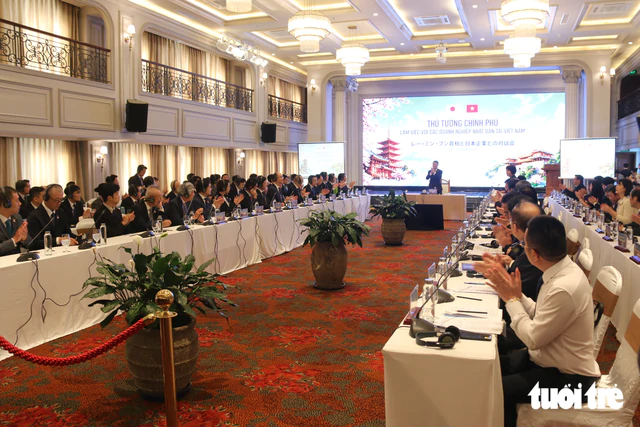
An overview of the meeting between Vietnamese Prime Minister Le Minh Hung and representatives of Japanese businesses operating in Vietnam in Hue City, central Vietnam, September 6, 2026. Photo: Nhat Linh / Tuoi Tre
Other Japanese businesses at the meeting also raised issues related to transport, education, energy, taxation, science and technology, and retail.
Prime Minister Hung asked ministries, agencies and local authorities to urgently review the progress of handling recommendations from Japanese businesses and resolve issues within their jurisdiction in a timely manner.
He said agencies responsible for particular issues must proactively address them on schedule, while existing regulations should be accompanied by clear guidance for businesses to follow.
The responses and progress in addressing the recommendations are to be sent to the Vietnam Chamber of Commerce and Industry for coordination with the Japanese Business Association in Vietnam and Japanese companies to review and assess the results.
For unresolved recommendations or newly arising issues, the chamber will continue compiling them and forwarding them to the relevant authorities for consideration.
The prime minister also requested that the results of handling the recommendations be compiled and made public on the Government Portal and relevant government websites to ensure transparency and clarity.
Regarding the proposal on special consumption tax for self-charging hybrid vehicles, the prime minister asked the Ministry of Finance to study the Japanese businesses' proposal and report to the government in October.
PM Hung called on Japanese businesses to continue expanding their investment in Vietnam and work closely with Vietnamese companies to make better use of the potential for cooperation between the two economies.









Max: 1500 characters
There are no comments yet. Be the first to comment.